

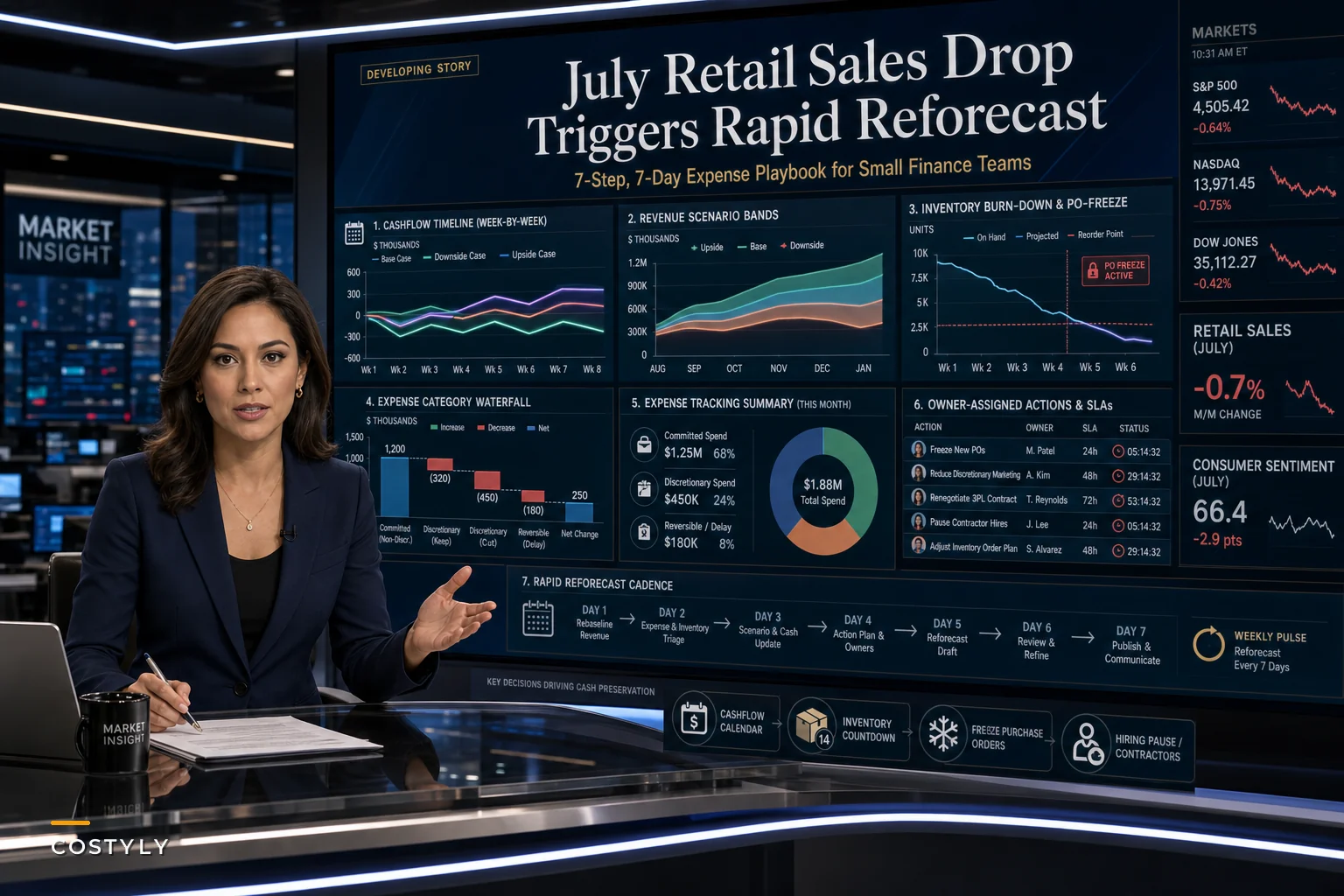

The July numbers landed harder than most people expected. U.S. retail sales fell 0.6% in July 2026 — the first monthly decline in nine months, according to a recent Reuters report. One month doesn't make a trend, and plenty of businesses will shrug it off. But if you spent the spring loading up on inventory, adding staff, or bumping ad spend on the assumption that consumer demand would keep climbing into back‑to‑school and holiday, this is the moment your budget assumptions quietly stopped matching reality.
The problem isn't the 0.6% itself. The problem is what a demand shock does to a small business's cash position when the expense side was built for a different world. Most small businesses don't reforecast because the numbers dropped — they reforecast three months later, when the bank balance forces the conversation. By then the options are worse and fewer.
This is a working playbook for reforecasting expenses fast — the kind of thing you should be able to run in a week or two, not a quarter.
Why one soft month actually matters for small operators
Big retailers can absorb a soft July. They have buying power, credit lines, and enough revenue diversity that a single month barely moves the ship. Small businesses don't have that cushion, and the damage from a demand shock usually shows up in the lag between when revenue slows and when your fixed commitments come due.
The mechanical problem is this: when you placed inventory orders in May and June, you committed cash on payment terms that assumed a certain sell‑through rate. When you added a part‑time hire in June, you committed to payroll that assumes a certain revenue run rate. A single soft month doesn't just cost you that month's sales — it stacks unsold inventory, ongoing payroll, and already‑spent marketing dollars on top of each other while the money to cover them shrinks.
The official Census Bureau retail data is worth checking against your own category, because "retail sales" as a headline number hides big differences. Some categories held up; others fell harder than the average. If your business sits in a category that dropped well past 0.6%, your reforecast urgency is higher than the news makes it sound.
The deeper issue this exposes: most small businesses forecast revenue once a year and treat expenses as fixed background noise. When demand surprises them, they have no muscle for adjusting the expense side quickly. That's the gap this playbook addresses.
The 7‑step expense reforecast
1. Re‑baseline revenue with three scenarios, not one
Stop losing track of your business spending.
Costyly helps you record, monitor & control expenses—accurately and efficiently.
- Automated expense categorization
- Real-time budget tracking
- Detailed financial reports
No credit card required
Before you touch expenses, you need a defensible revenue picture. Don't try to guess the "right" number — build three:
-
Mild revenue flat to July's actuals, no recovery
-
Moderate revenue down 5–8% versus your original plan through Q4
-
Severe revenue down 12–15%, demand keeps softening into holiday
The point of three scenarios isn't precision. It's to force yourself to answer: at what revenue level do I stop being able to cover committed costs? That break‑even threshold is the single most useful number you'll produce this week, and almost nobody calculates it until it's too late.
2. Freeze and triage inbound purchase orders
Pull every open PO and inbound order. For each one, ask a blunt question: if demand stays soft, will this sell through in 60–90 days, or will it sit?
There's a pattern worth watching here. Businesses tend to protect the big orders — too much sunk cost, too awkward to cancel — and cut the small ones. That's usually backwards. The big commitments are exactly where a partial delay or a reduced reorder saves the most cash. Call your vendors. "Can we push half of this to October?" is a normal conversation, and most suppliers would rather flex terms than lose a customer heading into their own soft quarter.
3. Split expenses into committed, discretionary, and reversible
You can't cut what you haven't sorted. Every line in your budget falls into one of three buckets:
| Bucket | Definition | Speed to adjust | Example |
|---|---|---|---|
| Committed | Contractual or already spent | Slow / none | Lease, insurance, signed inventory POs |
| Discretionary | Planned but not committed | Fast | New marketing campaigns, non‑essential software, travel |
| Reversible | Committed but cancellable | Medium | Month‑to‑month subscriptions, contractor hours, flexible ad spend |
The mistake is treating everything as untouchable. In practice, most small businesses have far more reversible spend than they realize — month‑to‑month tools, seasonal contractor hours, ad budgets that can be paused same‑day. When you actually tag every line this way, the reversible column is usually where the bulk of your near‑term savings live.
Start tagging reversible spend in your accounting file so you can filter and act on it quickly.
4. Rank discretionary cuts by revenue impact, not comfort
This is where reforecasts go wrong emotionally. It's tempting to cut the things that feel painless — the team lunch, the conference, the nice‑to‑have subscription. But some of those "small" line items don't touch revenue at all, while a marketing cut might.
Sort discretionary spend into two columns: revenue‑generating and overhead. Cut deep on overhead first. Protect the revenue‑generating spend that's actually working, and trim it only if the moderate or severe scenario forces your hand. A business that slashes its best‑performing ad channel to save cash often ends up accelerating the exact revenue decline it was afraid of.
5. Update cash timing, not just totals
A reforecast that only changes totals is half a reforecast. Demand shocks are a timing problem as much as a volume problem. Map out, week by week for the next 8–12 weeks:
-
Expected cash in (using your moderate scenario)
-
Committed cash out (payroll dates, vendor payment due dates, rent, loan payments)
-
Running balance after each week
-
The lowest point that balance hits — and when
That lowest point is your danger week. If it dips below your comfort floor, you now know exactly how many weeks you have to act, which changes which levers make sense. Negotiating extended vendor terms, delaying a discretionary purchase by three weeks, or pulling a receivable forward can all be enough to smooth a single bad week without cutting anything permanently.
6. Set corrective actions with owners and dates
A reforecast with no owner is a document, not a plan. For every cut or renegotiation you decided on, write:
-
What the action is
-
Who owns it
-
The date it's done by
-
The dollar impact expected
This sounds obvious, and it's the step most commonly skipped. Finance produces a revised budget, emails it around, and then nothing happens because no single person was on the hook for the "renegotiate the logistics contract" line. Reforecasts fail in execution far more often than in analysis.
7. Set a reforecast cadence and actually stick to it
The July number is one data point. August will give you another, and your own weekly sales are the fastest signal you have. Commit to re‑running the reforecast on a fixed schedule — every two weeks while conditions are uncertain — and put a soft deadline on it (variances surfaced within 7 days of each period close). The businesses that come out of a soft patch cleanly aren't the ones that guessed right in August. They're the ones that adjusted fastest as new data came in.
A simple visual of this workflow helps keep the team aligned.
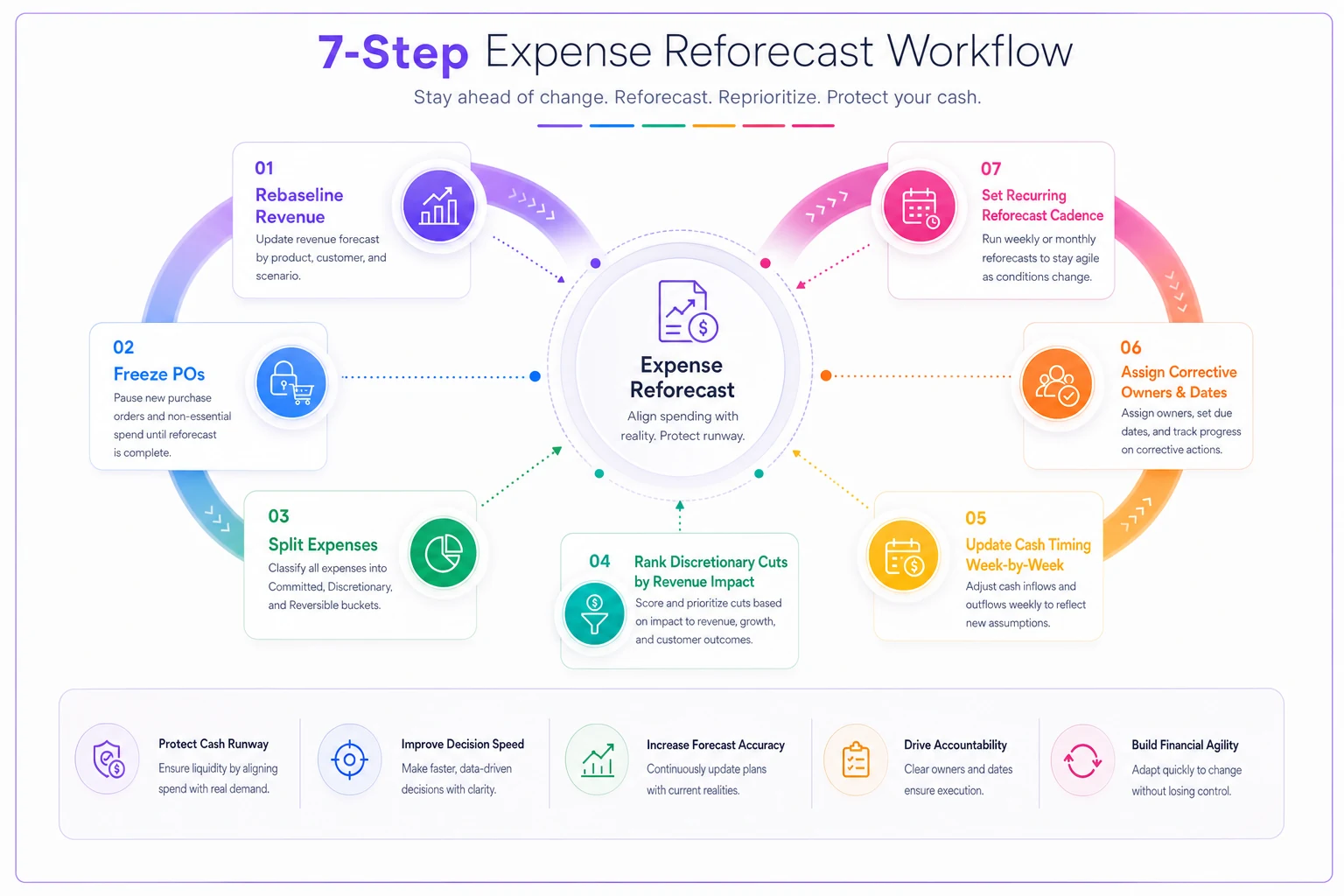
Use it as a quick checklist during your 14‑day triage.
A short checklist for the first 72 hours
If you only do a handful of things this week, do these:
-
- [ ] Pull every open PO and inbound order into one list
-
- [ ] Calculate your committed‑cost break‑even revenue
-
- [ ] Tag every expense line
committed / discretionary / reversible
-
- [ ] Pause any non‑committed spend that isn't clearly generating revenue
-
- [ ] Build the 8‑week cash timing view and find your danger week
-
- [ ] Call your two largest vendors about flexing terms or delivery timing
None of this requires new software or a consultant. It requires a couple of focused hours and the willingness to look at uncomfortable numbers before the bank forces you to.
A real scenario: a specialty gift retailer
Consider a small specialty gift shop with two locations, running somewhere in the $90k–$110k monthly revenue range during a normal fall. Coming off a strong spring, the owner placed larger holiday inventory orders in May, added a part‑time floor associate in June, and increased local ad spend expecting a strong Q4.
When July came in soft and foot traffic dipped, the committed side got heavy fast: roughly $38k in inbound inventory scheduled to arrive in September, plus the new payroll and the ad commitment. Their moderate scenario showed a danger week in early October where cash would dip uncomfortably low.
The reforecast didn't require dramatic cuts. They pushed about half the September inventory to late‑October delivery, paused around $2k in monthly ad spend on a channel that wasn't converting, and moved the new associate to reduced hours until traffic recovered. Sales stayed soft into the fall — this isn't a turnaround story — but they cleared the October danger week without touching their best‑performing marketing or damaging vendor relationships. That's what a good reforecast actually looks like: not heroics, just enough adjustment to stay solvent while you wait for real data.
When to reforecast hard — and when not to
Reforecast aggressively when: your category dropped more than the headline, your committed costs recently jumped, or your cash runway is under roughly three months. In those cases, speed beats precision.
Go lighter when: you have healthy runway, your revenue held steady against your own numbers, and your committed costs are modest. Over‑reacting to one month has its own cost — cutting revenue‑generating spend in a panic can strangle growth just as effectively as ignoring a real problem. Not every soft month is a crisis.
Who should not do a full reforecast right now: businesses whose July was already forecasted to be slow (seasonal patterns matter) and whose actuals matched plan. If reality matched your forecast, the news doesn't change anything for you — keep watching August.
Making this repeatable instead of reactive
Most small businesses only build this muscle during a scare, then let it atrophy until the next one. The businesses that handle demand shocks well have turned reforecasting into a standing process — where expense data continuously feeds a rolling forecast, so a soft month surfaces as a small variance instead of a crisis.
That's the real fix, and it's bigger than any single downturn. If you want to move from firefighting to a system where your actual spend automatically informs your forward budget, it's worth reading how to turn expenses into an ongoing, expense‑driven reforecast rather than rebuilding a spreadsheet from scratch every time the news gets bad. When your expense categorization and cash timing live in one place and update as transactions flow in, the seven steps above stop being an emergency drill and start feeling like a weekly habit.
July might turn out to be noise. It might be the start of something. You won't know for a few months — but you do get to decide whether the next soft print catches you flat‑footed or whether you've already got the numbers in front of you and a short list of levers ready to pull. That readiness is the entire point. The reforecast isn't about predicting the future correctly. It's about being able to respond to it fast.
Ready to master your business expenses?
Join 5,000+ businesses using Costyly to save time, reduce overspending, and improve financial visibility.