



Most small businesses organize expenses the way their accounting software suggests — utilities here, marketing there, salaries in that bucket. Makes sense for tax filing. But when you're trying to figure out why gross margins dropped 4% last quarter or which client segments actually make money, those generic categories become useless.
A logistics company I worked with went from $2M to $8M revenue in eighteen months. Their books looked clean, their CPA was happy, but the owner couldn't answer basic questions like "are our enterprise clients more profitable than mid-market?" or "what's our actual cost to fulfill rush orders?" The spend taxonomy that QuickBooks gave them kept the IRS satisfied, but it didn't help them run the company.
The real problem isn't tracking expenses — it's organizing them in a way that maps to how your business actually operates. Every leadership question you ask requires a specific lens on your spending data. Get the taxonomy wrong, and you're flying blind on the decisions that matter most.
Why standard accounting categories fail operational reality
Traditional expense categories exist for compliance, not management. They group spending by type (rent, wages, supplies) rather than purpose (customer acquisition, order fulfillment, market expansion).
Consider a typical marketing agency running about $1.2M annually. Their P&L shows "Contractor Costs" as one line item — usually their biggest expense after salaries. But inside that number lives the entire story of their business model. Designer contractors working on retainer clients operate at different margins than developers brought in for project work. The senior strategist supporting enterprise accounts has different economics than the junior writers handling blog content.
When everything gets lumped together, you lose the ability to see which parts of your business actually generate profit. This creates chaos when businesses try to answer growth questions. A home services company expanding from residential to commercial work needs to understand the true cost difference between these segments. If truck maintenance, technician time, and equipment all sit in separate buckets with no way to allocate them properly, you can't calculate segment profitability.
Most businesses already track the detailed data they need. The project management system knows which client each hour belongs to. The inventory system tracks which materials went to which job. The CRM records deal sizes and sales cycles. But none of this operational data connects to the financial taxonomy, creating parallel universes of information that never quite align.
The three questions that drive taxonomy design
Before diving into category structures, you need clarity on what you're actually trying to measure. Three core questions drive most taxonomy decisions.
Stop losing track of your business spending.
Costyly helps you record, monitor & control expenses—accurately and efficiently.
- Automated expense categorization
- Real-time budget tracking
- Detailed financial reports
No credit card required
Growth trajectory questions focus on where the business is heading. Can we afford to hire two salespeople next quarter? What's the real payback period on our marketing spend? Should we open a second location or double down on the current one? These questions require categories that separate growth investments from operational maintenance.
Margin and efficiency questions dig into operational performance. Why did gross margin drop even though revenue increased? Which service lines actually make money after accounting for all costs? Are we spending more to deliver the same value? These questions demand categories that map to your actual delivery process, not generic expense types.
Strategic positioning questions examine competitive dynamics and market position. How much are we really investing in product development versus competitors? What's our true customer acquisition cost compared to customer lifetime value? Can we afford to match competitor pricing?
I see companies constantly trying to answer all three question types with one rigid taxonomy. A specialty food manufacturer could tell you exactly how much they spent on ingredients, but couldn't separate R&D costs for new products from production costs for existing ones. When a major retailer asked about their innovation pipeline, they couldn't quantify their development investments.
Building taxonomies that preserve audit trails while enable analysis
The fear of messing up audit requirements keeps many businesses stuck with useless categories. You don't have to choose between compliance and insight. Build a multi-dimensional taxonomy that preserves transaction-level detail while enabling flexible analysis.
Start with a three-layer approach. Your base layer maintains the standard accounting categories your CPA expects. The second layer adds operational tags that map to how work actually happens in your business. The third layer creates analytical groupings that answer specific leadership questions.
For a digital marketing agency doing roughly $2.8M annually:
Base Layer (Accounting)
-
Professional Services
-
Software Subscriptions
-
Contractor Payments
-
Office Expenses
Operational Layer (How Work Happens)
-
Client Delivery Costs
-
Sales & Proposal Development
-
Internal Operations
-
Capability Building
Analytical Layer (Decision Support)
-
Retainer Client Costs vs Project Client Costs
-
Direct Delivery vs Support Functions
-
Growth Investments vs Maintenance Spending
Each transaction gets coded at all three levels. That contractor invoice for $3,400? It's Professional Services for accounting, Client Delivery for operations, and specifically Retainer Client Costs for analysis. One transaction, three lenses, zero loss of audit detail.
A simple workflow shows how a transaction gets tagged across the three layers.
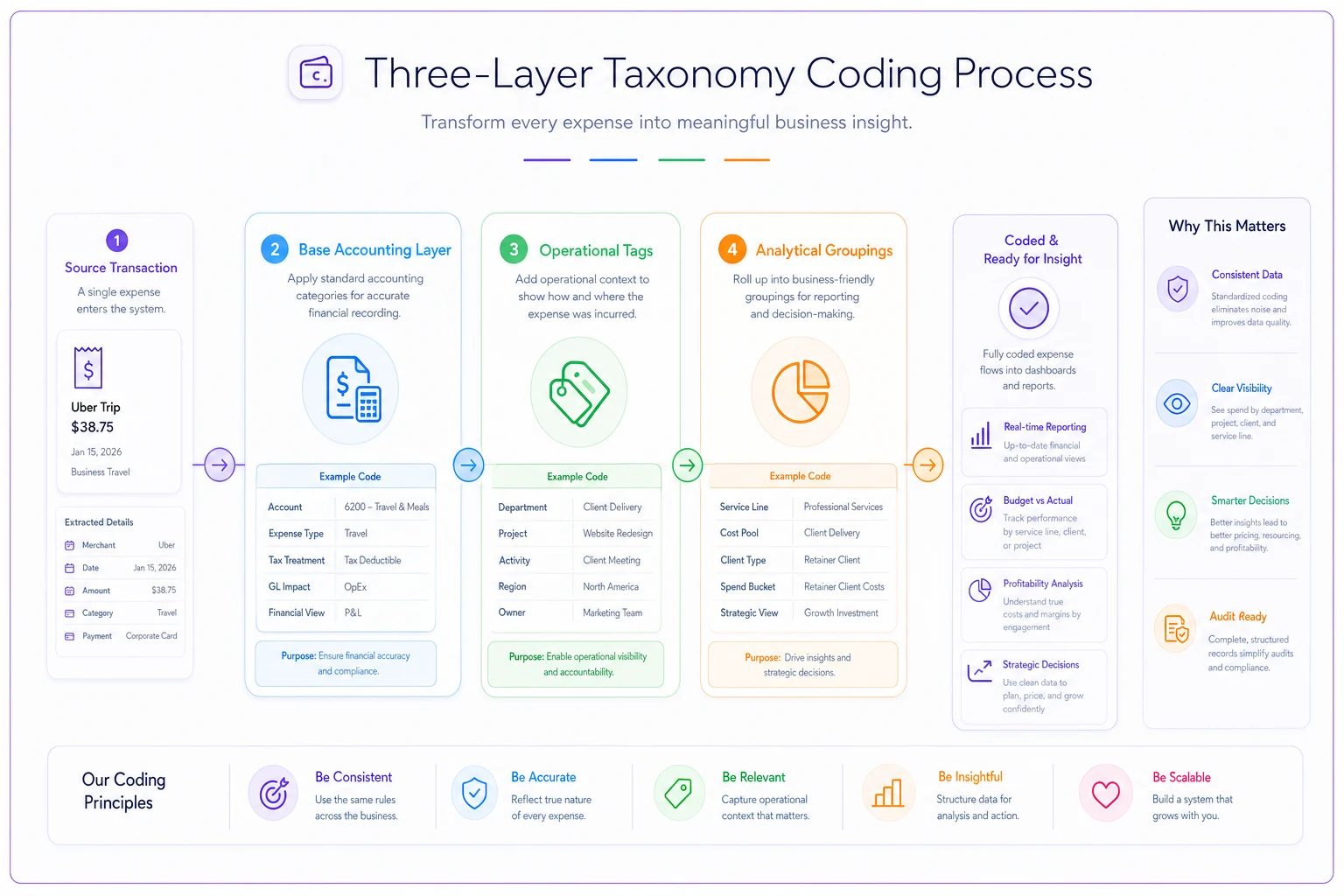
Each transaction is coded at transaction time and stored with all three lenses so reports can default to high-level groupings while allowing drill-down.
Sample taxonomies for common SMB models
Different business models require fundamentally different taxonomy structures. What actually works for the most common SMB types.
Professional Services (Consulting, Agencies, Firms)
Your taxonomy needs to separate revenue-generating time from everything else, while maintaining visibility into client profitability and service line performance.
Primary Categories:
-
Direct Delivery Costs (billable team time, project-specific tools, client-specific travel)
-
Business Development (proposals, pitches, relationship building)
-
Delivery Support (project management, quality review, internal meetings)
-
Capability Development (training, certifications, R&D time)
-
Operations Infrastructure (admin, finance, facilities)
Critical Allocation Rules:
Tag every hour and expense with both client and service line. Split shared resources based on billable hour ratios, not revenue. Track business development costs by opportunity size and close rate.
E-commerce and Retail
The key challenge is connecting front-end sales with back-end fulfillment costs while maintaining product line visibility.
Primary Categories:
-
Product Acquisition (inventory, shipping inbound, quality control)
-
Fulfillment Operations (pick/pack labor, shipping outbound, returns processing)
-
Customer Acquisition (advertising, promotions, affiliate commissions)
-
Customer Service (support team, refunds, replacements)
-
Platform & Technology (websites, payment processing, inventory management)
Critical Allocation Rules:
Allocate fulfillment costs by order, not by product. Track customer acquisition by channel AND product category. Include return processing in product line profitability.
Home Services (HVAC, Plumbing, Electrical, Cleaning)
Your taxonomy must handle the complexity of mobile operations while maintaining job-level profitability visibility.
Primary Categories:
-
Job Direct Costs (technician time, materials, travel between jobs)
-
Fleet Operations (vehicles, fuel, insurance, maintenance)
-
Lead Generation (advertising, referral fees, estimate time)
-
Dispatch & Scheduling (coordinators, software, communication)
-
Warranty & Callbacks (return visits, warranty parts, customer satisfaction)
Critical Allocation Rules:
Track drive time separately from job time. Allocate fleet costs based on miles driven, not jobs completed. Include callback rates in technician performance metrics. Separate new customer acquisition from repeat customer marketing.
Manufacturing and Production
The challenge is tracking costs through multi-step processes while maintaining product and customer profitability.
Primary Categories:
-
Materials & Components (raw materials, packaging, inbound logistics)
-
Production Labor (direct manufacturing, setup, changeovers)
-
Production Support (maintenance, quality control, production planning)
-
Inventory Carrying (storage, obsolescence, financing)
-
Product Development (R&D, prototyping, testing)
Critical Allocation Rules:
Use activity-based costing for shared production resources. Track setup and changeover costs separately from run time. Include inventory carrying costs in product profitability. Allocate development costs based on expected production volumes, not current sales.
Rules for maintaining granularity without overwhelming operations
The natural tendency is to create increasingly detailed categories until the system becomes unusable. Companies end up with 200+ expense categories where no one knows where to code anything. The sweet spot for most SMBs is 15-25 primary categories with 3-5 subcategories each.
Start with the 80/20 rule for granularity. Track the 20% of categories that drive 80% of your spending decisions. For a graphic design studio, the difference between senior and junior designer time matters immensely. The difference between branded pens and branded notebooks doesn't.
Build in aggregation rules from day one. Individual transactions might have six different tags, but reports should default to showing 5-7 major groupings. Users can drill down when needed, but shouldn't drown in detail during routine reviews.
| Category Management Best Practices | Implementation |
|---|---|
| Establish clear coding responsibilities | Make category assignment part of operational workflow, not separate accounting task |
| Create self-destructing miscellaneous categories | Flag any category hitting 5% of monthly spending for breakdown |
| Document decision rules | Specify when team lunches count as Direct Delivery vs Business Development |
| Use 80/20 granularity principle | Focus detailed tracking on categories driving major spending decisions |
The person who assigns work should also assign the client and project codes. The person ordering supplies selects the category when they submit the purchase request. This prevents month-end scrambles and improves accuracy.
Flag any "miscellaneous" category that climbs above 5% monthly spend to trigger a category split review.
This prevents month-end scrambles and improves accuracy.
When categories need to evolve (and how to manage the transition)
Business models shift. What made sense at $1M revenue breaks at $5M. The taxonomy that got you here won't get you there.
Watch for these warning signs:
-
Leadership questions consistently can't be answered with existing categories. When every analysis requires manual spreadsheet gymnastics to recombine categories, the structure no longer fits the business.
-
New business lines or customer segments emerge that don't fit existing buckets. A residential contractor adding commercial work needs new categories to track these fundamentally different operations.
-
The percentage of spending in "miscellaneous" categories exceeds 10%. This indicates your defined categories no longer capture how the business actually operates.
-
Major strategic initiatives launch without corresponding financial visibility. If you're investing heavily in digital transformation but can't track those costs separately, you can't measure ROI.
When change becomes necessary, use parallel taxonomies for at least one quarter. Code transactions in both old and new systems to maintain comparability. Map historical data forward, not current data backward. Take your old categories and show how they split into new ones, rather than trying to recreate old categories from new data.
The operational impact of proper spend categorization
Getting taxonomy right changes how the entire organization operates, not just how finance reports numbers. When everyone can see how their decisions impact segment profitability or growth investments, behavior shifts in ways that traditional budgeting never achieves.
A commercial cleaning company restructured their categories to separate customer segments and service types. Within six months, operations managers started rejecting unprofitable job types without being told to. They could see that post-construction cleanup jobs, despite higher hourly rates, actually lost money after accounting for equipment damage and rework.
Project-based businesses see the most dramatic improvements. An engineering consultancy went from generic categories to project-type taxonomies. Partners discovered that government contracts generated 60% less profit per hour than private sector work when accounting for proposal costs and payment delays.
Teams start self-organizing around profitability when they can see it. A marketing agency sharing client profitability data watched as account managers started pushing back on scope creep without being asked. Designers began suggesting more efficient approaches for low-margin clients.
Modern operational platforms make this kind of multi-dimensional tracking feasible for businesses that could never afford enterprise-grade systems. AI-powered spend categorization can automatically code transactions based on patterns, reducing manual work while improving consistency. Automated workflows ensure coding happens at transaction time, not during month-end scrambles.
Building financial visibility that scales
The difference between businesses that scale successfully and those that grow themselves into chaos often comes down to financial visibility. Not the backward-looking compliance reports your accountant generates, but forward-looking operational intelligence that drives daily decisions.
Your spend taxonomy is the foundation of this visibility. Get it right, and every question becomes answerable. Which clients should we fire? What's our real cost to serve different market segments? Can we afford this growth investment?
Start simple but think ahead. Design for the business you're becoming, not just the one you are today. Build in flexibility from the beginning. Maintain audit trails while enabling analysis. Connect financial data to operational reality. Treat your taxonomy as a living system that evolves with your business.
The perfect categorization for today will be obsolete in eighteen months. That's not failure — it's growth.
Start simple but think ahead. Design for the business you're becoming, not just the one you are today. Build in flexibility from the beginning. Maintain audit trails while enabling analysis. Connect financial data to operational reality. Treat your taxonomy as a living system that evolves with your business.
The perfect categorization for today will be obsolete in eighteen months. That's not failure — it's growth.
Ready to master your business expenses?
Join 5,000+ businesses using Costyly to save time, reduce overspending, and improve financial visibility.