

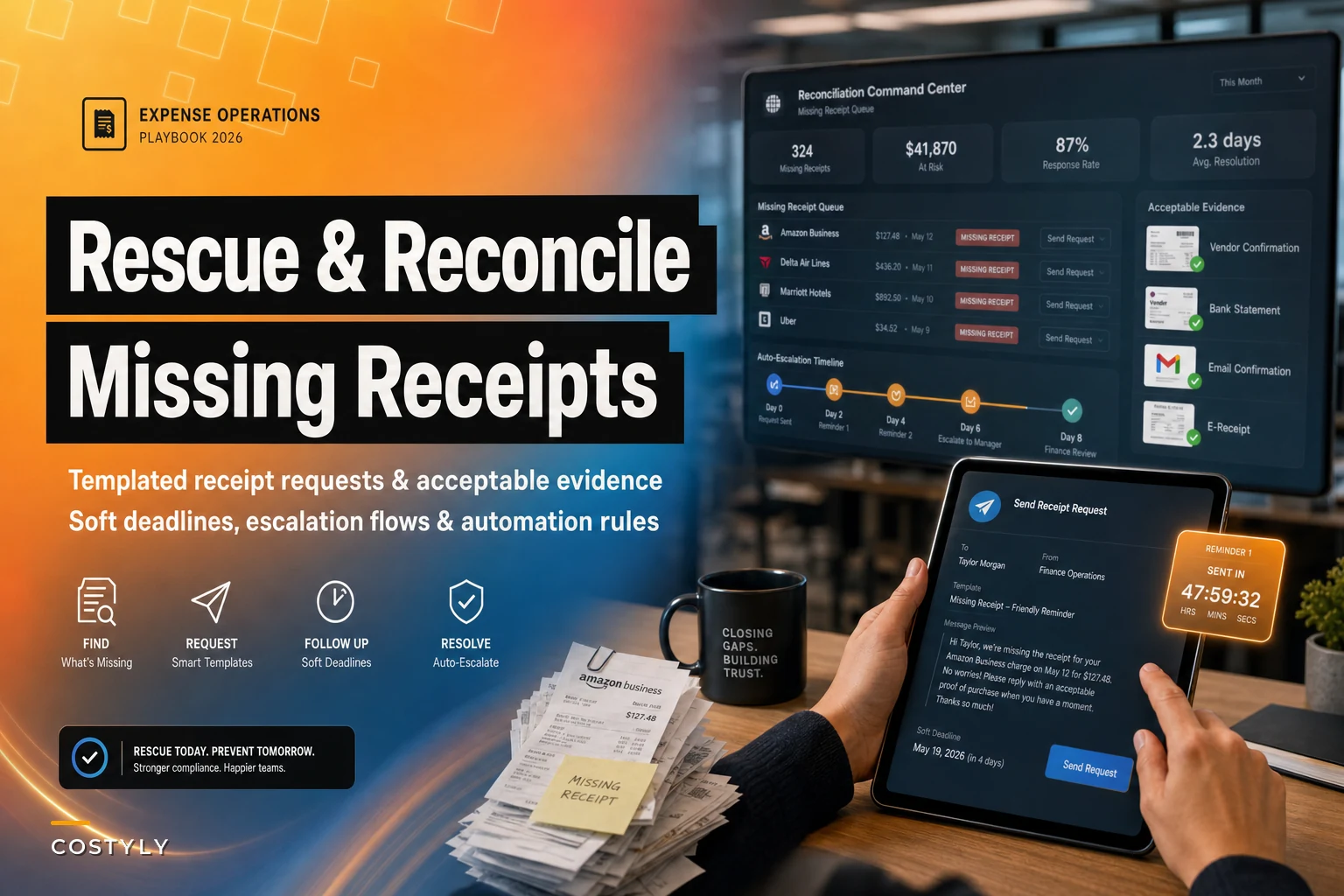

Card statements don't wait for your team. The statement closes, the charges land, and somewhere in that list are 14 transactions with no receipt attached. Some are $9 parking fees. One is a $2,400 conference registration from a salesperson who's now on vacation. Month-end is in four days.
This is the specific mess we're solving: you need to reconcile corporate card missing receipts before close, and you'd like to never spend a full afternoon chasing people again. Not fraud detection, not categorization — just the gap between a charge that hit the card and the documentation that's supposed to back it.
Rescue first (you have a deadline), prevention second (so next month is boring).
Why the receipt gap forms in the first place
Most missing-receipt problems aren't laziness. They're timing and friction.
A charge posts to the card 2–3 days after the cardholder actually spent the money. By then the mental context is gone. The physical receipt is in a jacket pocket, a car cupholder, or a hotel folio inbox they never opened. When finance flags it at month-end — sometimes three weeks later — the trail is cold and the person is annoyed to be asked about a $31 lunch they barely remember.
The second driver is no clear owner at the moment of spend. A shared card, a virtual card tied to a subscription, or a card the office manager uses for "whatever comes up" produces charges nobody feels personally responsible for. In real operations, this is where the worst gaps hide — transactions everyone assumes someone else will handle.
The third is vendor-side evidence that was never captured. Ride-share apps, SaaS tools, and airlines email receipts to whatever address was on file. If that's a personal Gmail or a dead inbox, the receipt technically exists but lives nowhere your books can see it.
The real cost of letting it ride
The obvious cost is the scramble. The expensive part is quieter.
Stop losing track of your business spending.
Costyly helps you record, monitor & control expenses—accurately and efficiently.
- Automated expense categorization
- Real-time budget tracking
- Detailed financial reports
No credit card required
Undocumented card spend without a receipt and a business purpose is a soft spot in any audit or tax review. A single $2,400 charge with no backup isn't just one awkward line — it signals weak controls, which invites a deeper look. A small marketing agency I know got a sampling request during a review, failed to produce 6 of 20 requested receipts, and ended up reconstructing a year of travel from calendar invites and bank memos. Days of someone's time, not minutes.
There's also the slow leak. Charges that can't be substantiated sometimes get coded to a generic "miscellaneous" bucket just to close the month. Do that for a year and your actuals quietly drift from reality, which makes every forecast built on them a little wrong.
Reimbursements get tangled up in this too. When a cardholder also submits personal reimbursements, a missing card receipt and a duplicate claim can collide — you end up paying for the same dinner twice or clawing it back later.
Part 1: The rescue — recover what's missing before close
You're not trying to be elegant here. You're trying to close clean. Work it in this order.
Step 1: Triage by materiality, not by date
Don't chase chronologically. Split the missing list into three buckets:
-
High (over ~$250 or any travel/entertainment) needs a real receipt. Non-negotiable.
-
Medium ($75–$250) receipt preferred, strong alternative evidence acceptable.
-
Low (under $75) a documented business purpose is usually enough under most policies and IRS substantiation rules, but confirm your own threshold.
This one move cuts the stressful part of the list in half. If 10 of your 14 missing receipts are under $40 parking and coffee charges, you don't need to hunt receipts — you need a one-line purpose for each.
Step 2: Send a templated request, not a custom email
> **Subject: Receipt needed by Thu 5pm — [Vendor] $[amount] on [date] > > Hi [Name], > > This charge hit your card and we're missing documentation: > - Vendor: [vendor] > - Amount: [$amount] > - Date: [date] > - Last 4: [card] > > I need one of these by Thursday 5pm:
-
The receipt (photo or PDF is fine)
-
The vendor's email confirmation
-
A one-line business purpose if it's under $75
> Reply straight to this email with the attachment. Takes 90 seconds.
The specificity matters. "Please send your missing receipts" gets ignored. "This $142 Delta charge from March 3 — send the confirmation email by Thursday" gets answered, because there's nothing for the person to figure out.
Step 3: Offer acceptable evidence alternatives
Half the delay is people thinking they need the original paper receipt and not having it. Tell them what else works. For most SMB policies, these substantiate a charge when the receipt is genuinely gone:
| Evidence type | Good for | What it must show |
|---|---|---|
| Vendor email confirmation | SaaS, airfare, hotels, online orders | Vendor, date, amount |
| Credit card statement line + business purpose | Low-value, hard-to-document charges | The charge + a written reason |
| Bank/app transaction screenshot | Ride-share, food delivery | Vendor, amount, date |
| Reissued receipt from vendor | Restaurants, hotels | Full itemized copy |
| Signed missing-receipt affidavit | Last resort, higher-value items | Amount, date, purpose, attestation |
The affidavit is your safety valve, not your default. If someone uses it twice in a quarter, that's a pattern worth a conversation — not a process to normalize.
Step 4: Set a soft deadline with a hard consequence
"Whenever you get a chance" guarantees you'll be chasing the same charge in three weeks. Give a soft deadline (Thursday 5pm) attached to a clear, pre-agreed consequence: unsubstantiated charges over the threshold get treated as personal and deducted from the next reimbursement, or flagged to the cardholder's manager.
The point isn't to be punitive. It's that a deadline with no teeth isn't a deadline. Once people know the Thursday cutoff is real, the receipts show up on Thursday.
Step 5: Document the gaps you couldn't close
Some receipts won't come back. Create a short log for close: charge, amount, what evidence exists, business purpose, and whether an affidavit was used. This log is what protects you later — it shows the control was applied and the exception was handled deliberately, not ignored.
Part 2: Prevention — make next month quiet
The rescue is firefighting. Prevention is where you actually win back your time. The goal is straightforward: capture the receipt at or near the moment of spend, while context is still warm.
Shrink the capture window
The single highest-leverage change is pulling receipt capture as close to the transaction as possible. A receipt photographed in the parking lot after lunch takes 15 seconds and never gets lost. The same receipt chased three weeks later takes three emails and sometimes never arrives.
Practically, the ask should happen when the charge is fresh — ideally the same day it posts, not at month-end. That's the whole game.
Build an escalation flow instead of improvising
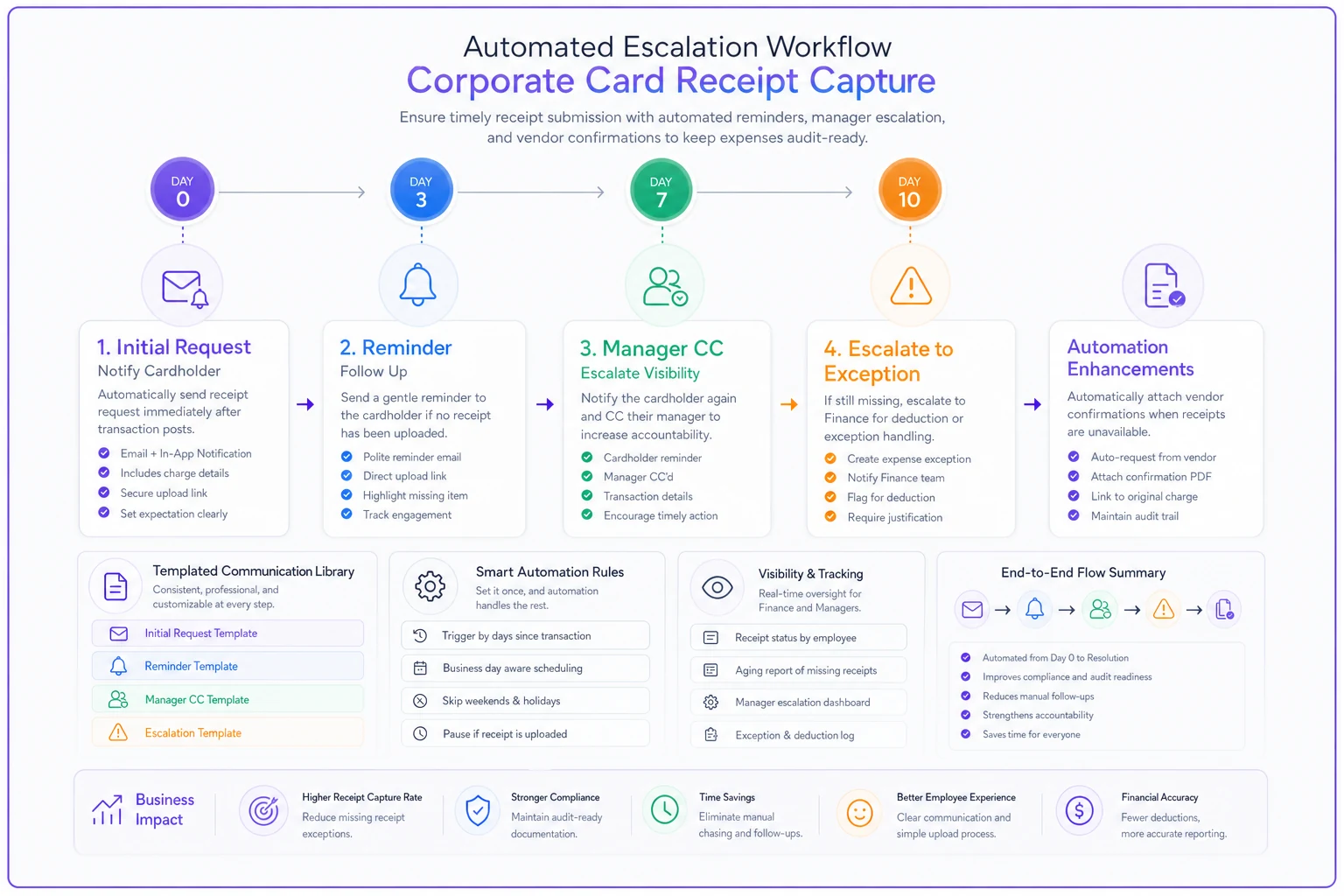
When you do have to chase, the sequence should be automatic and predictable, not invented each time:
-
Day 0 (charge posts) automated notification to the cardholder — "snap the receipt now."
-
Day 3 reminder if still missing.
-
Day 7 second reminder, cc the person's manager.
-
Day 10 escalation — charge flagged for the personal-deduction / month-end exception process.
Four touches, fixed timing. Nobody has to decide when to follow up or how hard to push — the flow decides. That alone removes most of the awkwardness.
A prevention checklist worth pinning up
-
Every card has a single named owner — no anonymous shared cards.
-
All vendor receipt emails route to one monitored finance inbox, not personal addresses.
-
Receipt-required thresholds are written down and the same for everyone.
-
Cardholders know the Day 0 / 3 / 7 / 10 cadence before it ever hits them.
-
A missing-receipt log exists and gets reviewed at close.
-
Repeat offenders (3+ missing in a quarter) get a direct conversation, not another reminder.
Ask cardholders to photograph receipts immediately after the transaction.
Where automation actually earns its keep
Most teams do this by hand far longer than they should. The chasing, the reminders, the matching of a receipt to the right charge — it's repetitive, rule-based work, which is exactly where AI-assisted expense platforms pull their weight.
In practice, it works like this: a charge posts, the system matches it against receipts already captured, and only the genuinely unmatched ones trigger the escalation flow — sending the templated request, firing the Day 3 and Day 7 reminders, looping in a manager at Day 10 without anyone touching it. When a vendor emails a confirmation to the finance inbox, the platform reads it and attaches it to the matching charge automatically. By month-end, your "missing" list is just the real exceptions, not 40 charges you haven't looked at yet.
Here's a simple visual of that escalation flow.
The point isn't to remove judgment — you still decide on the odd affidavit and the awkward $2,400 item. It's to stop spending your afternoon being a reminder service for receipts that should've been captured on day zero.
A real scenario
A 22-person construction and remodeling outfit ran four corporate cards — one per project lead plus the office manager's catch-all. Every month-end, their bookkeeper spent most of two days chasing roughly 30–40 missing receipts, mostly fuel, hardware store runs, and permit fees. Two or three material charges a month ended up in "miscellaneous" because nobody could reconstruct them in time.
They changed three things. Receipt capture moved to same-day via a photo on the spot. The office manager's catch-all card got split so every charge had a named owner. And the chase became an automated Day 0/3/7/10 flow with templated requests and a Thursday-before-close cutoff.
Within two cycles, the missing-receipt list at close dropped to around 4–6 items — the genuine stragglers. The bookkeeper's two-day chase became a couple of hours. And "miscellaneous" stopped being a dumping ground, which meant their job-cost numbers finally matched what projects actually spent.
Nothing fancy. They just moved capture earlier, assigned ownership, and stopped improvising the follow-up.
When a formal process is overkill
If you've got one card and under 20 transactions a month, a shared folder and a weekly 10-minute review beats building escalation flows. The overhead of a four-step chase cadence only pays off once the volume or the number of cardholders makes manual tracking genuinely slow.
Where it becomes worth it: multiple cards, travel-heavy teams, anyone handling client-billable spend, or any business that's had an audit question come up. At that point the missing-receipt gap stops being an annoyance and starts being a real liability.
The takeaway
Missing receipts aren't a discipline problem you fix by nagging harder. They're a timing problem. Charges post late, context evaporates, and nobody owns the moment of spend — so documentation never gets captured while it's easy.
Rescue what you can with a sharp, deadline-driven, templated chase and sensible evidence alternatives. Then move capture to day zero, give every card an owner, and let a fixed escalation flow handle the follow-up so you're not the one sending the fifth reminder. Do that, and reconciling card charges against receipts turns from a month-end crisis into a short list of real exceptions.
Ready to master your business expenses?
Join 5,000+ businesses using Costyly to save time, reduce overspending, and improve financial visibility.