


Three months ago, a marketing agency owner called me frustrated about a $1,400 software purchase. The request bounced between four people for twelve days before someone finally approved it. By then, the vendor's promotional pricing had expired. The kicker? It was for project management software that would save them roughly 15 hours of coordination time monthly.
This scenario plays out constantly. Small businesses grow past the "owner approves everything" stage but never quite build the approval systems that keep decisions moving. You get stuck in this weird middle ground where some purchases fly through unchecked while others die in endless email chains.
The real damage isn't just delayed purchases. It's the operational paralysis when nobody knows who can approve what. Teams stop asking for tools they need. Managers hesitate on routine decisions. Everything slows down because the approval process feels unpredictable.
Why approval matrices fail in small businesses
Most approval matrix templates you'll find online look impressive. Clean grids showing exactly who approves what at every dollar threshold. Department heads, VP signatures, board approvals. They make perfect sense until you try implementing them in a 25-person company where the CFO also handles HR and the operations manager covers three different departments.
The standard enterprise approach breaks down fast:
Your "department head" for marketing might be a senior coordinator who started eight months ago. Your finance team is two people who already handle payroll, invoicing, collections, and reporting. Creating separate approval chains for IT, facilities, and operations sounds great until you realize that's all the same person.
Threshold rigidity kills these systems. A $5,000 approval threshold makes sense for office supplies but feels ridiculous when you're buying specialized equipment that always costs exactly $5,200. You end up with exceptions everywhere, and the matrix becomes more suggestion than system.
One retail company implemented a four-tier approval matrix that looked textbook perfect. Within two months, they'd created seventeen exception categories because their actual spending patterns didn't match the neat boundaries they'd drawn. The controller spent more time managing exceptions than reviewing purchases.
Building an approval system that actually works
The approval matrix for small businesses needs to handle reality: people wear multiple hats, spending patterns are irregular, and you can't afford approval delays on routine operations.
Stop losing track of your business spending.
Costyly helps you record, monitor & control expenses—accurately and efficiently.
- Automated expense categorization
- Real-time budget tracking
- Detailed financial reports
No credit card required
Start with categories, not just dollar amounts. A $2,000 marketing campaign needs different oversight than a $2,000 equipment repair. Your approval matrix should reflect what's being bought, not just how much it costs.
Operational spending (keeps the business running)
-
Under $500
Direct manager approval
-
$500-$2,500
Department lead or equivalent
-
Over $2,500
Finance review + executive approval
Growth spending (new initiatives, expansion)
-
Under $1,000
Department lead + finance notification
-
$1,000-$5,000
Finance review + executive approval
-
Over $5,000
Executive team discussion
Emergency spending (breakdowns, urgent fixes)
-
Under $1,000
Verbal approval, documentation within 24 hours
-
Over $1,000
Text/call approval from executive, formal documentation within 48 hours
The key difference is context.
A facilities manager shouldn't need three approvals to fix a broken HVAC unit in summer. But that same manager should get oversight before signing a new three-year maintenance contract.
Here's a quick visual of how category-based routing and escalation should flow.
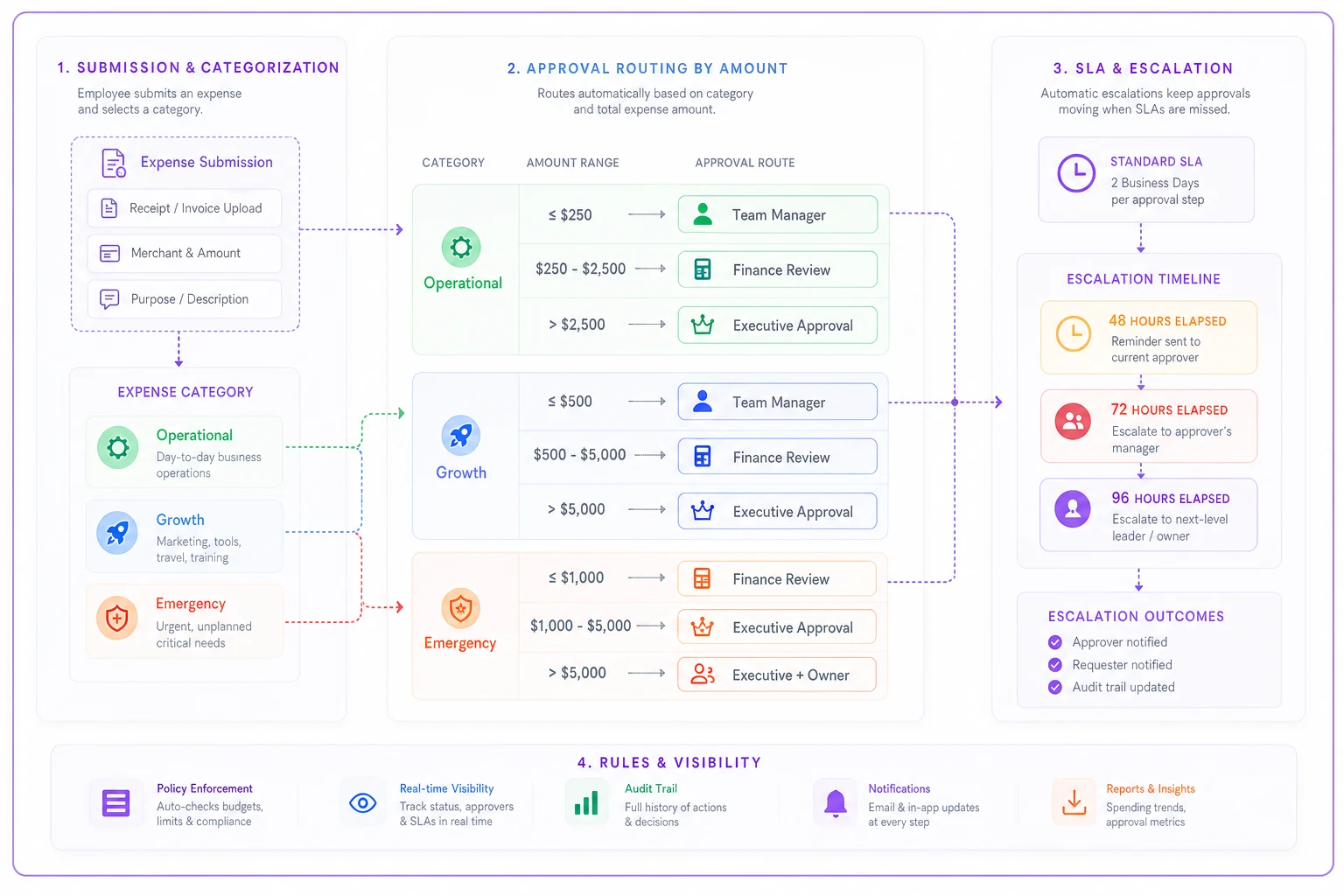
This diagram shows requests routed by category and amount, with automatic escalation steps when SLAs are missed.
SLA mechanics that prevent bottlenecks
Service level agreements for approvals sound bureaucratic, but they keep decisions moving. Most small businesses either have no SLAs or create ones nobody follows.
Real SLAs need enforcement mechanisms built in. Not punishment exactly, but automatic escalation that makes delays visible and painful for the person sitting on the request.
24-hour rule for routine operations: Any operational purchase under $1,000 gets approved or explicitly rejected within one business day. No response means automatic escalation to the next level.
48-hour rule for standard purchases: Regular business purchases between $1,000 and $5,000 get handled within two business days. This includes clear feedback if more information is needed.
72-hour maximum for everything else: Even complex purchases need initial feedback within three days. Not necessarily full approval, but at least "we're reviewing this and need X additional information."
The enforcement part matters more than the timeline. One distribution company built their SLAs directly into their expense system. Pending approvals automatically generated reminder emails every 12 hours after the SLA deadline. After 48 hours past deadline, the CEO got copied. Approvals moved fast after that system went live.
You need release valves too. If someone's out sick or traveling, the system needs to automatically route around them. Nothing kills an SLA system faster than requests dying in someone's vacation inbox.
The escalation playbook
Escalation paths in small businesses get weird because you run out of management layers quickly. In enterprise, you might escalate from manager to director to VP to executive. In a small business, that might just be two people, and one of them is already on the email.
Build escalation around decision authority, not org hierarchy:
Level 1: Operational escalation
The person who manages day-to-day operations makes the call. This might be a team lead, coordinator, or senior individual contributor. They handle anything that keeps existing operations running.
Level 2: Financial escalation
Finance or operations leadership reviews purchases that impact budgets, require new vendor relationships, or change spending patterns. They're checking for budget availability and financial impact.
Level 3: Strategic escalation
Executive or ownership review for anything that changes how the business operates, commits to long-term contracts, or impacts multiple departments.
Make escalation automatic, not punitive. At one software company, their system automatically escalated stalled approvals but included context: "This request has been pending for 3 business days. Based on the category and amount, it's being escalated to ensure timely resolution."
That framing matters. You're not tattling on someone for being slow. You're ensuring the business keeps moving.
Category-specific approval rules
Different spending categories need different oversight. A $5,000 laptop purchase for a new developer is routine. A $5,000 "consulting" invoice from an unknown vendor is suspicious.
Technology and software
-
Routine replacements
Manager approval up to standard equipment cost (usually $1,500-$2,500 for laptops)
-
New software subscriptions
Finance review regardless of amount (they compound fast)
-
Infrastructure upgrades
Technical review + finance approval
Marketing and advertising
-
Campaign spending within approved budget
Marketing lead approval
-
New channel testing
Finance notification required
-
Agency contracts
Executive approval (these always expand)
Professional services
-
Known vendors under $2,500
Department approval
-
New vendors or over $2,500
Finance review + reference check
-
Ongoing contracts
Legal or executive review
Travel and entertainment
-
Standard business travel
Manager approval with documented business purpose
-
Conference attendance
Department lead + demonstrated ROI plan
-
Team events over $50/person
Executive approval
I've watched companies treat all spending the same, leading to absurd situations. One manufacturing company required CFO approval for all software over $100/month. Their CFO was approving $12 Microsoft Office licenses while million-dollar equipment purchases sailed through because they fell under "operational necessities."
Real enforcement examples from the field
A logistics company implemented what looked like a simple approval matrix but added teeth to it. Every Monday, their leadership meeting started with an "approval aging report." Any request pending more than three business days got discussed first. Not the requester—the approver had to explain the delay.
Within six weeks, their average approval time dropped from eight days to 1.5 days. The public accountability mattered more than any official policy.
Another approach: automatic budget holds. One event planning company programmed their system to freeze discretionary budgets for any department with approvals pending over 48 hours. Suddenly, managers who ignored purchase requests found their own spending locked. The system forced them to clean up their approval queue before making new purchases.
The nuclear option, which I've only seen twice, is automatic approval with documentation. After five business days, purchases under $5,000 automatically approved but generated a report to the CEO showing which manager failed to respond. The embarrassment factor was powerful, but it only works if you have strong expense controls on the back end.
Building in flexibility without losing control
Rigid approval matrices break because business doesn't follow rigid patterns. You need pressure release valves that maintain control while handling reality.
Blanket pre-approvals: Marketing gets pre-approved for $3,000 monthly in ad spend. No individual approval needed, but they report on performance monthly. If they need more, that triggers the standard approval process.
Vendor allowlists: Established vendors with good payment history get streamlined approval. A purchase from your regular supplies vendor under $1,000 might only need notification, not approval.
Seasonal adjustments: Retail businesses might have different thresholds during peak season. A store manager who normally needs approval for purchases over $500 might get $1,500 authority during the holiday rush.
Role-based exceptions: Your facilities manager probably knows more about maintenance needs than your CFO. Give them higher authority for specific categories where they have expertise.
The balance point is tracking everything even when you're not approving everything. One construction company gave project managers $5,000 discretionary authority on active job sites but required same-day reporting of any spending over $500. They caught problems faster than their old approval system while eliminating jobsite delays.
Technology and automation in approval workflows
The approval matrix only works if it's faster than going around it. That's where operational software changes the game—not by adding more control, but by removing friction from legitimate purchases.
Modern expense platforms can encode your entire approval matrix, automatically routing requests based on amount, category, and requester. But the real value comes from the peripheral features that make the system self-enforcing.
AI automation handles the routine stuff that bogs down approvals. Duplicate detection catches when someone's trying to buy software the company already has. Vendor verification flags new or suspicious payees. Automated budget checks show available funds before approval, preventing the awkward "approved but no money" situation.
Enable mobile approvals with required context (photos, quotes, budget impact) so execs can act quickly without extra back-and-forth.
The intelligence layer spots patterns humans miss. Like when three different departments all start buying similar tools, suggesting you need an enterprise solution. Or when emergency repairs spike in particular equipment, indicating it's time for replacement rather than continued fixes.
But the biggest improvement is mobile approval. Property management company owner was constantly traveling between properties. Their approval backlog disappeared once he could approve purchases from his phone with full context—photos of what needed repair, quotes from vendors, budget impact—all in one screen.
Measuring what matters
Your approval matrix is only as good as its results. Track the right metrics to spot problems before they become cultural:
| Metric | Description |
|---|---|
| Approval velocity | Average time from request to decision, broken down by category and approver. If someone consistently takes five days to approve routine purchases, you've found your bottleneck. |
| Rejection rate | High rejection rates might mean unclear purchasing guidelines. Low rejection rates might mean rubber-stamping. The sweet spot is usually 10-20% for discretionary spending. |
| Bypass frequency | How often do people skip the system entirely? If it's over 15%, your process is too slow or complex. |
| Post-purchase adjustments | Are you constantly reclassifying expenses or reassigning approvals after the fact? That signals category confusion or threshold problems. |
One metric nobody tracks but should: time spent discussing purchases. A medical practice discovered they spent four hours monthly in meetings discussing purchases under $1,000. The fully-loaded cost of those meetings exceeded the risk of just letting managers make those decisions directly.
Scaling without enterprise overhead
The goal isn't building a Fortune 500 approval process. It's creating something that grows with you without becoming a burden.
As you scale from 20 to 50 to 100 employees, your approval matrix needs minor adjustments, not complete overhauls. The category-based system handles growth better than pure dollar thresholds. The marketing team growing from two to eight people doesn't fundamentally change what marketing purchases need oversight.
What changes is the automation layer. Manual reminders become system-generated escalations. Email approvals become mobile app workflows. Spreadsheet tracking becomes real-time dashboards. The underlying approval logic stays consistent while the execution mechanism evolves.
Companies that scale successfully build approval systems that enforce themselves through transparency rather than bureaucracy. When everyone can see approval queues, SLA performance, and bottlenecks, the system self-corrects without heavy-handed intervention.
Making the system stick
The best approval matrix in the world fails if people don't use it. Here's what makes adoption actually happen:
Make it less work to follow the system than to skip it. If getting approval takes two clicks but explaining why you didn't get approval takes a meeting, people follow the process.
Build in grace periods for adjustment. The first month, track everything but don't enforce SLAs. Let people learn the system before you add consequences.
Celebrate speed, not just compliance. Publicly recognize managers who consistently hit their SLA targets. Make fast approval times a performance metric, not just an expectation.
Keep iterating based on real usage. That threshold that seemed perfect in planning might be causing problems in practice. Those categories that made sense in theory might need splitting or combining based on actual spending patterns.
The reality check
An approval matrix for small business isn't about control—it's about velocity. Every day a purchase sits in limbo costs more than the risk of the occasional bad purchase. The system should accelerate good decisions while catching the truly problematic ones.
Most small businesses would be better off with a simple, fast, mostly-automated approval process than a complex, thorough, manual one. Save the detailed oversight for big purchases, new vendors, and unusual spending patterns. Let everything else flow through with appropriate visibility but minimal friction.
Companies that successfully implement these systems share one trait: they value speed over perfection. They'd rather approve something quickly and adjust if needed than delay operations waiting for perfect information.
Your approval matrix should enable your team to move fast while giving leadership visibility and control where it matters. Build it once, automate what you can, and adjust based on actual behavior rather than theoretical concerns. The goal is operational efficiency, not procedural perfection.
Every approval delay is a small operational failure. The system should prevent bad purchases, not slow down good ones. If your approval matrix does that, you've built something that actually serves your business instead of constraining it.
Ready to master your business expenses?
Join 5,000+ businesses using Costyly to save time, reduce overspending, and improve financial visibility.