


Picture running through your P&L at year-end and finding $47,000 in subscription expenses. That's what happened to a marketing agency owner I worked with last March. Not $47,000 in necessary subscriptions—just $47,000 total, with about $18,000 of it completely wasted on tools nobody had touched in months.
The worst part? This wasn't unusual. Most small businesses carry between 15-40% dead weight in their subscription spend. Not because they're careless, but because subscription management breaks down when you're focused on actual operations.
Why subscription bloat happens in growing businesses
Small businesses accumulate subscriptions differently than large companies. You don't have procurement departments or approval chains. Someone needs a tool, they grab a credit card, problem solved.
This works until it doesn't.
The pattern usually starts around 15-20 employees. Before that, everyone knows what everyone else is using. After that threshold, visibility breaks down. Marketing doesn't know what sales bought. Operations doesn't know what customer service is testing. The founder definitely doesn't know about the $79/month tool the intern signed up for six months ago.
Subscription vendors design their businesses around this exact blindspot. They know you'll forget. They count on it. Some enterprise software companies generate 23% of their revenue from accounts that haven't logged in for over 90 days.
The compounding cost of subscription chaos
Direct waste: $2,100/month in completely unused subscriptions
Stop losing track of your business spending.
Costyly helps you record, monitor & control expenses—accurately and efficiently.
- Automated expense categorization
- Real-time budget tracking
- Detailed financial reports
No credit card required
Overlap waste: $1,400/month in redundant tools (three project management platforms, two CRMs)
Tier waste: $890/month paying for features nobody used
The operational cost though—this company's team was spending roughly 6 hours per week just navigating between overlapping tools. That's $3,900/month in lost productivity at their average hourly rate.
Total monthly damage: $8,290. For a business doing $3.2M in revenue, that's almost their entire profit margin.
The real problem isn't the money. It's that subscription sprawl creates operational friction. When your team uses 47 different tools (yes, that's a real number), nothing integrates properly. Data lives in silos. Workflows break. People create workarounds for their workarounds.
Building an owner matrix that actually prevents problems
Most businesses try to solve this with spreadsheets. That fails because spreadsheets require maintenance, and nobody maintains them.
What works is an owner matrix combined with automatic detection. Start by mapping every subscription to three elements:
-
Primary owner (who requested it)
-
Functional owner (who actually uses it)
-
Finance owner (whose budget it hits)
Map owners to existing HR or billing records so updates happen automatically.
This seems like overkill until you realize most subscription problems happen when these three diverge. The sales director who requested Gong left eight months ago. Nobody owns it now. But it's still billing $4,000/month to the sales budget that the new director doesn't even know about.
Instead of trusting people to update a matrix, build detection into your expense workflow:
| Subscription Flag | Check Frequency | Action Trigger |
|---|---|---|
| No login in 30 days | Monthly | Email functional owner |
| No login in 60 days | Monthly | Escalate to primary owner |
| No login in 90 days | Monthly | Freeze or downgrade |
| Owner left company | Immediate | Reassign within 48 hours |
| Duplicate category detected | Weekly | Review meeting trigger |
A construction company implemented this exact system and caught $1,800/month in orphaned subscriptions within the first review cycle. They prevented about $500/month in new redundant purchases just by having visibility.
The renewal calendar that prevents surprise charges
Every business owner has experienced this: a $5,000 annual charge hits your card for software you forgot existed. You can't cancel because you're already charged. You can't get a refund because it's been over 30 days since last year's renewal.
Build a rolling 90-day renewal forecast. Not 30 days—that's not enough time to properly evaluate and migrate if needed.
90 days before renewal: Initial usage audit. Pull login data, feature usage, user feedback.
60 days before renewal: Decision point. Keep, downgrade, or cancel. If canceling, begin migration.
30 days before renewal: Execute decision. Cancel or renegotiate. Never let it auto-renew without conscious choice.
15 days before renewal: Confirm execution. Verify cancellations processed. Check for renewal blockers.
Make this systematic, not relying on memory. A wholesale distribution business saved $31,000 annually just by implementing 60-day renewal reviews. They didn't even cancel that many subscriptions—they just right-sized their tiers and negotiated better rates with advance notice.
Quick heuristic checks that catch 80% of waste
You don't need complex analytics to detect subscription creep. These simple checks catch most problems:
The login test: If nobody's logged in for 60 days, you probably don't need it. Exception: seasonal tools or compliance software.
The overlap test: List your subscriptions by function. If you see multiple tools in the same category, dig deeper. Three project management tools means two too many.
The user ratio test: Divide active users by paid seats. Below 70% means you're overprovisioned. Below 50% means you bought based on optimism, not reality.
The feature usage test: Most businesses use less than 30% of features in their enterprise subscriptions. Check if a lower tier would work.
The credit card test: Pull all recurring charges from company cards. About 20% won't match your official subscription list. That's your hidden creep.
A professional services firm ran these checks quarterly and reduced subscription spend by 31% in six months without cutting anything critical. They just eliminated waste and redundancy.
The low-friction cancellation playbook
What stops most businesses from canceling unused subscriptions? Fear of breaking something.
This fear is usually overblown, but sometimes justified. The solution is a low-friction cancellation process that reduces risk:
Step 1: Verify true usage (2 minutes)
-
Check last login across all users
-
Pull any recent exports or reports
-
Screenshot current configurations
Step 2: Identify dependencies (5 minutes)
-
List any integrations
-
Check for archived data
-
Note any shared assets
Step 3: Create safety net (10 minutes)
-
Export critical data
-
Document access credentials
-
Set calendar reminder for 25 days (most services allow reactivation within 30 days)
Step 4: Execute cancellation (3 minutes)
-
Cancel through dashboard if possible
-
Email if required
-
Screenshot confirmation
Step 5: Monitor for breaks (ongoing)
-
Watch for complaint emails
-
Check integration error logs
-
Be ready to reactivate if needed
Here's a visual of the cancellation workflow.
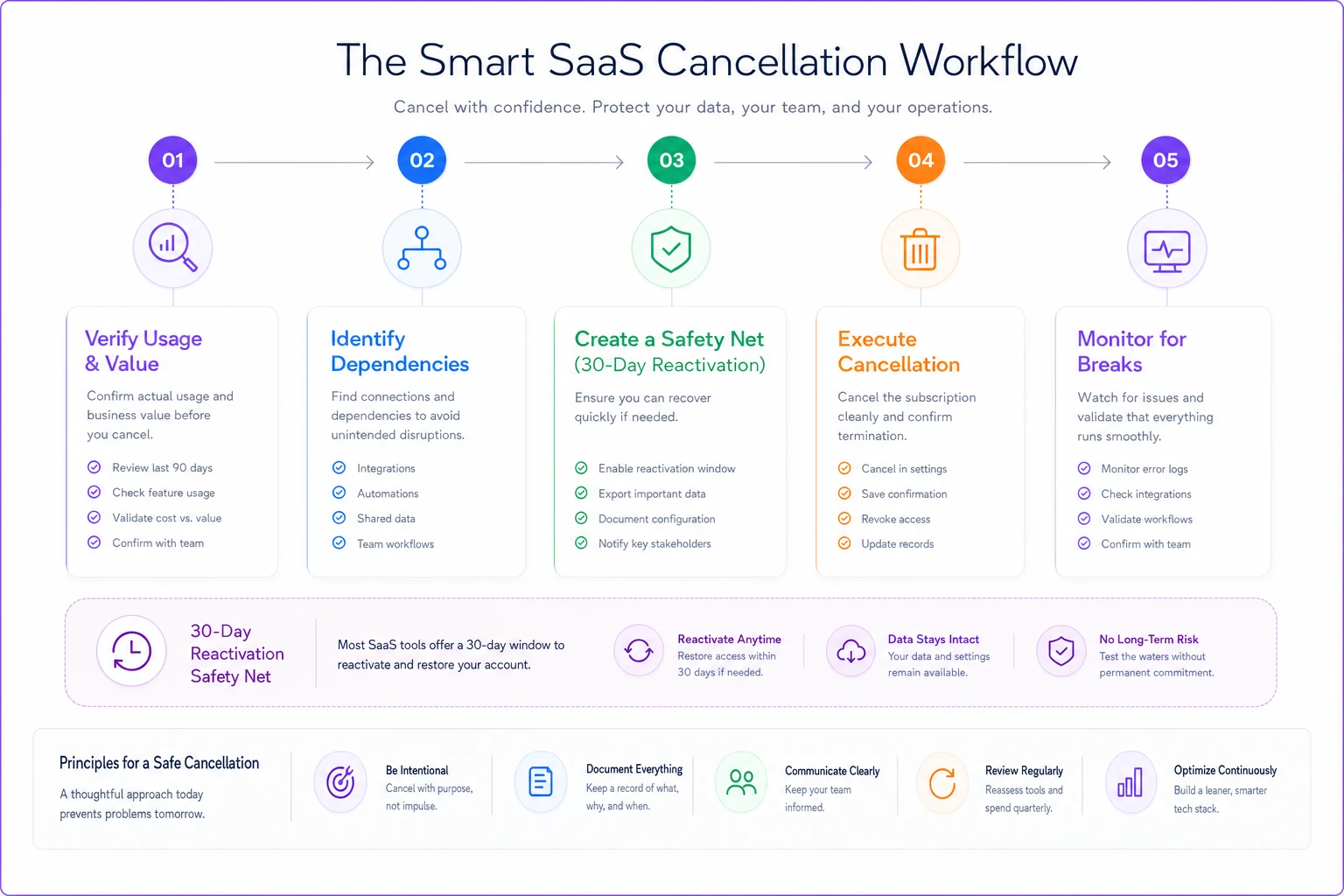
Total time: 20 minutes per cancellation. Risk: minimal with the 30-day reactivation safety net.
Recovery steps when you find massive waste
Discovering $50,000 in wasted annual subscription spend feels terrible. Don't cancel everything at once. Rank subscriptions by risk and savings:
| Priority | Criteria | Example | Action Speed |
|---|---|---|---|
| 1 | Zero usage, no integrations | Abandoned project tools | Cancel immediately |
| 2 | Duplicate function, clear winner | Multiple CRMs | Cancel within 30 days |
| 3 | Low usage, some dependencies | Underused analytics | Evaluate for 60 days |
| 4 | Moderate usage, high cost | Enterprise platforms | Renegotiate first |
Start with Priority 1. These are pure waste with zero risk. A retail chain found $8,400/year in Priority 1 subscriptions—tools from former employees, failed initiatives, and forgotten trials that converted to paid.
For Priority 2, pick the winner and consolidate. Don't try to merge three project management tools into one. Pick the one people actually use and sunset the others.
Priority 3 requires investigation. That analytics tool with two users might be critical for monthly board reports. Or it might be someone's pet project that died six months ago.
Priority 4 is where you negotiate, not cancel. Armed with usage data, you have leverage. "We're using 12 of your 500 seats" gets you a different conversation than "we want to cancel."
When automated detection beats manual audits
Manual subscription audits work until they don't. Usually around 30-40 subscriptions, manual tracking breaks down. You miss things. Updates lag. The audit itself becomes a burden.
Basic operational software with subscription detection helps. Not complex spend management platforms—those are overkill for most SMBs. But basic detection that flags anomalies:
-
New recurring charges appearing
-
Subscription costs increasing without approval
-
Multiple charges from the same vendor
-
Usage dropping below thresholds
-
Owners leaving the company
The difference is dramatic. Manual audits maybe happen quarterly if you're disciplined. Automated detection runs continuously. It catches the $200/month subscription that someone forgot to cancel after a trial. It flags when Zoom quietly raises prices 10%. It notices when you're paying for both Slack and Microsoft Teams.
A distribution company switched from quarterly manual audits to automated detection and found an extra $14,000 in annual savings—all subscriptions that started between audit cycles or had price increases they didn't notice.
Build prevention into your operational rhythm
The best subscription management isn't about better audits—it's about preventing creep from happening.
Week 1: Review new subscriptions added last month. Verify they're being used as expected.
Week 2: Check renewal calendar for next 90 days. Make keep/cut decisions.
Week 3: Run usage reports on top 10 most expensive tools. Look for drop-offs.
Week 4: Spot-check department spending. Ask managers to justify their subscription stack.
This takes maybe two hours monthly total, spread across the weeks. Compare that to the 20-hour forensic audit you'll need if you let subscriptions run wild for a year.
When people know subscriptions get reviewed monthly, they're more thoughtful about what they buy. The prevention effect is stronger than the detection effect.
Conclusion
Subscription creep is a profit killer that compounds silently. By the time most businesses notice, they're burning thousands monthly on tools gathering digital dust. But unlike other operational problems, this one has a clear fix: systematic detection, owner accountability, and a bias toward cancellation.
The businesses that control subscription spend don't have better discipline. They have better systems. They catch problems monthly, not annually. They assign clear ownership. They make cancellation low-friction and recovery easy.
Start with the quick heuristic checks. Run them tomorrow. Cancel the obvious waste. Build your owner matrix. Set up your renewal calendar. Make subscription review part of your operational rhythm.
Every month you wait is money burned on tools you don't use, features you don't need, and seats that sit empty. The fix takes less time than you're spending working around the operational friction these redundant tools create.
Ready to master your business expenses?
Join 5,000+ businesses using Costyly to save time, reduce overspending, and improve financial visibility.