


Most expense tools treat shipping as one lumped line: "Carrier — $4,312.88." For a consulting firm, fine. For an e-commerce operation shipping 800–3,000 orders a month, that single line hides everything you actually need to understand — fuel surcharges, residential delivery fees, dimensional weight adjustments, address corrections, Saturday delivery, and the slow bleed of per-package accessorials that don't show up until the weekly invoice lands.
The problem with evaluating software for this is that nearly every vendor demo looks great. You scan a receipt, it reads the total, it syncs to your accounting system, everyone claps. The demo never tests the one thing that breaks shipping-heavy books: can it tie a carrier surcharge back to the specific order that caused it, so you know whether that order actually made money?
This guide is built around that single requirement. Everything else — OCR, bank sync, pricing tiers — matters, but it matters in service of order-level cost truth.
Start with the question your current tool can't answer
Before comparing vendors, get specific about what you're actually trying to figure out. For a shipping-heavy seller it's almost always some version of: "Which orders, SKUs, or channels are quietly unprofitable once real shipping cost lands?"
A typical example looks like this. A home-goods seller prices free shipping into their product. Their blended shipping cost looks fine at the account level — maybe 11% of revenue. But when you break it down, oversized items going to residential zip codes in the far zones are costing 28–34% of order value once dimensional weight and residential surcharges hit. The account average hides a category that's losing money on every sale.
If your expense tool can't attach that residential surcharge and dim-weight adjustment to the order, you can't see the leak. You'll keep running "free shipping" on products that destroy margin, and the only signal you'll get is a vague sense that cash feels tighter than the P&L suggests.
So the real evaluation criterion isn't "does it track expenses." It's "can it track expenses at the resolution where shipping decisions actually get made." That resolution is the order and the surcharge line.
A note on bank sync vs. carrier invoice parsing
These get confused constantly. Bank/card sync tells you money left your account — "FedEx, $4,312." Carrier invoice parsing tells you why — "of that $4,312, $610 was fuel surcharge, $280 was residential, $190 was address correction." You need both, and they're different integrations. A tool can have flawless bank sync and still be useless for understanding surcharge drift. Don't let a clean bank-feed demo convince you the surcharge problem is solved.
The must-have features, ranked by how much they actually matter
Not all features are equal for this use case. Here's how I'd weight them for a shipping-heavy operation, roughly in priority order.
Stop losing track of your business spending.
Costyly helps you record, monitor & control expenses—accurately and efficiently.
- Automated expense categorization
- Real-time budget tracking
- Detailed financial reports
No credit card required
| Feature | Why it matters for shipping-heavy sellers | How often it's actually usable out of the box |
|---|---|---|
| Order-level expense capture | Ties carrier cost to the order that generated it — the whole point | Rare; most tools stop at the invoice level |
| Carrier invoice line parsing | Breaks a single carrier charge into surcharge components | Rare; usually needs a shipping-platform integration |
| Shipping-platform integration (ShipStation, Shippo, EasyPost, etc.) | Source of order-to-tracking-to-cost linkage | Moderate; depends on the vendor's connector list |
| Accounting integration (QBO, Xero) | Clean sync to the GL without manual re-keying | Common, but mapping quality varies a lot |
| Bank & card sync | Catches charges that never hit a receipt | Common and usually solid |
| OCR receipt scanning | Useful for non-carrier spend (supplies, packaging) | Common; quality is wildly inconsistent |
The ranking surprises people. OCR gets all the marketing attention, but for shipping-heavy sellers it's near the bottom. Your biggest, most volatile cost — carrier spend — rarely arrives as a receipt you scan. It arrives as a weekly electronic invoice with hundreds of line items. The capability that matters is whether the tool can ingest and decompose that, not whether it can read a coffee receipt.
If you only stress-test one thing during a trial, make it this: upload a real carrier invoice with surcharges and see whether the surcharge lines survive the import as separate, categorizable data. If they collapse into one total, the tool isn't built for you.
Sample configuration patterns for capturing carrier surcharges
This is where most implementations go sideways, so here are concrete patterns that work. The goal is to make surcharges visible and attributable, not just recorded.
Pattern 1 — Surcharge sub-categories under a parent carrier category. Don't book everything to "Shipping Expense." Create a parent "Carrier Cost" category and sub-categories for the surcharges that move:
-
Base transportation
-
Fuel surcharge
-
Residential delivery
-
Dimensional weight adjustment
-
Address correction
-
Additional handling / oversize
-
Peak/seasonal surcharge
This mirrors the approach in our 7-step reforecast playbook for rising carrier surcharges — you can't reforecast a cost you've lumped into one undifferentiated line.
Separating these at capture is what makes the reforecasting possible later.
Pattern 2 — Tag at the order and channel level. Every carrier cost should carry two tags minimum: the order ID and the sales channel (Amazon FBM, Shopify, wholesale). This lets you answer "what's my true fulfilled cost by channel" without a month of spreadsheet surgery.
Pattern 3 — Create a "surcharge drift" flag. Set a rule that flags any invoice where surcharge components exceed a threshold of base transportation — say, surcharges above 35% of base. When peak season or a fuel spike hits, this flag fires before the month-end surprise does.
Pattern 4 — Reconcile billed weight vs. shipped weight. Dimensional weight reclassification is where carriers quietly recover margin. Configure the capture so billed weight is stored alongside your declared weight. When they diverge consistently on certain SKUs, you've found a packaging problem worth real money.
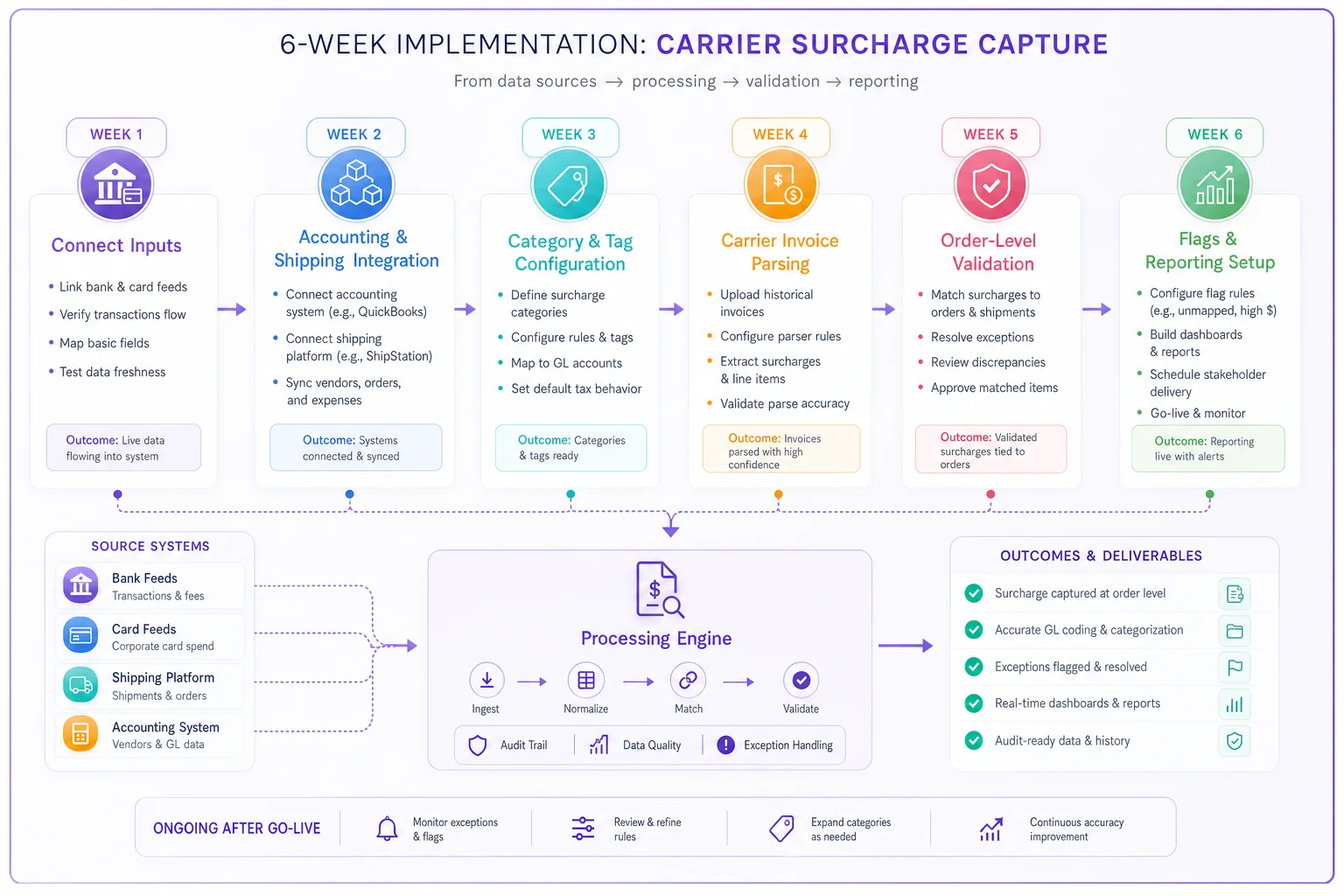
A realistic implementation timeline
Nobody gives you an honest timeline on this, so here it is. For a small team, expect four to six weeks to get genuinely useful data — not the "live in a day" the sales deck promises.
-
Week 1 — Connect the plumbing. Bank/card feeds, accounting integration, and your shipping platform. This part usually goes smoothly.
-
Week 2 — Build the category and tag structure. Set up the surcharge sub-categories and channel tags above. Don't skip this to "fix it later" — later never comes, and you'll have booked a month of unusable lumped data.
-
Weeks 3–4 — Parse a real carrier invoice end to end. Import one full weekly invoice, verify the surcharge lines map to your sub-categories, fix the mapping rules. This is the week that reveals whether the tool actually fits.
-
Weeks 4–5 — Validate order-level attribution. Pick 15–20 recent orders and trace each one from sale to tracking number to carrier cost. If the chain breaks, find where.
-
Week 6 — Set up the flags and reports. Surcharge drift flag, channel-level cost report, billed-vs-declared weight check.
This diagram shows the six-week implementation workflow at a glance.
Teams that rush this end up with a tool that technically "works" but produces numbers nobody trusts. The slow part isn't the software — it's getting your category and attribution logic right once, so everything downstream is clean.
Vendor sizing: matching the tool to your volume
Buying too much software is as damaging as buying too little. Rough guidance based on order volume:
-
Under ~300 orders/month You probably don't need a dedicated carrier-parsing tool yet. A solid general expense tool with good accounting sync plus a monthly manual surcharge review will do. The complexity of order-level attribution isn't worth it at this volume.
-
Roughly 300–1,500 orders/month This is the range where surcharge leakage becomes real money and manual tracking stops working. Prioritize tools with a native shipping-platform integration and surcharge-level categorization.
-
Over ~1,500 orders/month You need carrier invoice parsing as a first-class feature, not an add-on. At this volume, a half-percent of hidden surcharge drift is a meaningful number, and you can't catch it by eye.
The common mistake is a 400-order-a-month seller buying enterprise logistics-cost software with a six-month onboarding and seat-based pricing that assumes a ten-person finance team. You'll pay for complexity you can't staff.
Pricing considerations most buyers miss
Sticker price is the least important number. Watch these instead:
-
Transaction or volume-based fees. Some tools price per expense or per synced transaction. At a few thousand carrier line items a month, "per transaction" pricing gets ugly fast. Model it against your actual invoice line count, not your order count.
-
Integration tier gating. The shipping-platform connector you specifically need is often locked behind a higher tier. The base price is irrelevant if the one feature you're buying for is on the plan above.
-
Implementation and data-cleanup cost. If you're migrating historical spend, factor in the cleanup effort. Messy history imported badly is worse than no history.
-
Seat pricing vs. your real team. A three-person operation doesn't need twelve seats. Don't get talked into headroom you won't use for two years.
Model total cost of ownership against your actual invoice lines and team size rather than the sticker price alone.
A short ROI checklist
Before signing, run the numbers against these questions. If you can't answer at least four of them, the purchase is probably premature.
-
[ ] Can I name at least one product or channel I suspect is unprofitable on shipping but can't currently prove?
-
[ ] Do my carrier invoices contain surcharge lines I'm not categorizing today?
-
[ ] How many hours a month does someone spend manually reconciling shipping cost? (Multiply by their loaded rate.)
-
[ ] What's my monthly carrier spend, and what would catching even 1–2% of hidden surcharge drift be worth?
-
[ ] Will the tool pay for itself on surcharge visibility alone, before counting time savings?
-
[ ] Do I have the internal discipline to maintain the category structure once it's built?
That last question quietly kills more ROI than any pricing decision. Good software with a half-maintained tagging structure drifts back into lumped, useless data within a quarter.
A real scenario
A mid-size apparel-and-accessories seller doing roughly 1,100 orders a month was running on a general expense tool with clean bank sync. Their books looked fine. Shipping ran around 13% of revenue, which felt normal, so nobody dug in.
When they rebuilt their capture setup with surcharge sub-categories and channel tags, two things surfaced within the first full invoice cycle. Address-correction fees were running close to $400 a month — almost entirely from one wholesale channel feeding them bad addresses. And a cluster of oversized bundle SKUs was getting hit with additional-handling and dim-weight charges that pushed those specific orders to roughly 26% shipping cost.
Neither problem was huge on its own, but together they were costing somewhere in the $700–900-a-month range that the lumped "shipping" line had completely hidden. The address-correction leak got fixed with a validation step at order import. The oversized SKUs got repackaged and repriced. None of that was possible when the cost arrived as a single number.
The point isn't the exact dollars. The money was invisible until the tool captured cost at surcharge and order resolution. The software didn't save them money. The visibility did, and the software was just what made the visibility possible.
When this level of tooling is a bad idea
Not every shipping business needs this. Skip the dedicated carrier-parsing setup if:
-
You ship under a few hundred orders a month and your product mix is uniform — your blended shipping cost is probably representative enough.
-
You use a single flat-rate or heavily negotiated carrier program where surcharges are already bundled into a predictable per-package rate.
-
You don't have anyone who will actually look at the reports. Granular data that nobody reviews is just a more expensive version of ignorance.
In those cases, a good general expense tool plus a disciplined monthly carrier-invoice review beats an over-engineered setup you won't maintain.
The bottom line on choosing
Pick the tool that answers the question your current system can't: which orders actually made money after real shipping cost? Everything in the buying process — the demo, the integrations, the pricing tiers — should be judged against that. A gorgeous OCR engine and a flawless bank feed mean nothing if your largest, most volatile cost still lands as one undifferentiated line.
Test with a real carrier invoice. Build the surcharge categories before you go live. Size the vendor to your volume, not to the demo. And be honest about whether anyone will maintain the structure after week six. Get those four things right and the tool earns its keep. Get them wrong and you've just bought a more expensive way to be surprised at month-end.
Pick the tool that answers the question your current system can't: which orders actually made money after real shipping cost? Everything in the buying process — the demo, the integrations, the pricing tiers — should be judged against that. Test with a real carrier invoice. Build the surcharge categories before you go live. Size the vendor to your volume, not to the demo. And be honest about whether anyone will maintain the structure after week six. Get those four things right and the tool earns its keep. Get them wrong and you've just bought a more expensive way to be surprised at month-end.
Ready to master your business expenses?
Join 5,000+ businesses using Costyly to save time, reduce overspending, and improve financial visibility.