



The shipping market just shifted under your feet. Reuters reported that major U.S. retailers have pulled their China orders forward by several weeks to lock in holiday inventory. Walmart, Target, and the other big players are booking containers like cargo space is going out of style.
For small businesses that import goods or rely on third-party shipping, this creates an immediate problem that goes well beyond higher freight costs.
The capacity crunch hits differently when you're not shipping 10,000 containers
Big retailers frontloading orders doesn't just push up ocean freight rates. It sets off a cascade of operational headaches that small importers feel almost immediately.
Container availability evaporates first. Shipping lines prioritize their biggest accounts, so your regular booking gets bumped. You end up scrambling for space on premium services or alternate routings. Trans-Pacific rates that were sitting around $2,800 per forty-foot container suddenly spike to $4,200 or higher.
Then come the surcharges. FedEx's demand surcharges kick in when capacity tightens. UPS follows. Your domestic distribution costs jump 15–30% on top of the international freight increases. That product you were landing at $18 per unit is now hitting $23 before it even reaches your warehouse.
Timing disruption honestly hurts worse than the cost increase. Your normal 35-day transit becomes 45–50 days. Production slots at your supplier get reshuffled because everyone's rushing orders at once. You either accept later delivery dates or pay expedited production fees.
Working capital gets stretched thin too. Instead of financing September production in October, you're paying for July production that won't generate revenue until November. Your cash conversion cycle extends 20–30 days right when you need liquidity for holiday inventory.
Most small importers discover the damage in their P&L three months too late
Small businesses typically run their import operations on predictable cycles. Order in month one, receive in month two, sell in month three. When shipping surcharges and capacity crunches hit, that rhythm breaks completely.
Stop losing track of your business spending.
Costyly helps you record, monitor & control expenses—accurately and efficiently.
- Automated expense categorization
- Real-time budget tracking
- Detailed financial reports
No credit card required
The budget you built in January assumed freight at $3,000 per container and domestic shipping at standard rates. By July, you're paying $4,500 per container plus 25% shipping surcharges, but your pricing to customers was locked in months ago. Gross margins compress from 42% to 31% before you've even noticed what happened.
Traditional expense tracking makes this worse. Most small importers reconcile landed costs monthly or quarterly. They discover the full impact of shipping surcharges when they close the books—not when they could still adjust pricing or sourcing.
The inventory carrying cost sneaks up on you too. That extra three weeks of transit time means three more weeks of tied-up capital. At 8% annual cost of capital, extending your cash cycle by 21 days on $200,000 of inventory runs you roughly $920 extra. Multiply that across multiple shipments and it adds up fast.
Breaking down a typical shipping surcharge spiral
Take a small home goods importer bringing in $1.2 million of product annually. Here's how the current environment reshapes their numbers:
Pre-surge baseline (January–May)
| Cost Category | Amount |
|---|---|
| Ocean freight (20 containers × $3,000) | $60,000 |
| Domestic shipping | $85,000 |
| Duties/customs | $144,000 |
| Total logistics | $289,000 (24% of COGS) |
Current surge reality (June–August)
| Cost Category | Amount |
|---|---|
| Ocean freight (20 containers × $4,500) | $90,000 |
| Domestic shipping with surcharges | $106,000 |
| Duties/customs | $144,000 |
| Expedite fees for rushed production | $18,000 |
| Total logistics | $358,000 (30% of COGS) |
That's $69,000 in unbudgeted costs over three months. For a business running on 15% net margins, that wipes out close to 40% of quarterly profit.
The indirect costs pile on too. Rush orders mean less negotiating leverage with suppliers. Quality control slips when factories are pushing production to meet everyone's accelerated timelines. Customer complaints tick up when shipments arrive late despite paying premium freight rates.
The reforecast framework that actually works during volatility
Static annual budgets fall apart when shipping markets spike. You need a rolling reforecast system that catches cost changes before they compound. This connects directly to building an expense-driven reforecast system that updates as conditions change rather than waiting for month-end surprises.
Start with weekly freight rate tracking. Don't wait for invoices. Pull spot rates from Freightos or Xeneta every Monday and track the Shanghai Containerized Freight Index. When rates move more than 10% in either direction, that's your trigger to reforecast.
-
Base case — current spot rates hold
-
Stress case — 25% increase across all shipping costs
-
Opportunity case — 15% decrease if you shift timing
Calculate the working capital impact of each scenario. If extending payment terms by 30 days costs $2,000 in interest but saves $8,000 in freight by shipping later, the math isn't complicated.
Set operational triggers. When ocean freight clears $4,000 per container, evaluate air freight for high-margin SKUs. When domestic shipping surcharges hit 20%, consolidate shipments to distribution centers instead of drop-shipping direct to customers.
Here's what the reforecast cycle typically looks like in practice:
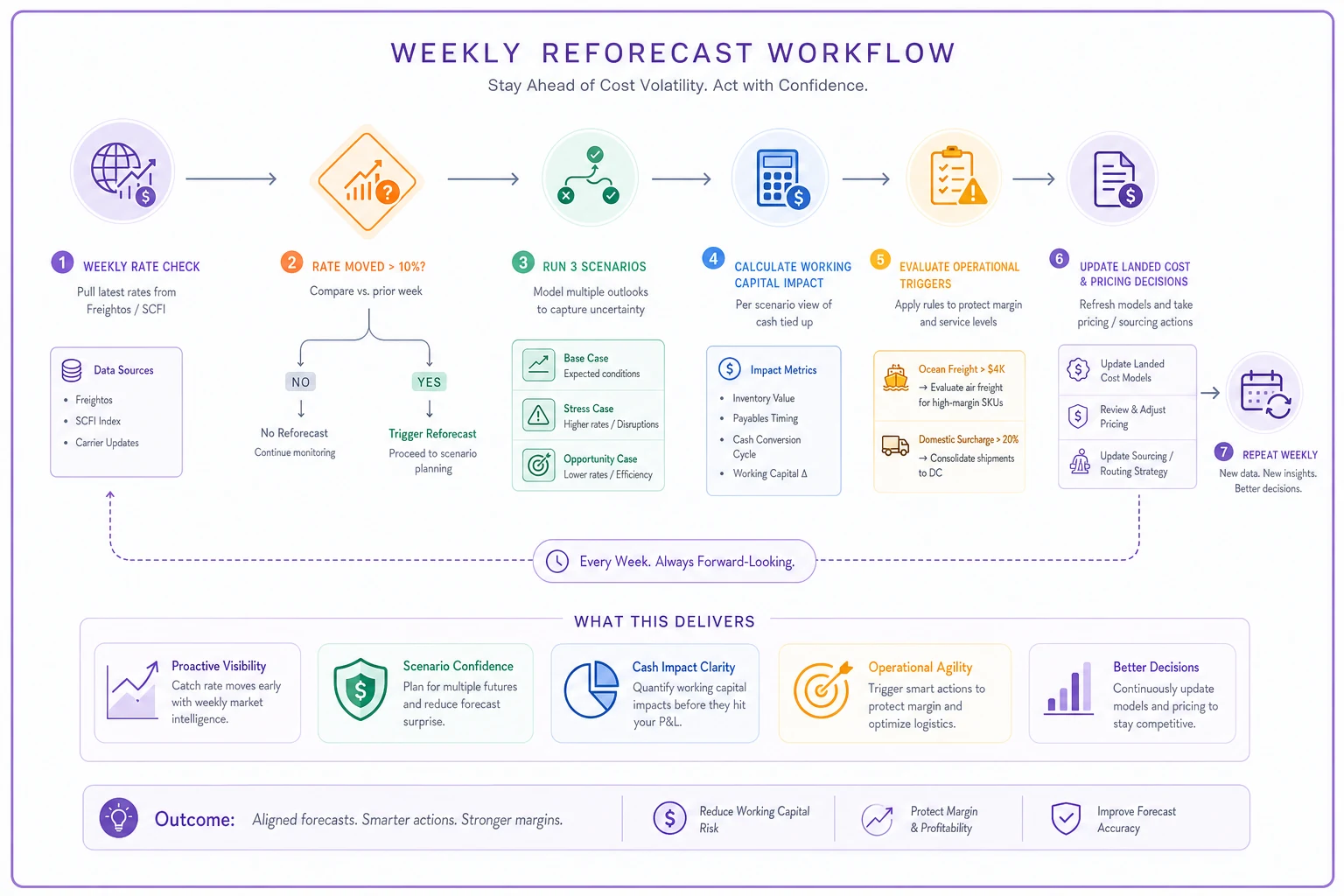
Use this cycle as your weekly routine to surface cost changes and act before they compound.
Immediate moves to protect margins during the current surge
Stop treating shipping as a pass-through cost. At this point it's your biggest variable expense after product cost, and it needs active management.
Audit every shipment in transit right now. Which ones can you consolidate? Which products have enough margin to absorb the surcharges, and which ones need a price increase? Don't wait for the landed cost calculation—make these calls now.
Audit shipments in transit now to identify consolidation opportunities and quick wins.
Renegotiate payment terms with suppliers. Every extra day of credit is worth roughly 0.02% of the invoice value at current interest rates. On $500,000 of purchases, stretching terms from net-30 to net-45 saves around $1,500 in carrying costs. Not life-changing, but it's real money you're leaving on the table otherwise.
Split your holiday orders. Instead of one massive September shipment, break it into three smaller ones across July, August, and September. You'll pay higher unit freight costs on each, but you get flexibility if rates drop or demand shifts.
Lock in Q4 domestic shipping rates now. FedEx and UPS offer contract rates that protect against surcharges. The commitment feels risky, but protection against 30% surcharges in November makes it worth it.
The technology stack that turns chaos into visibility
Manual tracking breaks down completely when every cost component fluctuates weekly. Spreadsheets can't keep pace with rate changes, surcharge updates, and currency movements all happening at once.
Modern operational software can pull freight rates directly from carrier APIs. When Maersk updates their rates or FedEx announces new surcharges, your cost models update automatically rather than showing up as a surprise in next month's invoice.
AI automation handles the pattern recognition that's easy to miss manually—things like noticing your Shanghai supplier consistently ships three days late, and automatically padding lead times to account for it. Or identifying that splitting a shipment across two carriers saves 18% despite the added handling.
The real value comes from connecting these systems to financial planning. When freight costs spike, the platform recalculates landed costs, updates pricing models, and surfaces which SKUs need immediate price adjustments. That's the kind of operational visibility that used to require a dedicated logistics analyst on payroll.
Beyond the current surge: building import operations that hold up
This shipping surge will probably settle down by October once holiday goods finish moving. But another disruption is always coming—port strikes, canal blockages, trade policy changes. The businesses that handle these well aren't just better at surviving shocks. They've built operations that adapt faster than everyone else.
Diversify your supplier base geographically. Having everything sourced from China made sense at 2019 freight rates. At current rates, Mexico or Vietnam sourcing might deliver better total landed cost even if unit prices are slightly higher.
Build inventory buffers where they matter. Not everything needs safety stock. Focus buffer inventory on your highest-margin, most predictable SKUs. Let the long-tail products run leaner and accept occasional stockouts rather than tying up capital across the board.
Think about how your products actually ship. A furniture importer saved around 30% on shipping by redesigning products to pack flat in standard container dimensions. Assembly cost at destination was a fraction of what they saved on freight.
Partner with other small importers for container consolidation. Three businesses shipping partial containers can share a full container and each save 20–35%. The coordination takes some effort, but it's worth it during surge periods.
The bottom line on navigating shipping volatility
Shipping surcharges and capacity crunches aren't temporary inconveniences anymore. They're recurring features of global trade that directly compress small business margins.
The companies navigating this well share a few things in common: they track shipping costs as closely as product costs, they reforecast regularly instead of annually, and they've taken the manual grunt work out of cost tracking and scenario modeling.
Quarterly budget reviews and manual spreadsheets can't keep pace with weekly rate swings and daily surcharge updates. The operational habits that worked in stable markets become a liability when every cost component is moving at once.
The importers who come out of this ahead won't be the ones who predicted the surge. They'll be the ones who built systems flexible enough to adapt while everyone else was still updating their spreadsheets.
The importers who come out of this ahead won't be the ones who predicted the surge. They'll be the ones who built systems flexible enough to adapt while everyone else was still updating their spreadsheets.
Ready to master your business expenses?
Join 5,000+ businesses using Costyly to save time, reduce overspending, and improve financial visibility.