



Most intercompany messes don't start with a bad decision. They start with no decision. One entity pays the Zoom bill, the software renewals, the shared office lease, and the thinking is "we'll sort it out later." Later arrives as a VAT query, a withholding tax assessment, or an auditor asking why Entity B owes Entity A £140k with no paperwork behind it.
The tricky part isn't the accounting. It's that the same cash movement can be treated four completely different ways — and each one carries different tax, legal, and documentation consequences. Picking the wrong wrapper is where small groups quietly create liabilities.
This guide is about that choice. Not the journals (we've covered the mechanics and templates in our intercompany expense recharges guide for small groups), but the decision that comes before the journals: recharge, loan, formal invoice, or full transfer-pricing treatment.
The four mechanisms, and what actually separates them
The labels get used loosely, which is half the problem. Here's the practical distinction — not the textbook one.
| Mechanism | What it really is | Typical trigger | Main risk if misused |
|---|---|---|---|
| Expense recharge | Passing on a third-party cost at cost, no markup | One entity pays a shared bill others benefit from | VAT treatment, disguised service supply |
| Intercompany loan | A financing arrangement with repayment terms | One entity funds another's cash shortfall | Thin cap, deemed interest, withholding |
| Formal intercompany invoice | A genuine sale of goods/services between entities | One entity provides value (not just pays for it) | VAT, permanent establishment, pricing |
| Transfer pricing | Arm's-length pricing framework over any of the above | Cross-border, related-party transactions of substance | Documentation, adjustments, penalties |
The line people trip over most is between a recharge and an invoice. A recharge is "I paid your share of a thing we both use." An invoice is "I did something for you." If your UK entity employs the developers and your Irish entity gets the software built, that is not a recharge of salaries — that's a service, and it gets priced, invoiced, and potentially sits inside transfer pricing. Calling it a recharge to keep it simple is how groups accidentally understate taxable profit in one jurisdiction.
The second common confusion is treating a persistent balance as a recharge when it's really a loan. If Entity A keeps paying Entity B's costs and the balance only ever grows, there's no commercial recharge happening — there's financing. Tax authorities will recharacterise it, usually at the worst possible moment.
A decision path you can actually follow
Work through these in order. The first "yes" that fits usually gives you your answer.
Stop losing track of your business spending.
Costyly helps you record, monitor & control expenses—accurately and efficiently.
- Automated expense categorization
- Real-time budget tracking
- Detailed financial reports
No credit card required
-
Is one entity simply covering a shared third-party cost that others consume? Think shared SaaS seats, group insurance, a lease split across entities. → Recharge at cost. No markup unless local rules demand one. Keep the original invoice attached.
-
Is one entity actually performing work or providing something of value to another? Management services, IT support, R&D, use of IP. → Formal intercompany invoice, priced at arm's length. Cross-border, this triggers transfer-pricing attention.
-
Is the movement really about cash — one entity short, another funding it? No underlying service, just liquidity. → Intercompany loan with a written agreement, interest rate, and repayment terms.
-
Does the arrangement cross borders between related parties and have real substance? → Whatever wrapper you chose in 1–3, it now sits inside transfer-pricing rules. Document the pricing basis before year-end, not during the audit.
The flowchart below maps the same logic visually for the four common scenarios teams actually encounter.
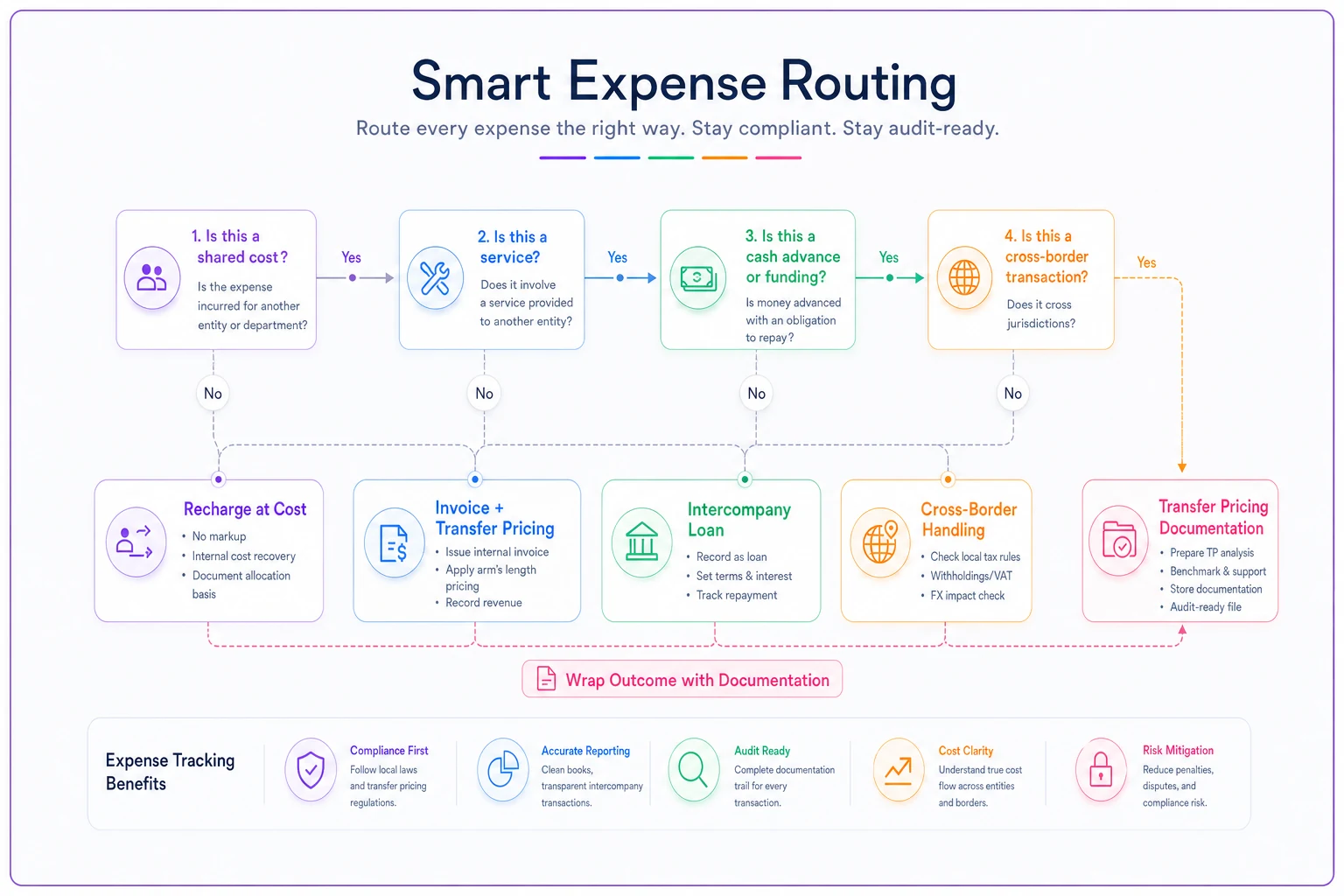
Refer to the flowchart when deciding the wrapper for each intercompany movement.
Where each scenario usually lands
Shared expenses (one bill, several beneficiaries). Recharge at cost. The thing people get wrong here isn't the method — it's the allocation key. "Split evenly across three entities" falls apart the moment one entity has 40 staff and another has 4. Pick a defensible driver (headcount, revenue, seats) and write it down once.
Cost pools (central function serving the group). A shared finance or IT team sitting in one entity isn't a pure recharge if it's actually doing work. It's closer to a service. Small groups often run this as a cost-plus arrangement — pool the costs, apply a modest markup, invoice out. Cross-border, this is squarely transfer-pricing territory.
Cross-border services. Formal invoice, priced at arm's length, with transfer-pricing support. This is the scenario that most often creates a permanent establishment risk when people from one entity are effectively operating inside another's jurisdiction.
Temporary cash needs. Loan. Even a 90-day bridge between entities should have a one-page agreement and a stated interest rate. "We'll charge zero because it's all one group" is exactly the position tax authorities love to challenge with deemed interest.
Jurisdictional red flags to check before you book anything
These are the four that generate the most unexpected bills in small cross-border groups.
-
VAT / GST. Recharges aren't automatically VAT-neutral. Whether you add VAT depends on whether it's a disbursement or a supply, and that depends on who contracted with the third party. Get this wrong and you either over-charge VAT or under-declare it.
-
Withholding tax. Interest on intercompany loans and certain service or royalty payments can attract withholding at source. A zero-interest loan doesn't dodge this — some jurisdictions impute interest anyway.
-
Permanent establishment (PE). If staff in one country are performing meaningful activity for an entity in another, you may have unintentionally created a taxable presence. Cross-border service invoices are the usual flag.
-
Transfer-pricing documentation. Even small groups below master-file thresholds often still need local contemporaneous support for the pricing method. The absence of a file is itself a penalty risk in many jurisdictions.
A pattern worth flagging: groups tend to set these arrangements up correctly on day one, then never revisit them. Two years later the business has changed shape — new entity, new country, different headcount — and the old recharge logic is now wrong. The arrangement didn't break. The business outgrew it.
A real scenario
A small group — a UK trading company and a newly opened Netherlands entity, maybe 18 people total — ran everything through the UK. The UK paid for the shared CRM, the group insurance, and seconded two staff to help the Dutch entity get going. Everything got dumped into one growing intercompany balance and recharged quarterly as a lump sum described as "shared costs."
The problem surfaced during the Dutch entity's first audit. Roughly €90k of the balance was genuine shared-cost recharges (fine). But about €55k was really the cost of two UK employees working for the Dutch business — a cross-border service, not a recharge. No invoice, no markup, no transfer-pricing rationale, and a PE question hanging over it because of where those people were actually working.
The fix wasn't dramatic. They split the single balance into three streams: recharges at cost with the original invoices attached, a properly documented service invoice with a modest cost-plus markup for the secondment, and a formal loan agreement for the net funding gap. The rework took a few weeks and some adviser fees — probably somewhere in the £4k–£6k range — but it closed the PE exposure and made the next two audits uneventful. Doing it upfront would have cost a fraction of that.
When to bring in specialists
You don't need a transfer-pricing adviser to split a Zoom bill. You almost certainly do when:
-
An arrangement crosses a border and involves services or IP, not just passed-through costs.
-
A balance has grown large or persistent enough to look like financing.
-
People from one entity are physically working in or for another jurisdiction (PE risk).
-
You're setting up a cost-plus or management-fee structure for the first time.
-
Any single intercompany stream is material to either entity's profit.
Involve legal for loan agreements and service contracts, tax for VAT and withholding, and a transfer-pricing specialist the moment pricing between related parties becomes a question rather than a formality. The cost of a short upfront review is almost always smaller than unwinding a mischaracterised arrangement later.
One-page policy checklist for finance/treasury
Keep this where whoever books intercompany entries can see it.
-
[ ] Every intercompany movement is classified as recharge, invoice, or loan before it's booked — never "sort out later."
-
[ ] Recharges keep the original third-party invoice attached and state the allocation key used.
-
[ ] Any arrangement where one entity performs work is invoiced, not recharged.
-
[ ] Loans have a written agreement, a stated interest rate, and repayment terms — including short bridges.
-
[ ] Cross-border related-party transactions have a documented pricing basis filed before year-end.
-
[ ] VAT treatment (disbursement vs supply) is confirmed per arrangement type.
-
[ ] Withholding tax checked on interest, royalties, and service fees.
-
[ ] Secondments and cross-border staff activity reviewed for PE risk.
-
[ ] Each recurring arrangement is reviewed annually against the current shape of the business.
-
[ ] Specialist sign-off obtained for any new cost-plus, management-fee, or material cross-border structure.
For the journal entries, reconciliation steps, and templates behind these decisions, the companion intercompany expense recharges walkthrough covers the mechanics in detail.
The takeaway
The four mechanisms aren't interchangeable, and the cost of mixing them up tends to land quietly — in VAT queries, deemed interest, and PE questions that surface years later. The single most useful habit is deciding the wrapper before the cash moves and writing down why.
A recharge covers a shared cost. An invoice covers work done. A loan covers cash. Transfer pricing wraps around whichever of those crosses a border with substance. Get the classification right at the point of entry, review it once a year, and most of the expensive surprises never happen.
The four mechanisms aren't interchangeable, and the cost of mixing them up tends to land quietly — in VAT queries, deemed interest, and PE questions that surface years later. The single most useful habit is deciding the wrapper before the cash moves and writing down why.
A recharge covers a shared cost. An invoice covers work done. A loan covers cash. Transfer pricing wraps around whichever of those crosses a border with substance. Get the classification right at the point of entry, review it once a year, and most of the expensive surprises never happen.
Ready to master your business expenses?
Join 5,000+ businesses using Costyly to save time, reduce overspending, and improve financial visibility.