

Most small groups don't set out to have intercompany recharges. They happen by accident. One entity has the company card. One entity signs the office lease. Someone pays a shared software bill from whichever account had cash that week. Six months later you've got a tangle of costs sitting in the wrong legal entity, and your accountant is asking why Entity A is carrying £40k of expenses that clearly belong to Entity B.
If you run two or three related companies — a trading entity plus a holding company, a US LLC plus a UK Ltd, an operating business plus a property company — this is your reality. And the painful part isn't the concept. It's the mechanics: how you capture the original cost, how you link it to a recharge, what the invoice looks like, when settlement actually happens, and whether the journals net to zero across the group when your accountant reviews them.
This is a working recipe for intercompany expense recharge SMB setups sized for finance teams of roughly 5 to 200 people. Not a theory piece. Capture conventions, linked entries, invoice templates, settlement timelines, sample journals, and what a clean reconciliation snapshot actually looks like.
The specific failure this prevents
Here's the scenario that drives people to fix this properly.
A group has two entities: OpCo (the operating company that does the trading) and PropCo (holds the lease and some assets). OpCo's card pays for everything — the office internet, the shared Adobe and Microsoft licenses, the cleaner, the coffee supplier. Some of that genuinely belongs to PropCo, which also sublets desks to a third party.
For the first year nobody splits anything. Then the year-end accounts come around and the accountant flags that OpCo is overstating costs and understating profit, PropCo is understating costs, and the directors' loan accounts are a mess because cash moved between the companies with no paper trail. Now someone has to reconstruct twelve months of shared spend from bank statements and guess at splits.
What happens across a lot of these small groups is that the problem is almost never the splitting logic. It's that nobody decided, at the point of capture, which costs were rechargeable and to whom. The decision got deferred to month-end or year-end, and by then the context is gone.
Capture conventions: decide at the source, not at close
The single highest-leverage change is tagging a transaction as rechargeable when it's booked, not when you're trying to reconcile.
Stop losing track of your business spending.
Costyly helps you record, monitor & control expenses—accurately and efficiently.
- Automated expense categorization
- Real-time budget tracking
- Detailed financial reports
No credit card required
A workable convention for a small group looks like this. Every expense gets three pieces of metadata at capture:
-
- Paying entity — which company's bank or card actually paid
-
- Benefiting entity — which company (or companies) the cost actually belongs to
-
- Recharge flag — a simple yes/no, plus a split basis if it's shared
When paying entity = benefiting entity, there's nothing to do. When they differ, you've just created a future recharge, and you've captured it at the moment you still remember why.
A typical tagging scheme that holds up:
| Field | Example value | Why it matters |
|---|---|---|
| Paying entity | OpCo | Drives the AR side of the recharge |
| Benefiting entity | PropCo | Drives the AP side |
| Recharge basis | Direct / Headcount / Floor area / Revenue | Documents how a shared cost was split |
| Recharge reference | IC-2024-031 | Links cost, invoice and journal together |
| Markup applicable | No | Transfer-pricing relevant for cross-border |
That recharge reference is the spine of the whole system. Every rechargeable cost, the invoice that recovers it, and the journals on both sides all carry the same reference. When your accountant pulls IC-2024-031, they should see the original invoice, the split calc, the recharge invoice, and the two mirrored journal entries. No archaeology.
Make the recharge reference a required field at booking so the trail exists before you need it.
If you're already allocating shared costs internally, the logic here is a close cousin — the difference is that a recharge crosses a legal entity boundary, so it needs an actual invoice, not just a cost-center split. The mechanics of fair splitting are worth borrowing from a proper approach to allocating shared expenses without spreadsheets, because the split basis you pick (headcount, floor area, revenue) has to survive scrutiny.
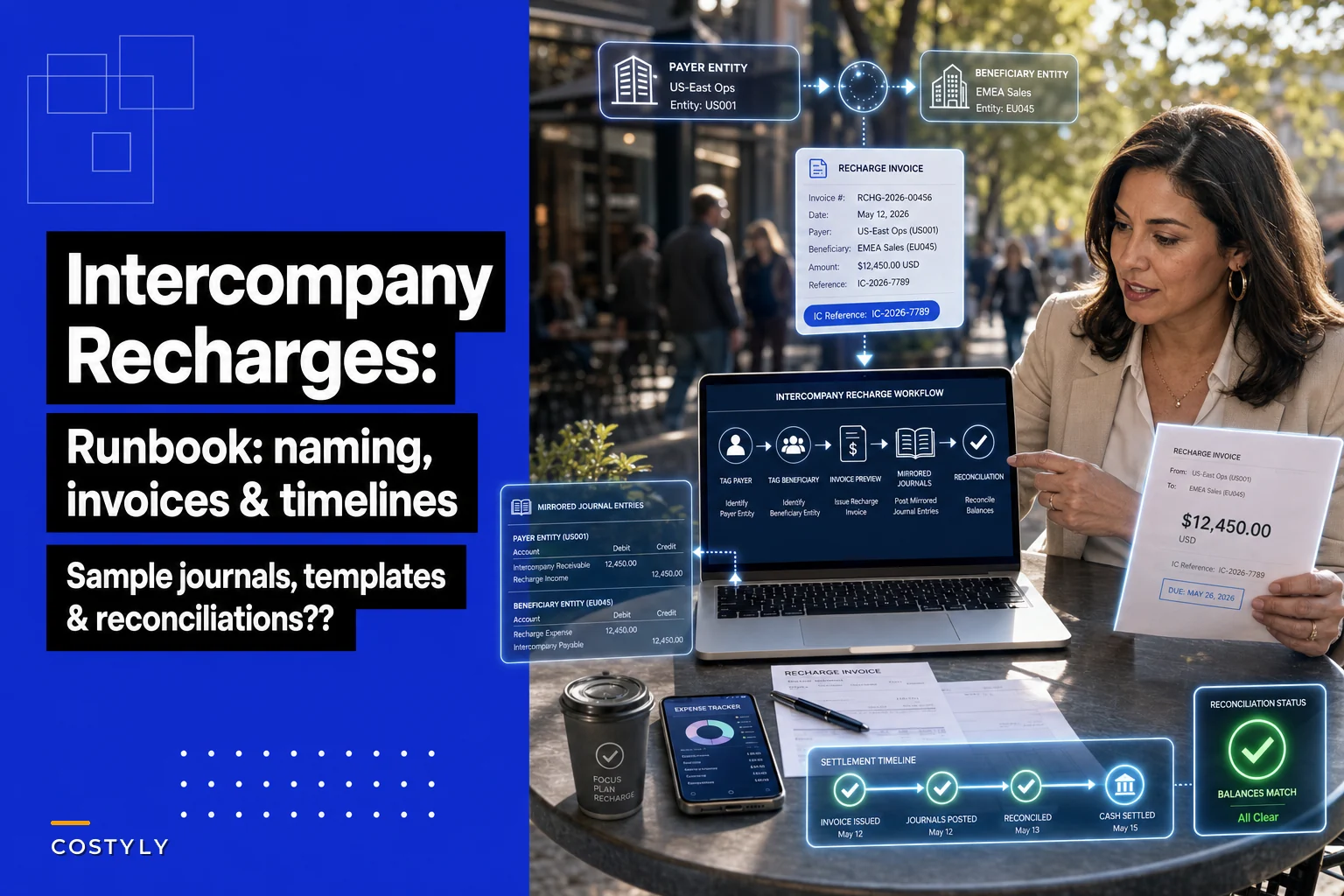
This diagram shows the flow from capture to invoice, journals, and reconciliation.
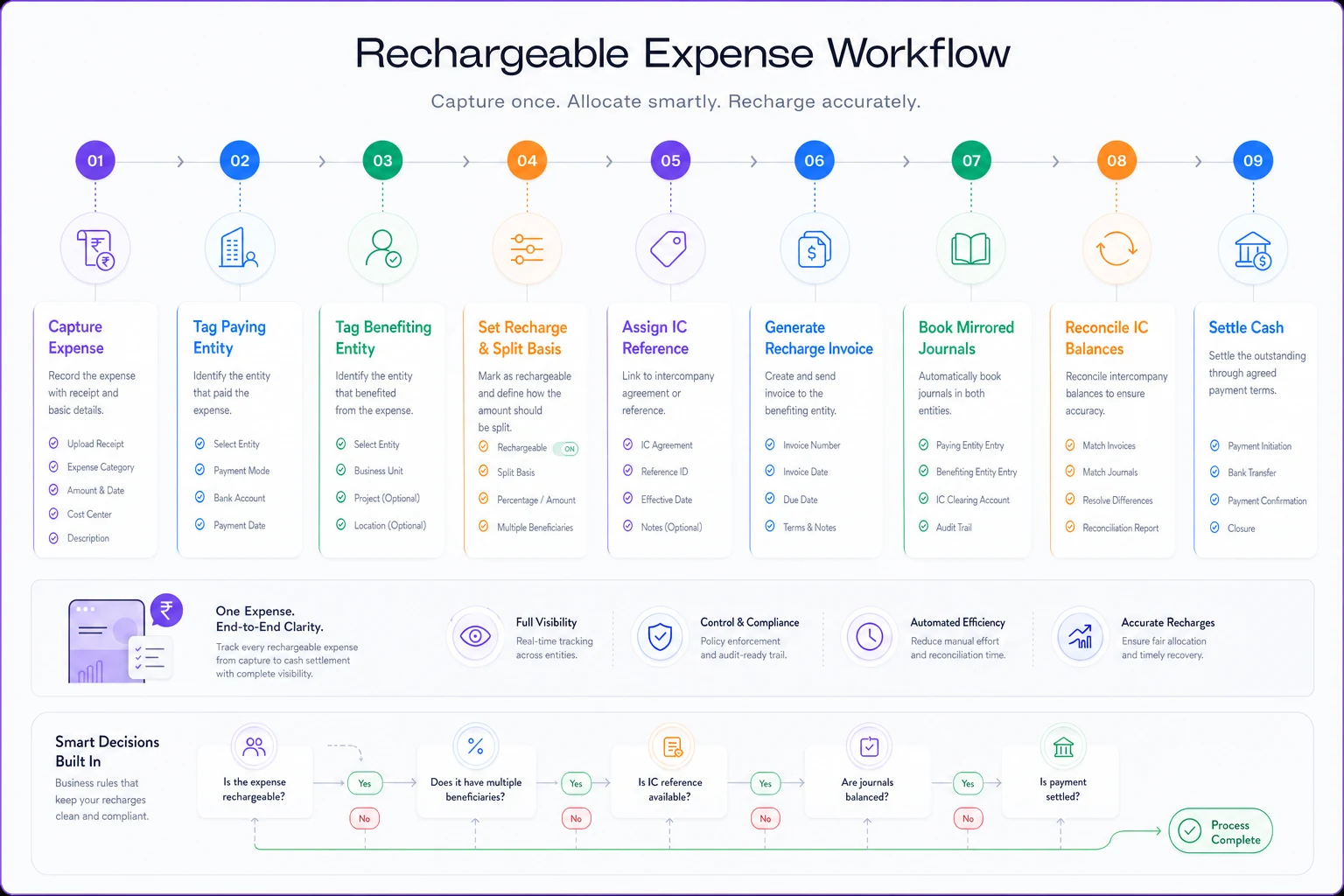
When your system carries the IC reference through every step, the ledger entries and supporting documents all link cleanly.
Linked cost entries: how the two sides tie together
What makes intercompany clean or messy is whether the two entities' books are mirror images for each transaction.
Say OpCo pays a £1,200 annual software bill, and half genuinely belongs to PropCo. The capture convention flags £600 as rechargeable to PropCo under basis "Direct, 50% shared license."
In OpCo's books, the full £1,200 hits the expense account on payment. But £600 of that needs to come back out and land as an intercompany receivable. In PropCo's books, that £600 needs to appear as a cost and an intercompany payable.
OpCo — original payment:
``
Dr  Software expense           1,200.00
    Cr  Bank                           1,200.00
``
OpCo — recharge raised (IC-2024-031):
``
Dr  Intercompany receivable - PropCo    600.00
    Cr  Software expense recovery             600.00
``
PropCo — recharge received (IC-2024-031):
``
Dr  Software expense                     600.00
    Cr  Intercompany payable - OpCo           600.00
``
Notice OpCo's net software cost is now £600, not £1,200 — the recovery line nets against the original expense rather than booking as revenue. That keeps OpCo's P&L honest. If you want the recharge to show as income — common when one entity is a shared-services hub — you'd credit intercompany income instead. Pick one and be consistent, because mixing the two makes the group P&L unreadable.
The check that matters: the intercompany receivable on OpCo must equal the intercompany payable on PropCo at all times. If those two balances ever diverge, you have an unrecorded or duplicated recharge. More on catching that in the reconciliation section.
The recharge invoice template
Even for a two-company group, raise an actual invoice. It's tempting to just move the numbers with a journal, but an invoice gives you a document the other entity can book against, VAT treatment lands correctly, and if a tax authority ever asks, you have evidence the transaction was commercial.
-
1. Issuing entity details — full legal name, registration number, VAT number
-
2. Receiving entity details — same, in full
-
3. Recharge reference — the IC- number that ties to the underlying costs
-
4. Line-level breakdown — not "Shared costs £3,400" but each cost category, the gross amount, the split basis, and the recharged portion
-
5. Supporting cost schedule — attached, listing the original supplier invoices behind each line
-
6. VAT treatment — stated explicitly, especially if entities are in different jurisdictions or VAT groups
-
7. Markup line — separate and visible if you're applying one for transfer-pricing reasons
-
8. Payment terms — the settlement window, even for internal counterparties
The line-level breakdown is where most small groups cut corners and regret it. A recharge invoice that says "Management recharge — £8,500" tells an auditor nothing and tells your future self even less. One that itemizes:
``
Office rent (floor area 40%)         3,200.00
IT licenses (direct, shared seats)     900.00
Cleaning (floor area 40%)              480.00
Shared bookkeeping (headcount 35%)     420.00
                              Subtotal 5,000.00
VAT @ 20%                             1,000.00
                                 Total 6,000.00
``
...is defensible, reproducible, and reconcilable. Keep the VAT treatment deliberate — getting the reclaim side wrong on intercompany is a quietly expensive mistake, and the same discipline you'd apply to VAT-aware tagging on normal expenses applies here with extra force because errors get multiplied across two sets of books.
Settlement timelines: decide when cash actually moves
There's a split that trips up a lot of small groups: the accounting recharge and the cash settlement are two different events, and conflating them causes problems.
You can book the recharge monthly — so the P&Ls are always right — while settling cash quarterly, so you're not making tiny transfers every month. What you can't do is leave the intercompany balances to grow indefinitely with no settlement. That's how you end up with a £60k intercompany balance that looks like an undocumented loan and attracts awkward questions.
A sensible cadence for a 5–200 person group:
| Activity | Frequency | Owner |
|---|---|---|
| Tag rechargeable costs | At capture | Whoever books the expense |
| Raise recharge invoices | Monthly, with close | Finance / bookkeeper |
| Book mirrored journals | Monthly | Finance |
| Reconcile IC balances | Monthly | Finance lead |
| Settle cash between entities | Quarterly | Finance lead + director sign-off |
| Confirm balances net to zero | Quarterly | Finance lead |
The quarterly cash settlement keeps the intercompany receivable/payable from drifting into "is this a loan?" territory. If a balance does need to persist as genuine funding, that's fine — but it should be a documented loan with terms, not an accidental build-up of unsettled recharges.
A reconciliation snapshot that actually proves it's right
The reconciliation isn't a chore you do if you have time. It's the thing that proves the whole system works. And for intercompany, the test is simple: the sum of all intercompany balances across the group should be zero.
Every pound OpCo is owed by PropCo is a pound PropCo owes OpCo. If the group consolidates and intercompany doesn't net to zero, you have an error — full stop.
A monthly reconciliation snapshot for the two-entity group looks like this:
``
INTERCOMPANY RECONCILIATION — March 2024

OpCo books:
  IC receivable - PropCo          12,400.00
  IC payable - PropCo               (800.00)
  Net OpCo position               11,600.00

PropCo books:
  IC payable - OpCo              (12,400.00)
  IC receivable - OpCo               800.00
  Net PropCo position           (11,600.00)

GROUP NET                              0.00   ✓

Open recharge references:
  IC-2024-029  Feb rent recharge    raised, unsettled
  IC-2024-031  Feb IT recharge      raised, unsettled
  IC-2024-033  Mar shared services  raised, unsettled
``
When that GROUP NET line isn't zero, the open-references list is where you hunt. The usual culprits:
-
- A recharge raised in one entity but not yet booked in the other (timing)
-
- A recharge booked twice on one side
-
- A split calc that was revised after the invoice went out but only updated in one set of books
-
- FX movement on a cross-border recharge booked at different rates on each side
That last one deserves a flag: if your entities report in different currencies, the recharge will be booked in each entity's functional currency, and rate differences mean the two sides won't tie to the penny. You handle this by designating one currency as the recharge currency, agreeing the rate used, and parking the FX difference in a dedicated account rather than letting it corrupt the intercompany balance.
A real scenario
A small design-and-build group ran two companies: a trading entity that invoiced clients, and a property entity holding the studio lease and subletting a corner to a freelancer collective. The trading entity paid for everything — rent, utilities, the full software stack, a part-time bookkeeper.
Before fixing capture, the split happened once a year at accounts time. The accountant spent the better part of two days reconstructing roughly £54k of shared costs from bank statements, guessing floor-area splits, and unwinding cash transfers that had no references. The accounts were filed late two years running, and the directors' loan accounts needed restating because unsettled recharges had been mistaken for drawings.
They moved to capture-time tagging and monthly recharge invoices. Each rechargeable cost got a paying entity, benefiting entity, basis, and an IC reference at the point of entry. Recharge invoices went out with close; cash settled quarterly.
The year-end reconstruction dropped from about two days to roughly an hour of review, because the IC references already linked every cost to its invoice and journals. The intercompany balance netted to zero every month. And the directors' loan accounts stopped being a surprise — because real funding was now a documented loan, separate from the recharge flow.
Not a dramatic transformation. Just a group that stopped losing days of work and started filing on time.
When this makes sense — and when it doesn't
This full recipe makes sense when:
-
- You have two or more related legal entities sharing real costs
-
- One entity routinely pays for things that benefit another
-
- You consolidate accounts, or your accountant does
-
- You've had a year-end where intercompany was a scramble
This is overkill when:
-
- You have a single legal entity with multiple cost centers — that's internal allocation, not intercompany, and you don't need invoices crossing a boundary
-
- Shared costs are genuinely trivial and infrequent (a one-off £200 split can be a single documented journal)
Who should be careful: cross-border groups. Once entities sit in different tax jurisdictions, recharges touch transfer pricing, VAT place-of-supply, and withholding rules. The capture and reconciliation mechanics here still hold, but the markup and VAT treatment lines need a tax adviser's input rather than a default guess. Getting the split right internally is one thing; getting it right across a border is a different conversation.
Where tooling earns its place
None of this requires fancy software to start — a disciplined spreadsheet with locked conventions beats a sophisticated system nobody follows. But the manual version breaks down around two specific points: capturing the paying/benefiting entity reliably at source, and keeping the mirrored journals in sync across two sets of books.
That's where an operational expense platform with AI-assisted tagging genuinely helps. When the system can read an incoming invoice, suggest the benefiting entity based on the supplier and cost pattern, auto-attach the IC reference, and flag when a recharge raised in one entity hasn't yet been booked in the other, the reconciliation stops being a monthly hunt. The split logic for shared costs is close enough to internal allocation that the same rule engine handles both — the difference is just whether the output is a cost-center tag or a cross-entity invoice. And when categories map cleanly to each entity's chart of accounts, the journals land in the right place without manual re-keying; getting that mapping between expense categories and your chart of accounts right upfront removes a surprising amount of month-end friction.
The point isn't to automate for its own sake. Intercompany errors compound — a wrong split or a one-sided journal sits quietly until year-end and then costs days to unwind. Catching the mismatch the same week it happens is worth far more than catching it twelve months later.
Closing thought
Intercompany recharges aren't complicated once the decision moves to the right moment. The whole thing hinges on tagging the paying and benefiting entity at capture, carrying a single reference through cost, invoice, and journals, settling cash on a real cadence, and proving the group nets to zero every month. The groups that struggle aren't the ones with complex structures — they're the ones deferring the decision to a reconciliation that happens too late to remember the answer.
If you're also charging costs onward to clients rather than just between your own entities, the same audit-trail discipline applies, and it's worth reading alongside a proper client-billable expense workflow so you're not running two incompatible systems for essentially the same problem.
Intercompany recharges aren't complicated once the decision moves to the right moment. The whole thing hinges on tagging the paying and benefiting entity at capture, carrying a single reference through cost, invoice, and journals, settling cash on a real cadence, and proving the group nets to zero every month. The groups that struggle aren't the ones with complex structures — they're the ones deferring the decision to a reconciliation that happens too late to remember the answer.
If you're also charging costs onward to clients rather than just between your own entities, the same audit-trail discipline applies, and it's worth reading alongside a proper client-billable expense workflow so you're not running two incompatible systems for essentially the same problem.
Ready to master your business expenses?
Join 5,000+ businesses using Costyly to save time, reduce overspending, and improve financial visibility.