

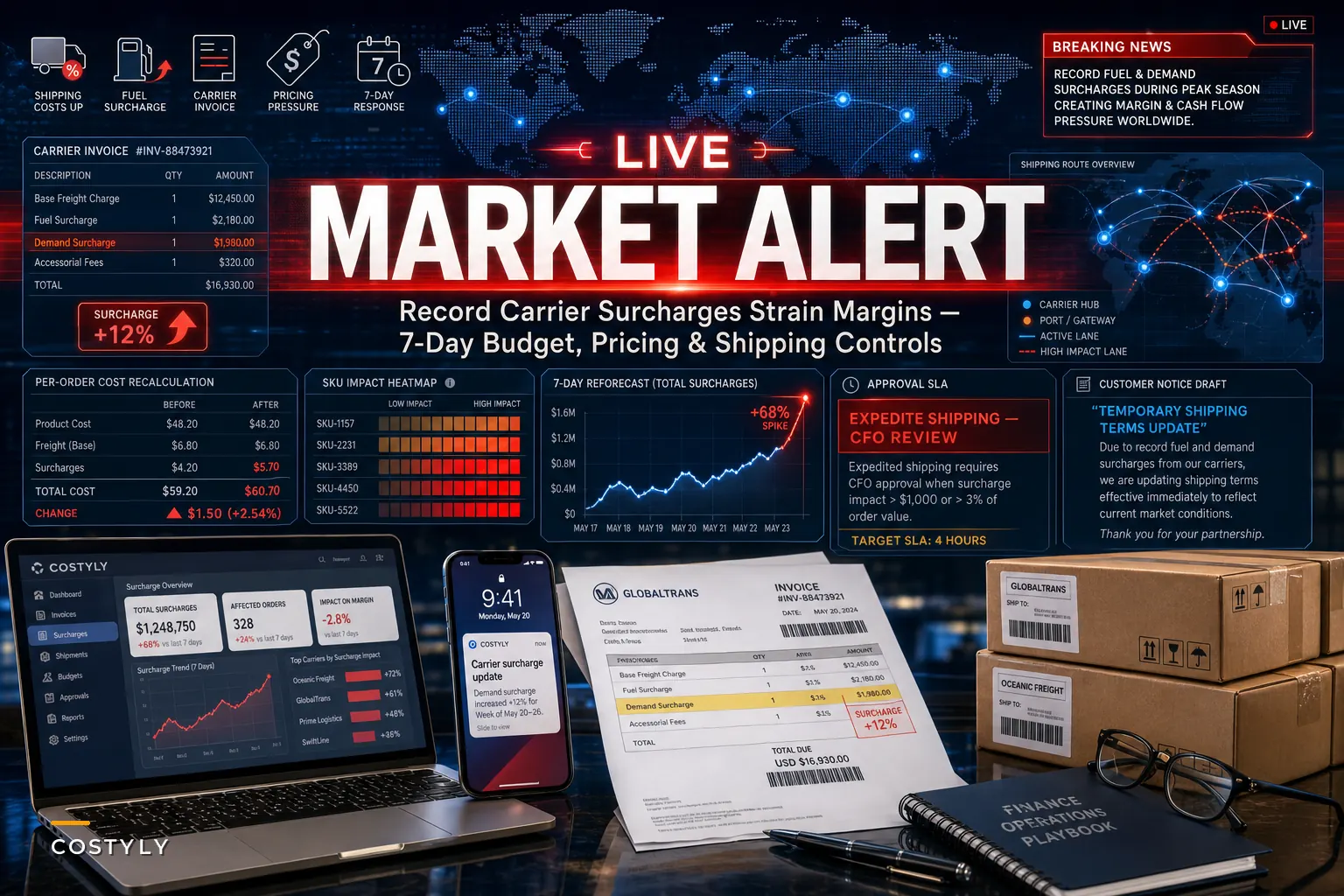

Diesel moved, and the carriers moved faster. Both UPS and FedEx have pushed fuel and demand surcharges to multi-year highs heading into the holiday stretch — UPS hovering around 29.5%, FedEx near 29%. Reuters reported on October 26 that costlier diesel is driving the spike, and the timing couldn't be worse. It lands exactly when small retailers are locking Q4 inventory and committing to Black Friday promises.
If you've already built your holiday budget, parts of it just quietly broke. The surcharge is a percentage riding on top of base rates, so it compounds against everything you ship. And unlike a base-rate increase that comes with a fixed annual schedule, fuel surcharges reset weekly. That weekly reset is what most small teams aren't set up to handle — and it's where margins leak without anyone noticing until month-end.
This isn't a "rebuild your whole model" situation. It's a "fix a few specific controls fast" situation.
The real problem isn't the surcharge — it's that it moves faster than your pricing
A base-rate hike is mentally easy to absorb. You get a notice, update a spreadsheet, move on. The surcharge is different because it's a floating number published weekly. UPS updates its fuel surcharge table every Monday, and FedEx runs its own demand surcharge schedule that shifts during peak weeks.
The mismatch looks like this: your free-shipping threshold, your flat-rate shipping price, and your product margins were all set against an assumption — something like "shipping costs us roughly 12% of order value." When the surcharge jumps from the mid-teens to nearly 30%, that assumption goes stale within a week. But your checkout page doesn't know that. You keep selling at old economics while paying new ones.
What you see across a lot of small shippers is that nobody actually owns the surcharge number. The warehouse person sees the invoice. Finance sees the monthly total. The person who sets shipping prices on the website sees neither until the P&L comes in. That gap — not the surcharge itself — is what turns a 10-point rate move into a surprise loss.
Where the money actually leaks
The damage shows up in a few predictable places, and they're not always obvious.
Stop losing track of your business spending.
Costyly helps you record, monitor & control expenses—accurately and efficiently.
- Automated expense categorization
- Real-time budget tracking
- Detailed financial reports
No credit card required
-
Free-shipping thresholds that no longer cover cost. If you offer free shipping over $50 and your average package now costs $9–$11 to deliver instead of $6–$7, every threshold order is eating more margin than planned.
-
Flat-rate shipping prices. Charging a flat $7.95 when fulfillment runs north of $10 means you're subsidizing every order — and volume makes it worse, not better.
-
Expedited and overnight approvals. This is the sneaky one. Rush shipping carries both the base premium and the surcharge, so a single approved overnight order during peak can cost 2–3x what the approver assumes.
-
Blended shipping assumptions in your forecast. If your reforecast uses one average shipping cost across all zones and weights, a surcharge spike distorts it unevenly — far zones and heavy items get hit hardest.
-
Dimensional weight interactions. Surcharges apply to billed weight, which for bulky-but-light items is the dim weight, not actual. A high surcharge on an inflated weight is a double penalty.
A quick gut check: pull your last two weeks of carrier invoices and divide total surcharge lines by total shipments. If that per-package surcharge number is higher than the shipping margin baked into your average order, you're losing money on a chunk of your volume right now.
A fast triage before you touch pricing
Before changing a single customer-facing number, get visibility. Repricing on bad data just moves the problem.
-
Isolate the surcharge line. On carrier invoices the fuel and demand surcharge is a separate line. Make sure it's being captured as its own expense tag, not lumped into "shipping." You can't manage what's hidden inside a blended total.
-
Recalculate your true per-order fulfillment cost. Base rate + surcharge + packaging + any accessorial fees (residential, additional handling, peak surcharges). This is your real number.
-
Segment by zone and weight. Pull cost by shipping zone and weight band. The surcharge hurts unevenly, and you'll usually find 20–30% of SKUs or destinations are driving most of the overage.
-
Compare against your thresholds and flat rates. Line up true cost next to what customers actually pay. Flag everything where cost exceeds collected shipping revenue.
-
Check your expedited volume. How many rush orders went out last week, and what did they actually cost loaded with surcharge? This number tends to surprise people.
This whole pass should take an afternoon, not a week. The point is to stop guessing and see exactly which orders are underwater.
The surcharge-response lever table
Once you can see the leak, you've got a handful of levers to pull. None are universally right — they depend on your margins and how price-sensitive your customers are.
| Lever | Best when | Watch out for | Speed to implement |
|---|---|---|---|
| Raise free-shipping threshold | Current threshold barely cleared cost even before the spike | Can dent conversion if raised too aggressively | Same day |
| Adjust flat-rate shipping price | You charge flat and it's clearly below true cost | Customers notice flat-rate changes fast | 1–2 days |
| Absorb into product price | Shipping is a visible friction point at checkout | Spreads cost to pickup/local buyers too | 2–5 days |
| Zone-based / calculated rates | Wide spread between near and far zones | More complex checkout experience | 3–7 days |
| Tighten expedited approvals | Rush orders are a meaningful share of volume | Needs a clear SLA so it doesn't slow legit orders | Same day |
| Renegotiate carrier / add regional carrier | Volume is high enough to have leverage | Takes weeks; not a peak-season fix | Slow |
The mistake is picking one lever and applying it everywhere. In practice the right answer is usually a mix — raise the threshold slightly, bump the flat rate a bit, tighten expedited approvals — spreading the adjustment so no single change spooks customers.
A real scenario
A small home-goods shop doing roughly 1,400–1,600 orders a month, mostly mid-weight items shipped nationally. Their model assumed shipping ran about 11% of order value, and they offered free shipping over $45.
When the surcharge climbed into the high-20s, their real per-order fulfillment cost moved from around $7.20 to just over $10 on average — worse on heavier bakeware SKUs shipping to the West Coast. Nobody caught it for about three weeks because the shipping line on the P&L only updates monthly. The quiet bleed came out to somewhere around $3,800–$4,500 in unplanned shipping cost over that window.
Their fix wasn't dramatic. They raised the free-shipping threshold from $45 to $59, added a modest calculated-rate surcharge for the two heaviest SKU categories going to distant zones, and put a same-day approval requirement on overnight orders above a small dollar limit. Conversion dipped slightly, but the margin recovery more than covered it. The bigger win was simply seeing the surcharge number weekly instead of monthly — once it had an owner and a dashboard, the surprises stopped.
When to absorb and when to pass it through
Not every surcharge increase should hit the customer. Pushing all of it onto buyers right before the holidays can tank conversion at the worst possible time.
Absorbing makes sense when:
-
Your margins are healthy enough to eat a few points temporarily
-
You're in a competitive category where a shipping-price change would cost you sales
-
The spike looks short-term and tied to seasonal peak pricing that'll ease in January
Passing it through makes sense when:
-
Shipping is already a thin-margin or break-even part of your model
-
Your customers aren't especially price-sensitive on shipping
-
The increase is large enough that absorbing it would push products into the red
Who should not reprice right now: if you haven't isolated the real per-order cost yet, don't touch customer-facing numbers. Repricing on a blended guess usually overcorrects on some SKUs and undercorrects on others — you end up losing on both ends.
Tighten the expedited-shipping gap specifically
Of all the controls, expedited approvals give the fastest payback and get ignored the most. During peak, an overnight or two-day upgrade carries the surcharge on top of an already-premium rate. One approved rush shipment can quietly cost what three standard orders bring in.
A simple control: require a quick second approval on any expedited shipment above a set dollar threshold, tied to an SLA so it doesn't slow down legitimate urgent orders. The goal isn't to block rush shipping — it's to make sure someone consciously decides the cost is worth it, instead of the upgrade getting rubber-stamped by default.
Require approvers to include a brief reason code when authorizing expedited shipments.
Tagging matters here too. If your expense workflow tags expedited shipments distinctly, you can watch that number weekly and catch creep before it compounds. Lumping it into general shipping hides exactly the spend you most need to see.
Build the weekly loop so this doesn't ambush you again
The deeper fix is operational rhythm. The surcharge resets weekly, so your visibility needs to match — not monthly, when it's already baked into the P&L.
A lightweight loop works like this: someone owns pulling the current surcharge rate each week, your expense data tags surcharge lines separately so they roll up on their own, and a short reforecast adjusts shipping assumptions whenever the rate moves meaningfully. The sequence below captures how that flow typically runs from invoice receipt to reforecast decision:
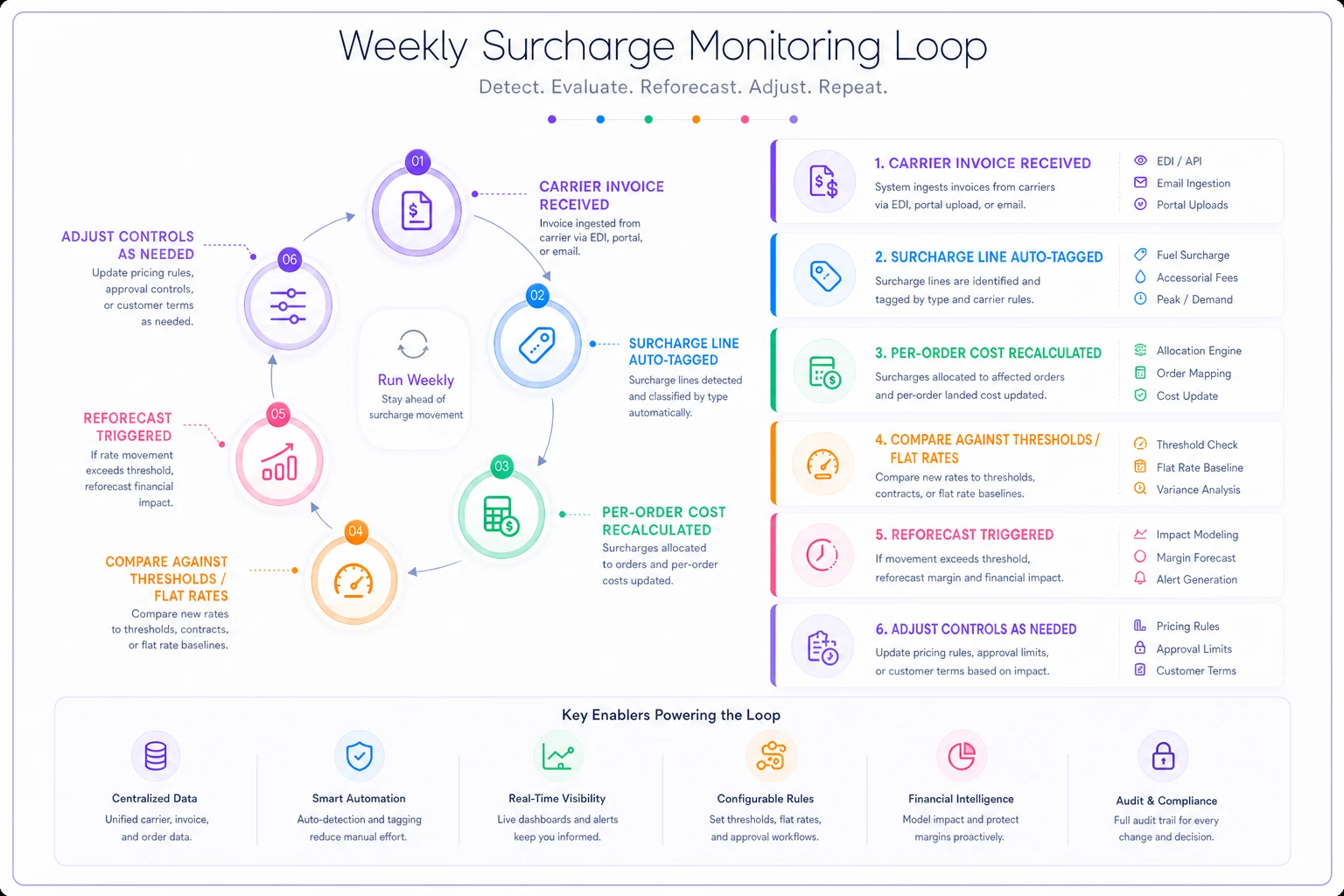
This is where AI-assisted expense tagging and automated categorization actually earn their keep — when surcharge lines get recognized and tagged the moment invoices land, finance sees the trend building instead of discovering it three weeks late. The automation isn't the point; the early visibility it creates is. Without that rhythm, you're always reacting to last month's numbers while paying this week's rates.
If you want the structured version of this — a full step-by-step on rebuilding shipping and budget assumptions when carrier costs jump — the 7-step reforecast playbook for rising carrier surcharges walks through the full rebuild. This post is the fast-response version; that one is for when you need to redo the whole model.
The short version
The surcharge spike is out of your control. How fast you see it and how precisely you respond isn't.
The businesses that get hurt aren't the ones paying 29% surcharges — everyone's paying those. They're the ones still selling against 15% assumptions three weeks into the increase.
Isolate the surcharge line, find your true per-order cost, fix the few places where price no longer covers cost, and put a weekly eye on expedited spend.
Do those four things this week and you'll protect most of the margin that would otherwise disappear quietly between now and January.
Ready to master your business expenses?
Join 5,000+ businesses using Costyly to save time, reduce overspending, and improve financial visibility.