

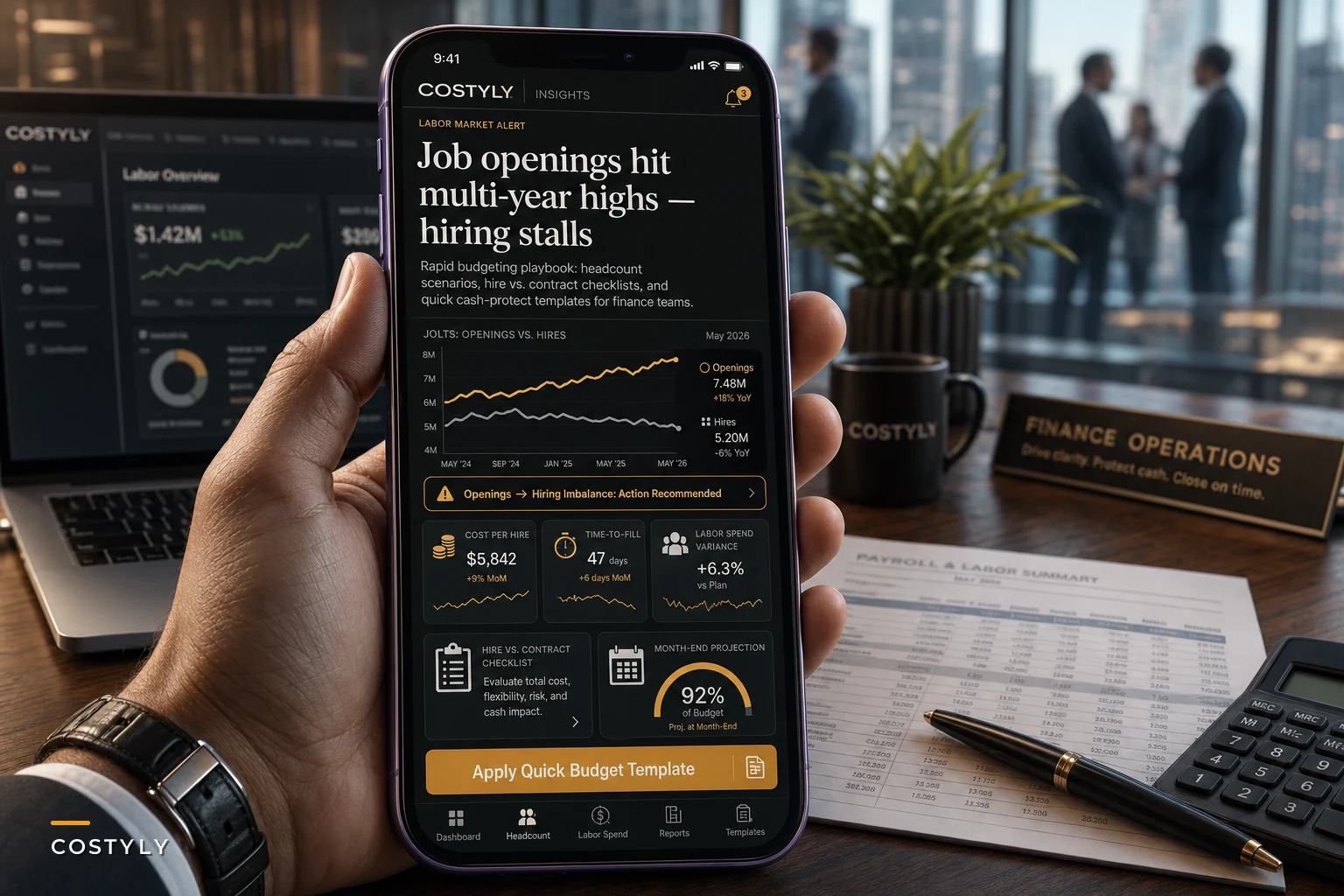

Something weird happened in April that's probably affecting your labor budgets. Job openings jumped to 7.6 million — the highest level in nearly two years according to CNBC — but actual hiring barely moved. Your competitors are posting jobs everywhere, candidates are getting pickier, and you're stuck trying to figure out if that means you need to bump salaries or if everyone's just window shopping.
This disconnect hits small businesses hardest because you can't throw money at the problem like bigger companies. When the labor market sends mixed signals like this, your monthly payroll forecasts become guesswork. One month you're planning for three new hires, the next month those positions are still open and you're scrambling to redistribute work or bring in contractors at premium rates.
Your labor cost forecasting just went from straightforward math to a moving target. Those clean projections you made in January? Already obsolete. And if you're still using last year's assumptions about hiring timelines and wage rates, you're probably underestimating costs by 15-20%.
Why traditional labor budgeting breaks when markets get choppy
Most small businesses build labor budgets using a simple formula: expected headcount times average salary plus benefits. Works great when markets are stable. Falls apart completely when positions stay open for 3-4 months instead of the usual 4-6 weeks.
Take a typical scenario — you run a home services company with 18 employees. You budget to hire two more technicians in Q2 at roughly $52k each. Simple enough. But when those positions stay open an extra eight weeks, you're suddenly paying $3,800 weekly in overtime to existing staff, plus another $2,400 to temp agencies for coverage. That's an extra $49,600 in unplanned labor costs for just two positions.
The bigger problem is that most businesses don't catch this drift until it shows up in month-end financials. By then, you've already blown through your quarterly labor budget and have no idea if next month will be better or worse.
Extended vacancies lead to burnout in existing staff. Burnout leads to turnover. Turnover creates more vacancies. Each cycle pushes your actual labor costs further from your original forecast. A manufacturing client watched their labor costs spike 34% over budget simply because three key positions stayed open for four months, creating a cascade of overtime and emergency contractor costs.
The hidden multiplier effect of vacant positions
A vacant position doesn't just cost you the missing productivity — it creates expense ripples throughout your operation that most budgeting systems completely miss.
Stop losing track of your business spending.
Costyly helps you record, monitor & control expenses—accurately and efficiently.
- Automated expense categorization
- Real-time budget tracking
- Detailed financial reports
No credit card required
When that warehouse supervisor position sits empty for three months, you're paying assistant managers overtime to cover shifts. But you're also seeing error rates climb because temporary coverage means less experienced oversight. Those errors translate to returns, rework, and customer credits that show up in completely different budget lines.
Then there's the recruiting cost creep. First month, you're just posting on job boards. By month two, you've engaged a recruiter at 20% of first-year salary. Month three? You're considering signing bonuses and relocation packages you never budgeted for. One retail operation went from a $500 recruiting budget per position to spending $8,400 trying to fill a single store manager role over five months.
Vacancies affect your contractor and consultant spending too. Can't find a marketing coordinator? Now you're paying an agency $6,000 monthly instead of the $4,200 you budgeted for salary. Missing an IT admin? That managed services contract just went from "nice to have" to "emergency purchase" at 2.5x the cost of an employee.
| Cost Category | Month 1 | Month 2 | Month 3 | Month 4+ |
|---|---|---|---|---|
| Overtime coverage | $2,400 | $3,200 | $3,600 | $4,000 |
| Contractor/temp | $0 | $4,800 | $6,400 | $7,200 |
| Recruiting costs | $300 | $800 | $2,400 | $4,000+ |
| Productivity loss | $3,000 | $3,500 | $4,000 | $4,500 |
| Error/quality costs | $500 | $1,200 | $2,000 | $3,000+ |
| Total monthly impact | $6,200 | $13,500 | $18,400 | $22,700+ |
Vacancies affect your contractor and consultant spending too. Can't find a marketing coordinator? Now you're paying an agency $6,000 monthly instead of the $4,200 you budgeted for salary. Missing an IT admin? That managed services contract just went from "nice to have" to "emergency purchase" at 2.5x the cost of an employee.
Building forecast scenarios that actually match reality
Traditional labor forecasting assumes you know when people will start and what you'll pay them. In this market, both assumptions are fantasy. You need multiple scenarios that account for extended timelines and wage pressure.
Build three hiring plans instead of one. Your baseline assumes normal hiring timelines — say 45 days to fill most positions. Your "tight market" scenario extends everything by 60% and adds 10% to salary assumptions. Your "crisis" scenario assumes critical roles take 4+ months and might require 20% premiums or significant signing bonuses.
You're planning to add a customer service team of four people in Q3. Baseline scenario budgets $165k total (four people at $38k plus benefits). Tight market scenario budgets $187k (extended recruiting, 10% salary bump, overlap training). Crisis scenario hits $214k (two contractors for three months, signing bonuses, 20% salary premium for at least two positions).
Trigger plan changes based on actual signals, not gut feel.
-
Average days to fill (if it exceeds 50, adjust timelines)
-
Offer decline rate (over 30% means salary adjustment needed)
-
Contractor cost ratio (if contractor costs exceed 150% of employee costs, accelerate hiring)
-
Overtime hours trending (sustained 15%+ means coverage crisis)
If your first position takes 60+ days to fill, immediately shift to your tight market assumptions for remaining positions. If you lose a candidate to a competing offer, that's your signal to adjust salary bands upward across all open positions.
Immediate controls to implement when labor markets shift
When markets get unpredictable, you need approval gates that prevent budget hemorrhaging while maintaining operational flexibility.
Separate your labor spend into categories with different controls. Regular replacement hires under budgeted salary? Standard approval. New positions or above-budget offers? That needs CFO or owner sign-off with a specific ROI case. Emergency contractors or significant overtime? Daily monitoring with weekly approval limits.
Here's a practical approval matrix:
-
Green Zone (Manager Approval) - Replacement hires at or below budgeted salary - Overtime up to 10% of department payroll - Temporary help under $2k weekly
-
Yellow Zone (Finance Team Approval) - Any hire 5-15% above budget - Contractor engagements $2k-5k weekly - New positions within approved headcount
-
Red Zone (Owner/CFO Approval) - Offers more than 15% above budget - Any signing bonus or relocation - Contractors exceeding $5k weekly - Positions outside approved headcount
Make these controls operational, not bureaucratic. A roofing company implemented this system using a simple shared spreadsheet with automatic alerts. Managers could still move fast on standard hires, but anything unusual triggered a quick review. They caught a potential $67k budget overrun when three departments simultaneously started recruiting above-market without coordination.
Set automated alerts on your shared spreadsheet to notify finance when offers or contractor spend cross your Yellow zone thresholds.
Make these controls operational, not bureaucratic. A roofing company implemented this system using a simple shared spreadsheet with automatic alerts. Managers could still move fast on standard hires, but anything unusual triggered a quick review. They caught a potential $67k budget overrun when three departments simultaneously started recruiting above-market without coordination.
Adjusting your monthly close process for labor volatility
Your month-end close probably treats labor as a fairly static line item — salaries plus benefits plus some payroll taxes. That worked when labor markets were predictable. Now you need a close process that catches drift before it compounds.
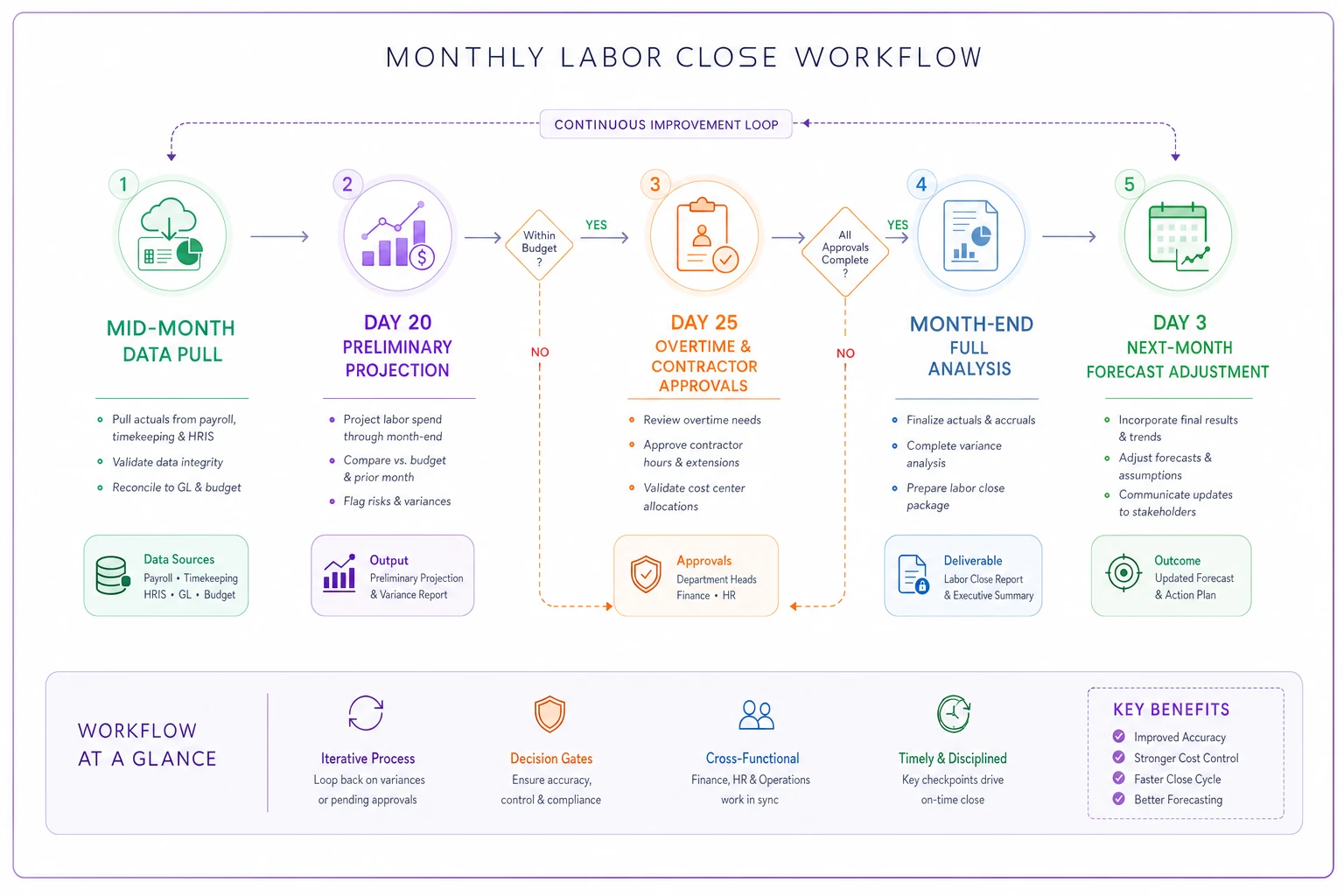
Run a mid-month labor forecast update. Pull actual overtime, contractor costs, and recruiting spend through day 15, then project the full month. Compare this to both your original budget and last month's actual. If you're seeing more than 5% variance, you've got time to adjust before month-end.
Add these checkpoints to your close:
-
Day 20 Preliminary labor cost projection including all contractor invoices received
-
Day 25 Final overtime calculation and approval for month-end contractor payments
-
Month-end Full labor cost analysis including cost per productive hour and vacancy impact
-
Day 3 next month Labor forecast adjustment based on previous month's variances
Here's a simple visual of the close process checkpoints to keep the team aligned.
A distribution business started doing this after their labor costs surprised them three months straight. The mid-month check caught issues like a department hiding contractor costs in "professional services" and another booking overtime as regular hours to avoid scrutiny. Once they had visibility, they brought labor variance from 18% to under 6% within two months.
Creating labor KPIs that flag problems before they hit P&L
Standard labor metrics like headcount and average salary tell you what already happened. In volatile markets, you need leading indicators that show where costs are heading.
Offer-to-acceptance ratio is the most useful metric nobody tracks. If you're making three offers for every acceptance, your salary assumptions are off. This shows up weeks before the actual cost impact hits your P&L. A property management firm saw their ratio jump from 1.3 to 2.8 and immediately knew they needed to revise their salary bands up 12%.
Track days-to-productivity for new hires. Not days to start — days until they're actually contributing at expected levels. In tight labor markets, you're often hiring less experienced people who need more training. If this metric extends from 30 to 45 days, that's effectively a 50% increase in your real hiring cost.
Your expense KPI dashboard should include these labor-specific metrics:
-
Vacancy cost per day (total coverage costs divided by open position days)
-
Contractor premium (contractor rate versus equivalent employee cost)
-
Recruiting cost per hire (all-in, including failed attempts)
-
Turnover replacement cost (separation costs plus vacancy plus recruiting plus training)
Watch the trends, not absolute numbers. If vacancy cost per day increases three months straight, your market is tightening regardless of what headlines say.
Building flexibility into compensation without breaking the budget
When everyone's struggling to hire, throwing money at the problem seems like the only option. But most small businesses can't compete on pure salary with larger companies. You need creative compensation approaches that don't destroy your cost structure.
Consider tiered starting bonuses tied to retention milestones. Instead of paying $5k upfront, structure it as $1k at start, $2k at 90 days, $2k at six months. This costs the same $5k but spreads the cash impact and protects against quick departures. A logistics company using this approach saw their 90-day retention jump from 68% to 84% while actually reducing their total bonus costs.
Flexible scheduling can be worth 10-15% in salary to the right candidates. A dental practice couldn't match hospital wages for hygienists but offered four-day weeks with no weekends. They filled positions faster than competitors paying $8k more annually.
Performance accelerators work better than high starting salaries. Start someone at market rate but offer quarterly reviews with potential 5% raises based on clear metrics. After a year, strong performers earn more than if you'd offered a premium starting salary, but you're only paying for proven value. Plus, underperformers stay at base rate, protecting your budget.
When to switch from employees to contractors (and when not to)
Contractors seem like an easy solution when hiring gets tough. No benefits, no long-term commitment, instant productivity. But the math rarely works out that cleanly, especially for core operational roles.
The real contractor equation: Contractor hourly rate × 1.3 (for management overhead) × 1.2 (for knowledge transfer loss) = actual cost. So that $75/hour contractor versus a $60k employee ($30/hour) isn't a 2.5x premium — it's actually 3.9x when you factor in hidden costs.
Contractors make sense for:
-
True expertise gaps (specialized technical skills you need temporarily)
-
Surge capacity (seasonal peaks, project-based work)
-
Testing new functions (proving a role before committing to permanent hire)
They're terrible for:
-
Core operations (customer service, regular production work)
-
Relationship-based roles (account management, culture-critical positions)
-
Anything requiring deep company knowledge
A home services company learned this the hard way. They brought in contractor technicians at $55/hour to cover vacancies. The contractors did the work, but customer satisfaction tanked because they didn't know the company's service standards. Callbacks increased 40%, eating up any savings from avoiding benefits costs.
Technology and systems that stabilize costs during volatility
The gap between planning and reality in labor costs usually comes down to information lag. You make decisions based on last month's data, but conditions changed two weeks ago. Modern operational software can close that gap.
Good labor forecasting requires dynamic inputs — real-time overtime tracking, immediate visibility on contractor spend, and current pipeline status for open positions. A manufacturing operation integrated their time tracking, recruiting platform, and financial system into a single dashboard. They went from monthly labor variance surprises to daily micro-adjustments that kept them within 3% of budget even during heavy hiring pushes.
AI-powered platforms can predict likely resignation risks based on patterns like declining productivity, increased absences, or manager feedback. One distribution center reduced surprise departures by 45% by identifying at-risk employees and proactively addressing concerns. That's 45% fewer emergency recruiting cycles and coverage crises.
The automation that matters most isn't replacing workers — it's automating the administrative burden that makes labor management reactive instead of proactive. Automated overtime alerts, contractor spend tracking, and recruiting pipeline monitoring give you hours back each week to focus on strategic workforce planning instead of fighting fires.
Making peace with permanent labor uncertainty
The uncomfortable truth: the days of predictable labor markets and stable forecasting are probably gone. Between demographic shifts, remote work options, and economic volatility, labor planning will stay complex for the foreseeable future.
The businesses that thrive won't be the ones that predict perfectly — they'll be the ones that adjust fastest. That means building systems and controls that assume variance rather than stability. Your budgets need scenarios, not single predictions. Your approvals need flexibility within boundaries. Your metrics need to flag trends, not just report history.
A construction company finally accepted this reality after two years of blown labor budgets. They stopped trying to nail perfect forecasts and instead built what they called "adaptive capacity" — the ability to scale up or down by 20% within a month without breaking operations or budgets. They maintained a bench of pre-vetted contractors, cross-trained existing staff for flexibility, and built approval processes that could move fast without losing control.
Labor cost forecasting in volatile markets isn't about getting the number right. It's about building systems that keep you close enough to plan while maintaining the flexibility to adjust when reality inevitably diverges. The companies that master this balance will have a significant competitive advantage as labor markets continue their unpredictable dance.
The spike in job openings without corresponding hiring is just today's challenge. Tomorrow will bring something different. But with the right operational controls, forecasting approaches, and management systems in place, you can navigate whatever comes next without destroying your P&L in the process.
Ready to master your business expenses?
Join 5,000+ businesses using Costyly to save time, reduce overspending, and improve financial visibility.