



The 10-year Treasury yield pushing above 5% isn't an abstract Wall Street headline. When yields jump this fast, the cost of nearly every dollar you borrow follows — floating credit lines reprice, new term loans get more expensive, and even your suppliers start passing along their own financing costs. A recent CNBC breakdown of what happens when yields soar laid out the macro mechanics well, but the part that actually hits a small business is narrower and more immediate: the gap between when money leaves your account and when it comes back gets more expensive to bridge.
That's the real exposure. Most small businesses don't carry massive debt. What they carry is timing risk — the days or weeks between paying a vendor and collecting from a customer. When borrowing gets expensive, that timing gap stops being free. This playbook is about tightening it before it costs you.
Why rate spikes hit SMB cashflow harder than the balance sheet suggests
When people hear "rates are up," they think about the interest line on their loan. For a business running on a revolving credit line, the damage shows up somewhere less obvious: the cost of normal operations.
Say you run a line that floats at prime plus a margin. You weren't borrowing to fund some big expansion — you were using it to cover payroll on the 15th because a big client pays on net-45. That's cashflow smoothing, not debt in any dramatic sense. And when the rate on that line jumps, you're now paying meaningfully more just to run the same operation you ran last quarter.
A typical example: a 12-person services firm carries around $180k average on its line. A 1.5-point rate increase adds roughly $2,700 a year — not catastrophic by itself. But stack that against softer demand, where cost-sensitive customers are stretching their own payment timing, and suddenly you're paying more to borrow and collecting slower. Those two forces compound. That's the squeeze.
The underlying problem isn't the rate itself. It's that most small businesses have no clear picture of when cash actually moves. They know their monthly P&L. They don't know their week-by-week liquidity. Rate spikes punish exactly that blind spot.
The 9-step playbook
1. Map your real cash timing, not your monthly totals
Stop losing track of your business spending.
Costyly helps you record, monitor & control expenses—accurately and efficiently.
- Automated expense categorization
- Real-time budget tracking
- Detailed financial reports
No credit card required
Pull the last 90 days and plot actual cash movement by week — not accruals, actual dollars in and out. You're looking for the troughs: weeks where outflows cluster before inflows have landed. Those trough weeks are where you'd normally reach for the credit line, and now that reach costs more.
Most owners are surprised here. They assume cash is "fine" because the month nets positive. But a month that nets +$8k can still have a week where you're -$22k mid-cycle and leaning on expensive credit to get through it.
2. Identify which expenses are timing-flexible vs. fixed
Not all spend is equal. Split your outflows into three buckets:
| Expense type | Flexibility | Action under rate pressure |
|---|---|---|
| Fixed obligations (payroll, rent, debt service) | None | Protect these first, forecast precisely |
| Vendor/supplier payments | Moderate — term-dependent | Renegotiate timing, align to inflows |
| Discretionary (tools, travel, non-urgent projects) | High | Delay or sequence into cash-positive weeks |
The win isn't cutting discretionary spend to zero. It's moving it into weeks where you're already cash-positive, so you're not financing it on a line that now costs more.
3. Renegotiate vendor terms before you need to
The best time to ask a supplier for net-45 instead of net-30 is when you're not desperate. When borrowing costs rise, extending payables is one of the cheapest forms of financing available — you're using the vendor's terms instead of the bank's rate.
A practical move: pick your top 10 vendors by spend and approach three of them for extended terms this month. Even shifting a few large payments out by 15 days can erase a trough week entirely. Vendors say yes more often than owners expect — especially long-standing ones who'd rather keep the relationship than win a 15-day argument.
4. Tighten the inflow side with collection discipline
Rate pressure makes slow receivables twice as painful. Every day a customer holds your money is a day you might be borrowing at a higher rate to cover the gap.
Quick wins:
-
Send invoices the day work completes, not at month-end
-
Offer a small early-pay discount (even 1%) if it's cheaper than your line rate
-
Flag anyone over 15 days past terms for a same-week follow-up
Do the math on that early-pay discount. If your credit line effectively costs 11% annualized and a 1% discount pulls a payment 20 days forward, you're often ahead. Owners skip this because 1% "feels like giving money away." It's usually cheaper than the interest.
5. Build a rolling 30/60/90 cash view
A static annual budget doesn't help much during a rate spike. What you need is a rolling forecast that updates as reality shifts — one that lets you see a trough week three weeks out, while you still have options, not on the Monday it actually hits.
This is where expense timing and cash forecasting have to talk to each other. If your expense system and your cash view live in separate spreadsheets, you'll always be reacting late. We went deeper on this in this guide on cashflow-aware expense systems — the core idea being that every committed expense should show up on your forecast the moment it's approved, not when the invoice clears.
6. Reprice or re-sequence discretionary projects
Anything you were going to self-fund — new equipment, a software migration, a marketing push — reevaluate its timing against the cost of the cash it consumes. This isn't "cancel everything." It's asking whether this project earns more than the now-higher cost of the dollars it uses.
A common mistake is freezing all discretionary spend in a panic. That often cuts the exact marketing or sales investment that brings cash in. Sequence by ROI and timing, not by across-the-board fear.
7. Reduce reliance on the floating line specifically
If a chunk of your revolving balance never really goes to zero — it's essentially permanent working capital in practice — that's worth considering terming out at a fixed rate. Yes, rates are higher now, but fixed removes the risk of another jump repricing it again, and it frees your line for what it's actually meant to do: short-term smoothing.
One caveat: if your balance genuinely swings to zero every couple of months, terming it out just locks in interest you'd otherwise avoid. This step is for the "silent permanent balance" situation only.
8. Pressure-test a stress scenario
Model one bad month: a key customer pays 30 days late and demand dips 15%. Does your trough week go from uncomfortable to dangerous? If yes, you now know your real buffer — and you can act on it while it's still hypothetical.
Businesses that handle rate shocks well aren't always the ones with the most cash. They're the ones who modeled the bad week before it arrived and already knew which levers they'd pull.
9. Set a weekly cash review cadence
Fifteen minutes, every Monday. Look at the rolling forecast, check the nearest trough, confirm which flexible expenses can move, verify collections are on track. During a calm quarter this feels like overkill. During a rate spike it's the difference between managing proactively and getting blindsided.
The full 9-step flow looks roughly like this:
Map weekly cash timing ↓ Segment fixed vs. flexible expenses ↓ Renegotiate vendor terms ↓ Tighten collections ↓ Build rolling 30/60/90 forecast ↓ Re-sequence discretionary projects ↓ Evaluate floating line exposure ↓ Run a stress scenario ↓ Lock in weekly review cadence
Here's a visual of the workflow.
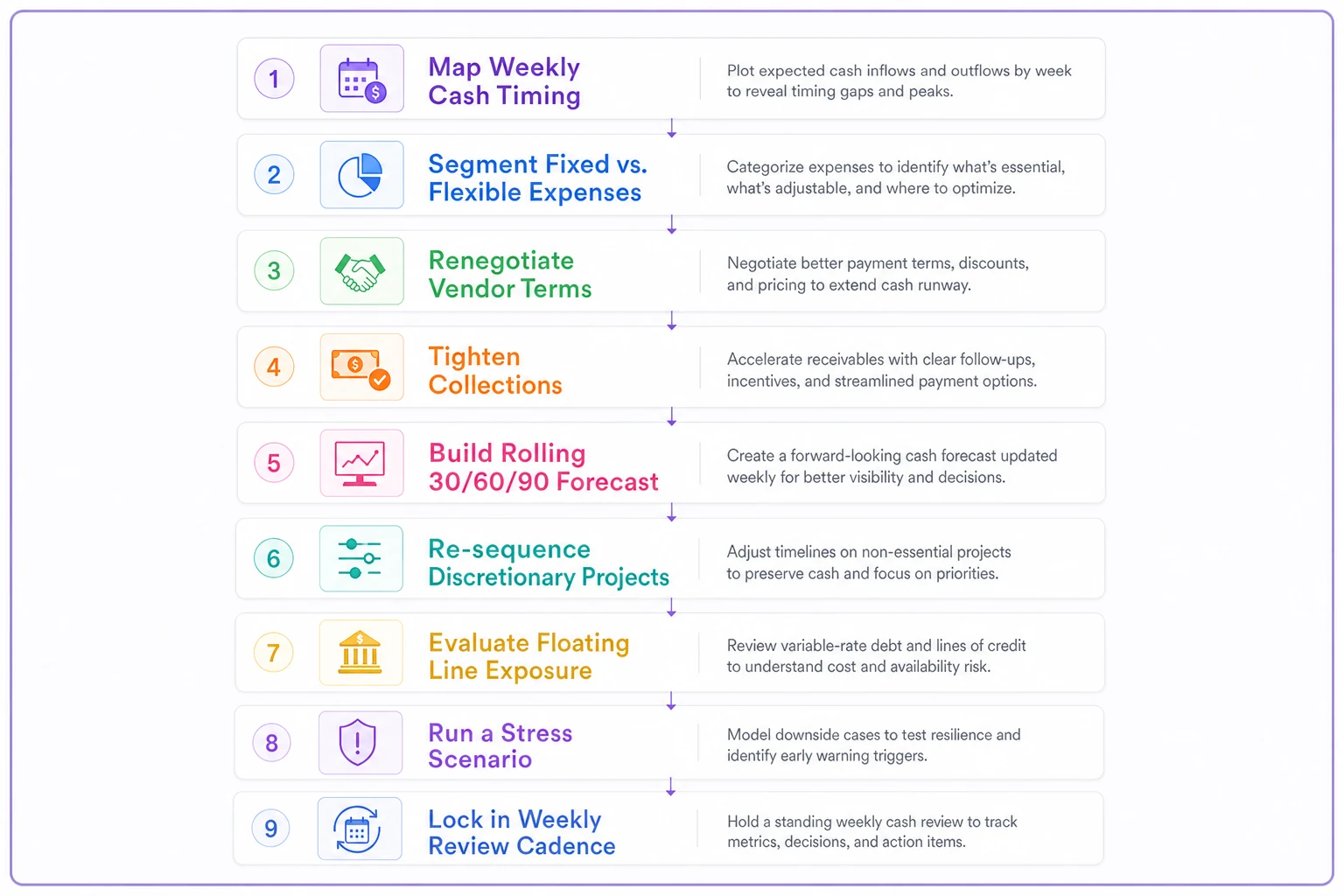
This diagram summarizes the sequence so you can quickly spot where to act.
A quick real scenario
A regional wholesale distributor — roughly $4M in annual revenue, 15 staff — ran most of its working capital on a floating line that averaged around $220k outstanding. When their line repriced, the added interest was only about $3k–$4k a year on its own. Manageable.
What actually hurt was the compounding: two large customers quietly stretched from net-30 to net-50, and the distributor's own suppliers added financing surcharges. Suddenly the business was borrowing more, for longer, at a higher rate.
The fix wasn't dramatic. They mapped their weekly cash timing, renegotiated terms with their three biggest suppliers out to net-45, and added a same-week follow-up on any receivable past 15 days. Within about two months, their average line balance dropped to the $150k range and the mid-cycle trough weeks mostly flattened out. No layoffs, no frozen projects — just tighter timing.
When this playbook matters most (and when it's overkill)
This makes sense when: you carry any floating-rate debt, you have meaningful payables/receivables timing gaps, or your business is sensitive to customer demand shifts. That's most small businesses.
This is lower-priority when: you operate nearly debt-free with fast cash conversion — say, a cash-at-point-of-sale business with minimal payables. You'll still benefit from the weekly cadence, but the vendor-term and line-management steps won't move much for you.
Don't bother with the heavy modeling if: you're a solo operation with predictable monthly cash and a healthy reserve. A simple rolling view (step 5) and the weekly check (step 9) are plenty.
The real takeaway
Rate spikes expose a problem that was already there — most small businesses manage cash monthly when the risk actually lives at the weekly level. Higher borrowing costs just make that gap expensive enough to finally fix.
The work here isn't about predicting the Fed or timing the bond market. It's about knowing your own cash timing well enough that a trough week three weeks out is something you see coming and plan around, instead of something you cover with increasingly expensive credit. Get that visibility right and the next rate move — up or down — becomes a lot less frightening.
Ready to master your business expenses?
Join 5,000+ businesses using Costyly to save time, reduce overspending, and improve financial visibility.