



Most cash surprises don't come from overspending. They come from spending at the wrong time relative to when cash actually leaves the account. A business can be profitable on paper, on budget for the quarter, and still get squeezed hard in a specific week because three big charges happened to land at once — a vendor invoice hit net-30, an annual software renewal auto-charged, and a corporate card statement closed all within four days of each other.
That gap — between when an expense is recorded and when the cash moves — is where forecasts quietly fall apart. It gets worse as a business grows, because the number of moving pieces (payment terms, card cycles, recurring charges, vendor-specific quirks) multiplies faster than most finance teams update their assumptions.
A cashflow-aware expense system isn't a fancier budget. It's a way of tagging every expense with when it actually hits cash, then routing that into near-term buckets so you can see the collision points before they happen. Below is a breakdown of how the timing actually works, where it breaks, and how to build the mapping layer that keeps 30/60/90-day cash visibility honest.
The four dates hiding inside every expense
Every expense has more than one date attached to it, and most forecasts only track one of them. That's the root problem. Here are the four that matter:
-
Transaction date — when the purchase happened or the invoice was issued.
-
Payment date — when cash actually leaves your account.
-
Vendor terms — the delay between the two (net-15, net-30, net-60, due-on-receipt, prepay).
-
Card billing cycle — for anything on a corporate card, the real cash-out date is the statement due date, not the swipe.
The forecast lives or dies on the payment date, but almost every expense report is built around the transaction date. That single mismatch is why a business can look on-budget in the P&L and still get caught short.
A quick way to see it: imagine you buy $8,000 of inventory on the 3rd, on a card that closes on the 25th with payment due the 15th of the following month. In a transaction-date view, that $8k is "spent" in the current month. In cash reality, it doesn't leave until roughly six weeks later. If your forecast doesn't carry that offset, you're planning against a number that's already wrong.
Where the timing model breaks across businesses
The single-date view works fine when a business is small and everything runs through one card or one bank account. Cash-in and cash-out feel intuitive. A few predictable patterns break it as things scale.
Stop losing track of your business spending.
Costyly helps you record, monitor & control expenses—accurately and efficiently.
- Automated expense categorization
- Real-time budget tracking
- Detailed financial reports
No credit card required
-
Mixed payment rails. Once you've got ACH to some vendors, cards for others, and a couple of vendors on prepay, the "average" cash-out timing becomes meaningless. Each rail has its own delay. Averaging them hides the clusters.
-
Terms drift. Vendors change terms and nobody updates the forecast assumption. A supplier who used to be net-45 quietly moves you to net-30 after a late payment, and now $12k lands two weeks earlier than modeled. This is one of the most common silent forecast killers — the terms in your head don't match the terms in the contract anymore.
-
Card cycle stacking. Multiple cards with different closing dates create weeks where two or three statements come due within days. Teams that add cards for departments (which is smart for control) often accidentally create cash pressure points because nobody mapped the due dates against payroll.
-
Annual and quarterly charges. Recurring annual renewals are the classic ambush. Invisible eleven months of the year, then a lump hits. If you're not carrying them in a forward bucket, they always feel like a surprise — even though they're the most predictable expense you have.
None of these are individually complicated. The problem is that they compound. Three medium-complexity timing quirks stacking in the same week is what actually causes the scramble.
The mapping layer: from expense event to cash bucket
The fix is a translation layer that sits between your expenses and your forecast. Every expense event gets mapped to a cash-out date and dropped into a near-term bucket. Here's how the mapping logic works for the common cases:
| Expense type | Timing driver | Cash-out rule | Bucket |
|---|---|---|---|
| Card purchase | Card billing cycle | Statement close → due date | Based on due date |
| Vendor invoice (net terms) | Vendor terms | Invoice date + net days | Based on payment date |
| ACH / direct debit | Vendor schedule | Fixed pull date | Usually 0–30 |
| Prepay / deposit | Order date | Immediate or scheduled | 0–30 |
| Annual renewal | Contract anniversary | Auto-charge date | 30/60/90 depending |
| Payroll & related | Pay calendar | Fixed run dates | Recurring, all buckets |
The three near-term buckets are straightforward:
-
0–30 days — cash committed and leaving imminently. Very little flexibility here.
-
31–60 days — the negotiation window. You can still shift some of this by moving payment dates or timing renewals.
-
61–90 days — the planning window. Enough runway to renegotiate terms, delay a purchase, or line up financing if needed.
The insight most teams miss: the value of the mapping isn't precision on any single expense. It's seeing how much of each bucket is fixed versus movable. A 0–30 bucket that's 90% payroll and prepay is a very different problem from one that's mostly card statements you could pay early or late.
A worked example: the collision week
A small e-commerce business, somewhere in the $90k–$110k monthly revenue range, ran everything off a single "monthly spend" number and gut feel for cash. Spend was on budget almost every month. But every quarter there'd be one week where the bank balance dipped scary-low, and nobody could explain why until it was already over.
-
Two card statements (different closing dates, both due around the 15th–18th) — roughly $18k combined
-
A net-30 supplier invoice from a big restock — about $22k
-
A quarterly SaaS bundle renewal — around $4k
-
Regular payroll — the usual run
None of these were unexpected individually. Stacked, they pulled close to $60k out inside eight days, against a cash cushion that was comfortable for a normal week but not that one.
The fix wasn't spending less. It was moving one card's due date by requesting a different statement cycle, and shifting the restock order forward by ten days so the net-30 landed after the card statements cleared instead of on top of them. The collision week flattened out. Same total spend, completely different cash experience.
That's really the whole point — the money was always going to leave. Timing it so it doesn't all leave at once is essentially free.
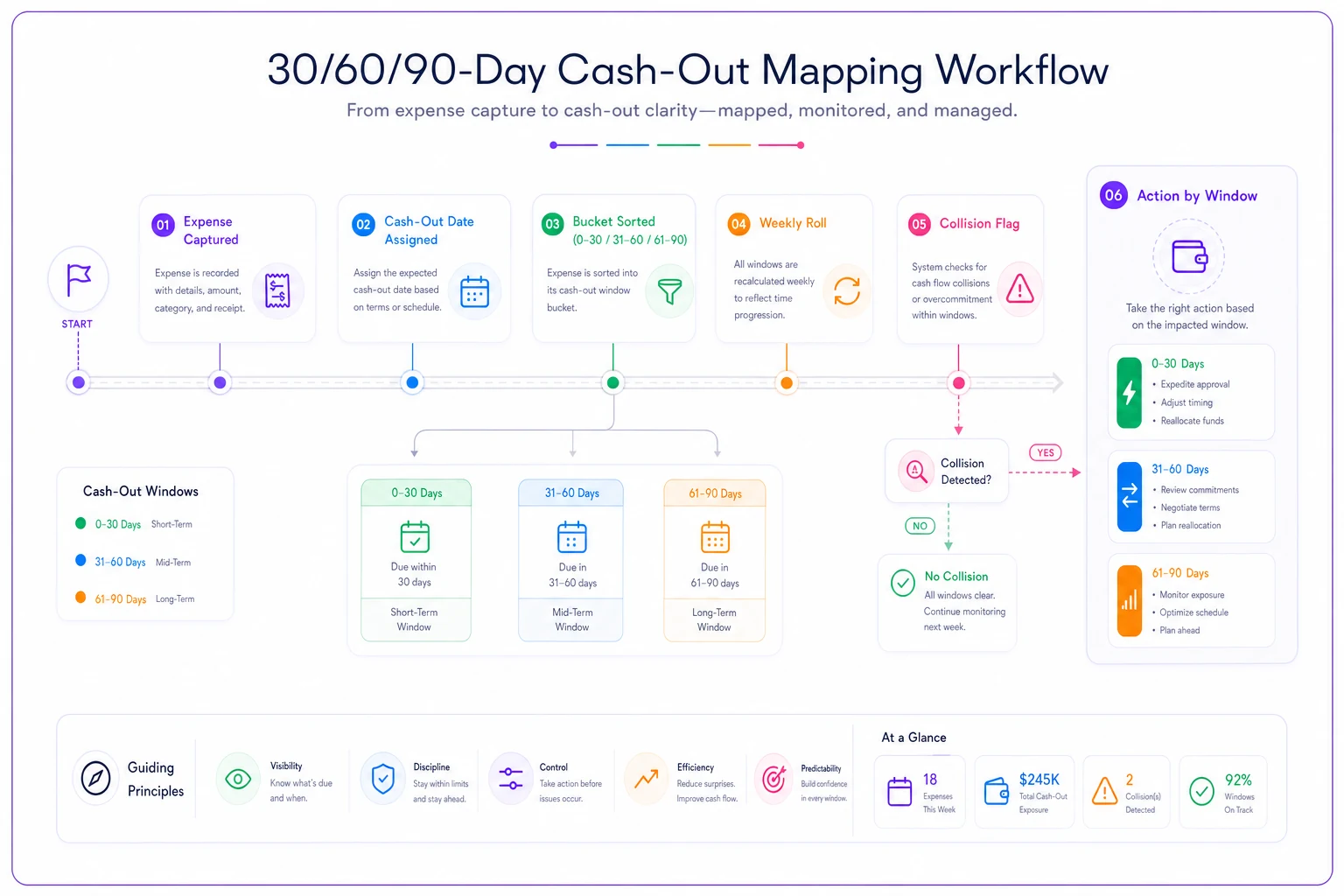
The 30/60/90-day action workflow
Below is the actual cadence for running this, not just building it once and letting it collect dust.
Here's a simple visual of the workflow.
-
Tag at capture. When an expense enters the system, it gets its cash-out date assigned right away based on its rail and terms — not at month-end. If you assign timing after the fact, you've already lost the forward view.
-
Roll the three buckets weekly. Every week, recalculate what's landing in 0–30, 31–60, 61–90. The buckets slide forward continuously, so a renewal that was in the 90-day window last month moves into 60 this month automatically.
-
Flag collisions. Any week where committed cash-out crosses a threshold — more than a certain percentage of your normal weekly cushion, for example — gets flagged for review while there's still time to act.
-
Decide in the right window. Collisions in the 61–90 bucket get the renegotiation playbook: change terms, delay orders. Collisions in 31–60 get the timing playbook: shift due dates, move renewals. Collisions in 0–30 get the coverage playbook: draw on a line, delay a discretionary payment.
-
Update assumptions after every terms change. The moment a vendor changes terms or you add a card, the mapping gets updated. This is the step everyone skips, and it's why forecasts decay.
The buckets feed naturally into a broader reforecast rhythm. If you're already running an expense-driven reforecast system, the cash-timing layer is what makes those forecasts cash-accurate instead of just accrual-accurate. And the collision flags are exactly the kind of threshold-based alerting that belongs on an expense KPI dashboard rather than living in someone's head.
A decision matrix for when a collision shows up
When a flagged week appears, you don't want to improvise. Match the lever to the window:
| Situation | Best lever | Window needed |
|---|---|---|
| Two card statements stacking | Request different statement close date | 60–90 days |
| Big restock landing on payroll week | Move order date forward/back | 30–60 days |
| Annual renewal about to hit | Negotiate monthly billing or delay renewal | 60–90 days |
| Cash-out cluster, no runway left | Draw line of credit / delay discretionary | 0–30 days |
| Recurring monthly clusters | Re-space vendor payment dates permanently | One-time fix |
The pattern is consistent: the earlier you catch a collision, the cheaper the fix. A 90-day flag costs you an email to a vendor. A 5-day flag costs you interest on a credit line. Same collision, very different price — and the only variable is how early your mapping surfaced it.
When this system is worth building — and when it isn't
When it makes sense:
-
You're running multiple payment rails (cards + ACH + prepay).
-
You've got two or more corporate cards with different cycles.
-
Your revenue is seasonal or lumpy, so cash cushions vary a lot week to week.
-
You've had at least one "why is the balance so low this week" moment that nobody could explain at the time.
When it's overkill:
-
Everything runs off one card and one account, and cash never gets tight.
-
Your spend is small and steady enough that a simple monthly view is fine.
-
You have enough of a cash cushion that no realistic collision could threaten it.
Businesses that haven't cleaned up their expense capture at all should probably hold off. If you can't reliably tag expenses by vendor and rail today, timing precision is premature. Fix data capture first, then layer timing on top. Building cash-timing logic on messy expense data just produces confident-looking wrong numbers.
Where automation earns its place
A workflow platform actually pays off here, but only for the repetitive, mechanical parts — not as some magic forecast oracle.
-
Auto-assigning cash-out dates based on each vendor's terms and each card's cycle, so nobody's doing date math by hand.
-
Rolling the 30/60/90 buckets forward each week without someone rebuilding a spreadsheet.
-
Tracking recurring charges and annual renewals so lump-sum ambushes show up in a forward bucket months early.
-
Firing a flag when a week's committed cash-out crosses your threshold.
The judgment — whether to move an order, renegotiate terms, or draw a line — stays with you. What AI-assisted expense tooling removes is the manual re-mapping that causes this system to fall out of date within a month of building it by hand. That decay is the real enemy. A system nobody maintains is worse than no system, because it gives false confidence.
The takeaway
Your forecast isn't wrong because you spent too much. It's wrong because it's reading transaction dates while your bank account reads payment dates.
Close that gap by mapping every expense to when cash actually leaves, sorting it into near-term buckets, and reviewing the collision weeks before they arrive. The businesses that stop getting blindsided aren't spending less than everyone else — they just know, three weeks ahead, that the 18th is going to be tight, and they've already moved one thing off it.
Your forecast isn't wrong because you spent too much. It's wrong because it's reading transaction dates while your bank account reads payment dates.
Close that gap by mapping every expense to when cash actually leaves, sorting it into near-term buckets, and reviewing the collision weeks before they arrive. The businesses that stop getting blindsided aren't spending less than everyone else — they just know, three weeks ahead, that the 18th is going to be tight, and they've already moved one thing off it.
Ready to master your business expenses?
Join 5,000+ businesses using Costyly to save time, reduce overspending, and improve financial visibility.