

Most expense problems aren't really expense problems. They're maturity problems. A company running 200 people on the same expense habits it had at 12 people isn't lazy—it just never rebuilt the machine for the load it's carrying now. And a 15-person team drowning in approval Slack messages isn't disorganized so much as stuck in a stage they've outgrown.
The useful way to think about this is as an operating maturity model. Not a fancy framework—just an honest map of where your spend controls actually are, where they need to go, and what breaks if you skip a stage. This post lays out three stages (ad-hoc → repeatable → automated), the KPIs that matter at each, headcount-based workbacks for the next 12–18 months, and a couple of decision tables for the vendor-vs-build questions that come up along the way.
I'm framing it this way because I've watched companies buy $40k/year expense platforms at 8 people and then abandon them, and I've watched 90-person companies still routing everything through one overloaded controller and a shared spreadsheet. Both are stage mismatches. The goal isn't the most software—it's matching your controls to your actual complexity.
The goal isn't the most software—it's matching your controls to your actual complexity.
The three stages, and why most SMBs misjudge which one they're in
Define the stages by behavior, not by tooling. The tooling follows.
Stage 1 — Ad-hoc. Spend happens, then gets reconstructed after the fact. Receipts live in inboxes and glove compartments. Approvals are verbal or informal. Categorization is whatever the bookkeeper decides at month-end. The defining trait: you can't answer "what did we spend on X last month" without doing archaeology.
Stage 2 — Repeatable. There's a policy people actually follow. Approvals have a defined path. Categories map cleanly to your chart of accounts. Month-end is a known sequence, not a scramble. The defining trait: a new hire can submit an expense correctly without asking three people how it works.
Stage 3 — Automated. The system enforces the rules so humans don't have to. Recurring charges match themselves. Policy violations surface before payment, not after. Allocations run on tags, not manual splits. The defining trait: your finance team spends most of its time on exceptions and analysis, not data entry.
The misjudgment I see constantly—companies think they're in Stage 2 because they bought Stage 2 software. But if half the team still forwards receipts to the office manager who keys them in manually, you're running Stage 1 behavior on Stage 2 tools.
A quick gut-check on which stage you're actually in:
-
Can you close the books in under 5 business days without heroics? (If no → likely Stage 1.)
-
Does a random expense get categorized the same way regardless of who touches it? (If no → Stage 1.)
-
Do approvals have a deadline, or do they just… sit? (Sitting → Stage 1/early 2.)
-
When someone leaves, does their spend knowledge leave with them? (If yes → Stage 1.)
-
Are your people manually matching the same recurring vendors every month? (If yes → you're stuck at the Stage 2/3 boundary.)
The tool doesn't set your stage. The workflow does.
Stage-specific KPIs (measure the right thing for where you are)
One of the most common mistakes is importing the KPIs of a bigger company. A 10-person shop tracking "cost per expense report processed" is measuring something it can't act on. Different stages need different scoreboards.
Stop losing track of your business spending.
Costyly helps you record, monitor & control expenses—accurately and efficiently.
- Automated expense categorization
- Real-time budget tracking
- Detailed financial reports
No credit card required
| Stage | Primary KPIs | What "good" looks like | What NOT to measure yet |
|---|---|---|---|
| Ad-hoc | % of spend with a receipt; days-to-close; # of uncategorized transactions | 90%+ receipts captured, close under 8 days | Automation rates, per-report cost |
| Repeatable | Policy compliance rate; approval cycle time; categorization accuracy; on-time close | 95% compliance, approvals under 48h, close under 5 days | ML match accuracy, exception-only workflows |
| Automated | Auto-match rate; % exceptions requiring human touch; forecast variance; time-to-detect anomalies | 80%+ auto-matched, <15% manual touch, tight forecast variance | Basic receipt capture (should be a solved problem) |
The insight buried in that table: your KPIs should retire as you mature. At Stage 3, tracking "% of spend with a receipt" is a waste of a dashboard slot—it should be near 100% and self-enforcing. If you're still fighting for receipt capture at 150 people, you have a Stage 1 leak inside a Stage 3 company, and that's worth treating as an alarm, not a footnote.
One more pattern worth naming. Approval cycle time is the single most predictive early metric. When it starts creeping—say from 1 day to 4 days over a quarter—it's almost always the first visible symptom that your controls are getting overloaded for your headcount. It shows up before compliance drops and long before close slips.
The 5-person workback: don't build the machine yet
At 5 people, your enemy is overhead you can't afford. The temptation is to install grown-up systems early "so we don't have to redo it later." Mostly a trap. You'll spend more time configuring than you save, and your process will change so much by 20 people that the config is wasted anyway.
The 12-month goal at this size: get to clean, boring Stage 1—consistent capture and reliable categorization—without hiring anyone or buying anything heavy.
Months 1–3:
-
Pick one card program, kill personal-card reimbursements wherever possible.
-
Set 6–10 expense categories that map directly to your chart of accounts (not 40).
-
Require receipt capture at point of purchase—a photo, same day. No end-of-month batches.
Months 4–8:
-
Write a one-page policy. Literally one page. Limits, what needs pre-approval, what doesn't.
-
Assign a single owner for month-end—even if it's the founder for now.
-
Start tracking days-to-close and receipt %.
Months 9–12:
-
Once the pattern holds for two months, tighten the categories that keep getting miscoded.
-
Decide whether headcount growth is about to force Stage 2 (it usually is around 15–20 people).
The mistake at this stage is over-tooling. The second mistake is under-documenting—relying entirely on the founder's memory of "how we do expenses." That memory doesn't transfer, and when your first finance hire lands, they inherit chaos with no map.
The 50-person workback: this is where you actually build Stage 2
Somewhere between 20 and 50 people, ad-hoc genuinely stops working. Not gradually—it hits a wall. More people means more edge cases, more approvers, more vendors, and the founder can no longer be the human router. The 12–18 month job here is building a real repeatable system.
This is the stage where a proper governance layer earns its keep. If you're around this size, the mechanics of policy, ownership, and lightweight audits are worth getting right early—there's a full breakdown in expense governance that scales for 5–20 person teams that pairs well with the workback below.
Quarter 1 — Foundations:
-
Define an approval matrix by amount and category. Every path gets an owner and an SLA.
-
Formalize the chart-of-accounts mapping so categorization stops being a judgment call.
-
Establish tiered card limits by role instead of one-size-fits-all.
Quarter 2 — The close:
-
Build a documented month-end sequence with named owners per step. The goal is a close that survives someone being on vacation. The repeatable expense management system for faster month-end is essentially the blueprint for this quarter.
-
Get days-to-close consistently under 5.
Quarter 3 — Compliance and visibility:
-
Turn on policy compliance tracking. Set a target (95%+) and review misses monthly.
-
Build a basic spend dashboard leadership can read without you translating it.
Quarters 4–6 — Harden and prep for automation:
-
Audit your recurring vendors—this is where subscription creep hides.
-
Clean up your tagging before you try to automate anything on top of it. Automating on messy tags just makes wrong answers faster.
Hold quarterly spot audits to ensure senior people follow the approval matrix.
A realistic failure point at 50: you build a beautiful approval matrix, and then two senior people quietly ignore it because "they're busy." Once that happens without consequence, the whole thing decays. Stage 2 is less about designing controls and more about holding the line on the ones you designed.
The 200-person workback: automation, exceptions, and letting the system enforce itself
At 200 people, manual Stage 2 processes buckle under sheer transaction volume. You can't manually match hundreds of recurring charges, and you can't have humans eyeball every submission for policy violations. The whole point of Stage 3 is inverting the workload: the system handles the routine, humans handle the exceptions.
The 12–18 month arc here is less about new rules and more about enforcement moving into the tooling:
-
Auto-matching for recurring vendors so finance stops re-matching the same 80 charges every month.
-
Pre-payment policy checks that flag violations before money moves, not in the month-end review.
-
Tag-driven allocations so shared costs split themselves across departments and entities.
-
Anomaly detection so unusual spend surfaces in days, not at quarter's end.
To understand how these pieces connect in practice, here's how a mature Stage 3 transaction typically flows through an automated expense operation:
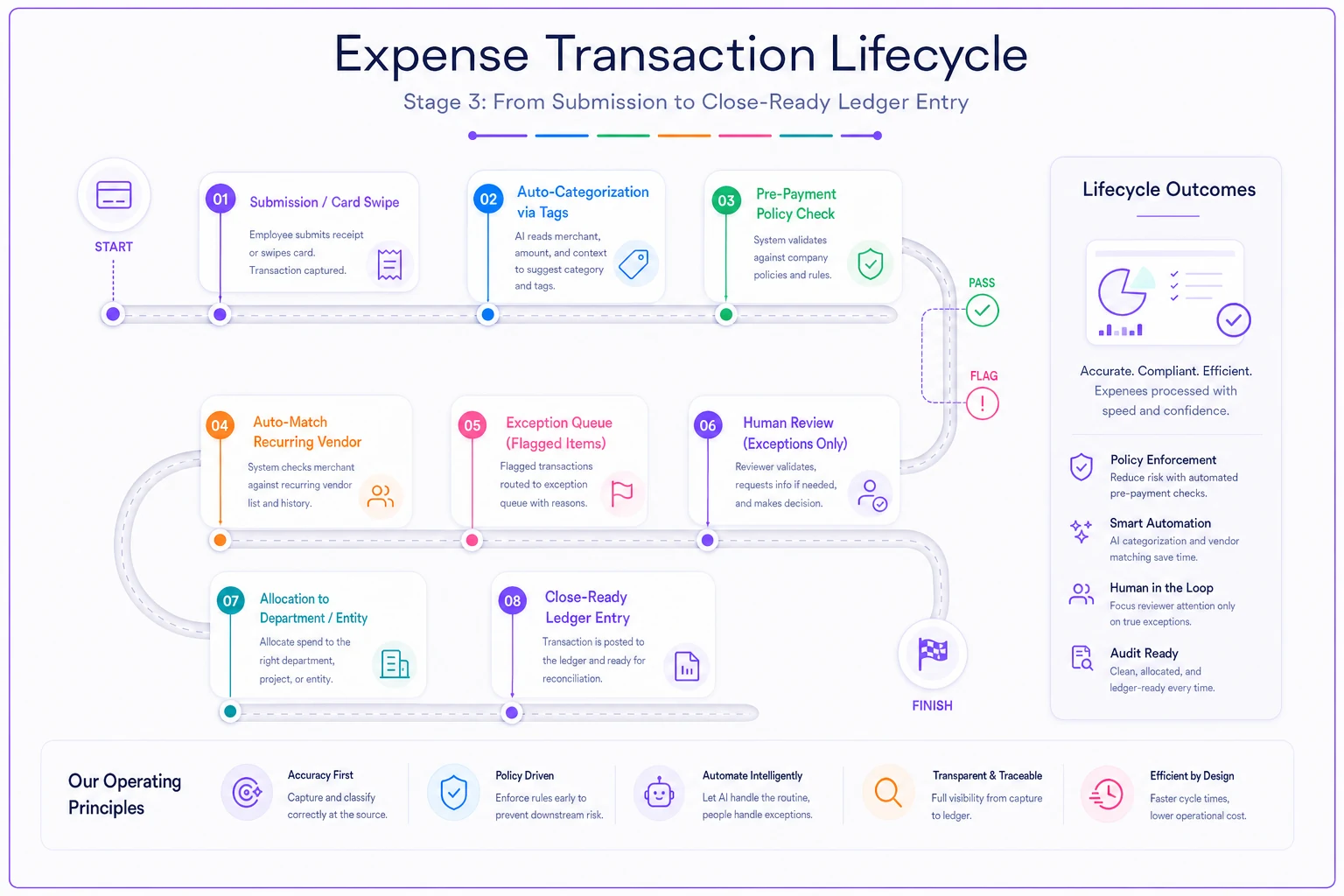
The KPI that matters most at this stage is the exception rate—the percentage of transactions that need a human. Early Stage 3 might sit at 30–40% needing a touch. Mature Stage 3 gets that under 15%. If your automation isn't lowering the human-touch rate, it's decoration.
The classic 200-person mistake: buying an expensive platform and configuring it to mirror the manual process instead of replacing it. If the tool just digitizes your old approval chain without removing steps, you've spent six figures to make the same bottleneck faster. Automation should let you delete steps, not gold-plate them.
Vendor vs build: the decision table nobody walks you through
At each stage boundary, you hit the same fork: buy something, build something, or keep doing it manually. The honest answer depends on complexity and headcount, not on what a sales rep tells you.
| Situation | Lean toward Buy | Lean toward Build/Manual | Why |
|---|---|---|---|
| Standard expense flow, <20 people | Light off-the-shelf tool | Spreadsheet + card app | Your process is generic; don't reinvent it |
| Unusual allocation logic (grants, multi-entity) | Configurable platform | Custom rules layer | Off-the-shelf often can't model your splits |
| Heavy recurring-vendor matching at scale | Buy automation | Never do this manually | Human matching doesn't scale past a point |
| Tight budget, simple needs, <10 people | Free/cheap tools | Manual | Overhead of a platform isn't justified yet |
| Compliance-heavy industry | Buy with audit trails | Don't build this | Reinventing audit logging is a liability |
| Truly bespoke workflow, strong eng team | — | Build | Rare, but real for some ops-heavy companies |
Two things people get wrong here.
First, they treat "build" as free because it's internal engineering time. It isn't. A homegrown expense workflow is a permanent maintenance obligation that competes with your actual product roadmap. Fewer than one in ten SMBs should build core expense infrastructure themselves.
Second, they buy for the company they wish they were. A 30-person company buying enterprise-tier tooling with SSO provisioning and multi-region compliance modules is paying for weight it can't lift. Buy for the stage you're entering, not three stages ahead.
When to deliberately stay at a lower maturity stage
Maturity isn't a race, and "further along" isn't automatically better. There are legitimate reasons to hold.
When staying ad-hoc makes sense: you're pre-revenue or under roughly 8 people with simple, low-volume spend. Formalizing here is premature optimization. Get the product working first.
When staying at repeatable (not automating) makes sense: your transaction volume is genuinely low even at moderate headcount—say a 40-person consultancy where only 8 people ever expense anything. Automation's payback depends on volume. A well-run manual Stage 2 can outperform a badly configured Stage 3.
Who should NOT rush to Stage 3: companies that haven't cleaned their categories and tags. Automating on a messy foundation is how you get confident, fast, wrong answers. Fix the data model first. Always.
A real scenario: a services firm caught between stages
A regional field-services company—roughly 60 employees, growing fast after landing a couple of large contracts—had a classic stage mismatch. They'd bought a mid-tier expense platform at around 25 people but never rebuilt the workflow around it. So they had Stage 2 software running Stage 1 habits: technicians photographing receipts, but an office admin still manually re-keying and re-categorizing most of them.
The symptoms were textbook. Month-end close was dragging to 11–12 business days. Approval cycle time had crept to about 5 days because everything funneled through one operations manager. Nobody trusted the category-level spend reports, so leadership kept asking for manual pulls.
They didn't buy new software. They fixed the stage mismatch. Over roughly four months they rebuilt the category-to-chart-of-accounts mapping so coding stopped being a judgment call, split approvals across three role-based approvers with a 48-hour SLA, and turned on the auto-matching for recurring vendors they'd been ignoring in the platform they already owned.
Close came down to around 5–6 days. Approval cycle time dropped to under two days. Roughly 70% of recurring charges started matching themselves, which freed the admin from a few days of monthly re-keying. Nothing exotic—they just aligned their behavior and their tooling to the same stage.
How the parts connect (the thing most roadmaps miss)
The reason a stage-based model works better than a checklist is that the pieces are coupled. Your approval matrix depends on clean categories, because you can't route by category if categories are inconsistent. Your automation depends on clean tags, because rules run on structure. Your forecasting depends on a reliable close, because you can't project from numbers that shift after the fact. Your compliance rate depends on limits people actually respect.
Pull one thread and the others move. That's why skipping stages backfires. A company that jumps to automation before it has repeatable categorization ends up automating inconsistency. A company that installs a strict approval matrix before it has SLAs ends up with a bottleneck instead of a control. The order matters because the dependencies are real.
The workback isn't just a timeline—it's a dependency chain. Get consistent capture, then reliable categorization, then defined approvals with SLAs, then a documented close, then—only then—automation on top of a foundation that can actually support it. Skipping any of those steps doesn't save time. It just moves the rework to a worse moment.
Where to start this week
Figure out which stage your behavior is in, not your software. Then pick the single next dependency in the chain—usually clean categorization or approval SLAs—and fix that before reaching for anything shinier.
Maturity in expense operations is quiet. It doesn't look impressive. It looks like a close that finishes on time, reports nobody argues with, and a finance team that spends its energy on decisions instead of data entry. Get the stages in order, match your tooling to where you actually are, and the roadmap mostly builds itself.
Figure out which stage your behavior is in, not your software. Then pick the single next dependency in the chain—usually clean categorization or approval SLAs—and fix that before reaching for anything shinier.
Maturity in expense operations is quiet. It doesn't look impressive. It looks like a close that finishes on time, reports nobody argues with, and a finance team that spends its energy on decisions instead of data entry. Get the stages in order, match your tooling to where you actually are, and the roadmap mostly builds itself.
Ready to master your business expenses?
Join 5,000+ businesses using Costyly to save time, reduce overspending, and improve financial visibility.