

Most small finance teams treat expense governance like it's binary: either you're a startup running on trust and spreadsheets, or you're enterprise with a 47-page policy document nobody reads. Between 5 and 20 people, you need something completely different—a framework that actually works without turning everyone into a compliance officer.
The problem isn't that small teams don't care about governance. It's that traditional frameworks assume you have dedicated audit staff, policy writers, and someone whose entire job is tracking remediation timelines. When your controller is also handling AP, month-end close, and basically everything else, you need governance that fits into existing workflows, not governance that creates new ones.
What breaks is pretty predictable. Around 8–10 people, informal controls start failing. The person who "just knew" which vendors needed extra scrutiny goes on vacation. The mental ownership map ("Sarah handles IT, Mike handles facilities") falls apart when Sarah gets promoted. The random spot checks that used to catch issues become less random and more never.
Then companies overcorrect. They implement enterprise frameworks, create steering committees, write policies nobody follows. Six months later, they're back to informal controls but now with the added guilt of abandoned governance initiatives sitting in shared drives.
Why lightweight governance frameworks fail at scale
The core mistake is thinking governance scales linearly. It doesn't. A 5-person team operates on trust and visibility—everyone sees everything, knows everyone, catches issues through proximity. A 20-person team has specialization, handoffs, blind spots. The governance framework that works at 5 people literally cannot work at 20, but the one designed for 20 will suffocate a team of 5.
Take ownership matrices. In a 5-person team, ownership is usually obvious. There's one person handling vendor relationships, one managing corporate cards, maybe two splitting expense reports. You don't need a RACI chart. But at 15 people, you've got regional differences, category specialists, coverage gaps. Without clear ownership, expenses get approved by whoever's available, policies get interpreted differently by each approver, and nobody knows who's supposed to follow up on that suspicious consulting invoice from three months ago.
The audit problem is worse. Small teams know they should audit expenses. They even plan to. But when month-end hits, when the CFO needs that variance analysis, when payroll has issues—audits get pushed. And pushed. Until you're "auditing" by scrolling through transactions during lunch, hoping nothing looks too weird.
This isn't laziness. It's resource reality. A 7-person finance team managing $30M in annual expenses doesn't have bandwidth for quarterly deep-dive audits across all categories. They need surgical precision—knowing exactly what to sample, when to sample it, and what constitutes "good enough" coverage.
Building blocks of SMB expense governance
Real expense governance for SMB finance teams needs five interlocking components, each scaled appropriately:
Stop losing track of your business spending.
Costyly helps you record, monitor & control expenses—accurately and efficiently.
- Automated expense categorization
- Real-time budget tracking
- Detailed financial reports
No credit card required
Policy Framework Not a novel. A single source of truth that answers the questions people actually ask. "Can I expense this team lunch?" "Do I need approval for this software?" "What counts as travel vs. entertainment?" Your policy document should be under 10 pages, searchable, and updated quarterly based on actual questions from the field.
Ownership Matrix Clear ownership across three dimensions: expense categories (who owns T&E vs. software vs. professional services), process steps (who submits vs. approves vs. audits), and escalation paths (who handles exceptions, disputes, investigations). This isn't about creating bureaucracy—it's about eliminating the "I thought you were handling this" conversations.
Audit Sampling Cadence Statistical sampling that gives you confidence without reviewing every transaction. For teams under 20 people, this means risk-based sampling: 100% review of new vendors, high-risk categories, and transactions over certain thresholds, then mathematical sampling for everything else. Not random spot checks—systematic coverage that adapts to your risk profile.
Remediation SLAs When you find issues (and you will), you need clear timelines for resolution. Missing receipts: 48 hours. Policy violations: 5 business days. Potential fraud: immediate escalation. These SLAs prevent the death-by-a-thousand-cuts problem where minor issues pile up because nobody knows who should fix them or when.
Performance KPIs Metrics that matter for your size. Not 50 KPIs across 12 dashboards. Five to seven numbers that tell you if governance is working: policy exception rate, audit coverage percentage, average remediation time, repeat violation rate, cost per transaction processed.
The Ownership Matrix: who owns what and when it matters
Ownership confusion kills more governance frameworks than anything else. Here's what typically happens: everyone knows Sarah reviews credit card statements, but nobody knows if she's supposed to flag policy violations or just coding errors. Mike handles vendor onboarding, but is he responsible for ongoing vendor audits? The CEO approved that marketing expense, but who tracks whether receipts ever showed up?
For 5–20 person teams, you need ownership across four layers:
| Category | Primary Owner | Backup Owner | Review Frequency |
|---|---|---|---|
| T&E | Controller | AP Manager | Weekly |
| Software/SaaS | IT liaison | Controller | Monthly |
| Professional Services | CFO | Controller | Bi-weekly |
| Facilities/Office | Office Manager | AP Clerk | Monthly |
| Marketing/Events | Marketing Ops | Controller | Per event |
Process Step Ownership
-
Submission
Employee or designated admin
-
Initial Review
Direct manager or department head
-
Finance Review
Category owner
-
Approval
Based on amount (see approval matrix)
-
Audit
Rotating between senior team members
-
Remediation
Original submitter with category owner oversight
Escalation Ownership This is where frameworks usually break. When the VP of Sales consistently violates meal policies, who actually has the conversation? When audit finds systematic issues with one department, who drives remediation? Without clear escalation paths, issues bounce around until they're forgotten.
Assign short handover notes to backup owners so coverage during PTO is immediate and clear.
Temporal Ownership Who handles what during transitions? When someone's on PTO? During month-end crunch? Year-end? The ownership matrix needs to account for time-based coverage, not just role-based assignment.
Practical audit sampling for small teams
Enterprise audit teams use complex statistical models to determine sample sizes. You need something simpler that still gives confidence without reviewing every transaction. Here's a framework that actually works:
Risk-Based Stratification
-
High Risk
New vendors, international transactions, round-dollar amounts, expense reports from new employees or those with previous violations
-
Medium Risk
Regular vendors with occasional issues, categories with policy ambiguity, transactions just below approval thresholds
-
Low Risk
Recurring subscriptions, pre-approved vendors, small-dollar routine expenses
Sampling Rules by Risk Level
High Risk: Review 100% until the vendor or employee establishes a pattern of compliance (usually 3–6 months)
Medium Risk: Review 25% monthly, rotating which transactions you pull
Low Risk: Review 10% quarterly, unless patterns indicate issues
Sample Size Calculation
-
For a 10-person finance team handling roughly 800–1,200 expense transactions monthly:
-
High risk transactions (≈15%)
Review all 120–180
-
Medium risk (≈35%)
Review 70–105 of 280–420
-
Low risk (≈50%)
Review 40–60 of 400–600
Total monthly review: 230–345 transactions, or about 11–17 per business day split across the team.
Coverage Rotation
-
Month 1
Focus on T&E and new vendors
-
Month 2
Software/subscriptions and professional services
-
Month 3
Marketing/events and facilities
-
Month 4
Comprehensive review of any problem areas identified
This ensures everything gets looked at quarterly while keeping daily workload manageable.
Remediation SLAs that actually work
SLAs without teeth are wishful thinking. But overly aggressive SLAs that ignore operational reality are worse—they train people that SLAs don't matter. For small teams, remediation timelines need to balance urgency with what's actually feasible.
Tiered Response Framework
Critical (Same day)
-
Suspected fraud
-
Violations over $5,000
-
Compliance/regulatory issues
-
Vendor payment holds affecting operations
Urgent (48 hours)
-
Missing receipts for transactions over $500
-
Unapproved expenses over threshold
-
Policy violations by repeat offenders
-
New vendor documentation gaps
Standard (5 business days)
-
Routine missing receipts under $500
-
Coding corrections
-
Policy clarification requests
-
First-time minor violations
Scheduled (Next cycle)
-
System improvements
-
Policy updates
-
Training needs
-
Process optimizations
Enforcement Mechanisms
-
First miss
Email reminder with new deadline
-
Second miss
Manager copied, expense privileges reviewed
-
Third miss
Expense privileges suspended until remediation
-
Chronic issues
Performance review impact
This seems harsh until you realize the alternative is no enforcement at all, which is where most small companies end up.
KPIs that tell you if governance is actually working
Most expense KPIs focus on spending levels. For governance, you need metrics that show whether your framework is functioning. Here are the ones that matter for small teams:
Policy Exception Rate Percentage of expenses that violate policy, tracked by category and person. Target: under 5% overall, under 2% for repeat violations. If it's higher, either your policies are too restrictive or training isn't working.
Audit Coverage Score Percentage of high-risk transactions reviewed within SLA. Target: 100% for high risk, 80%+ for medium risk. This tells you if your sampling plan is realistic.
Mean Time to Remediation Average days from issue identification to resolution, by severity tier. Critical should be under 1 day, urgent under 3, standard under 7. Trending longer means your SLAs are breaking down.
Repeat Violation Rate Percentage of people with multiple violations per quarter. Target: under 10%. Higher suggests systemic issues with either specific policies or specific people.
Cost per Transaction Total finance team time spent on expense processing divided by transaction count. This should decrease as governance improves. If it's going up, you're over-engineering.
False Positive Rate Percentage of flagged expenses that turn out to be legitimate. Target: under 15%. Higher means you're wasting time on non-issues.
Implementing without disrupting operations
The biggest risk in implementing an expense governance framework isn't that it won't work—it's that you'll try to implement everything at once and create chaos. Smart implementation for small teams follows a specific sequence.
Start with the ownership matrix. Before you can govern anything, people need to know who's responsible. This takes about two weeks to design and socialize. Don't overthink it—document current state, identify the obvious gaps, assign them. You can refine later.
A simple implementation sequence helps avoid chaos.
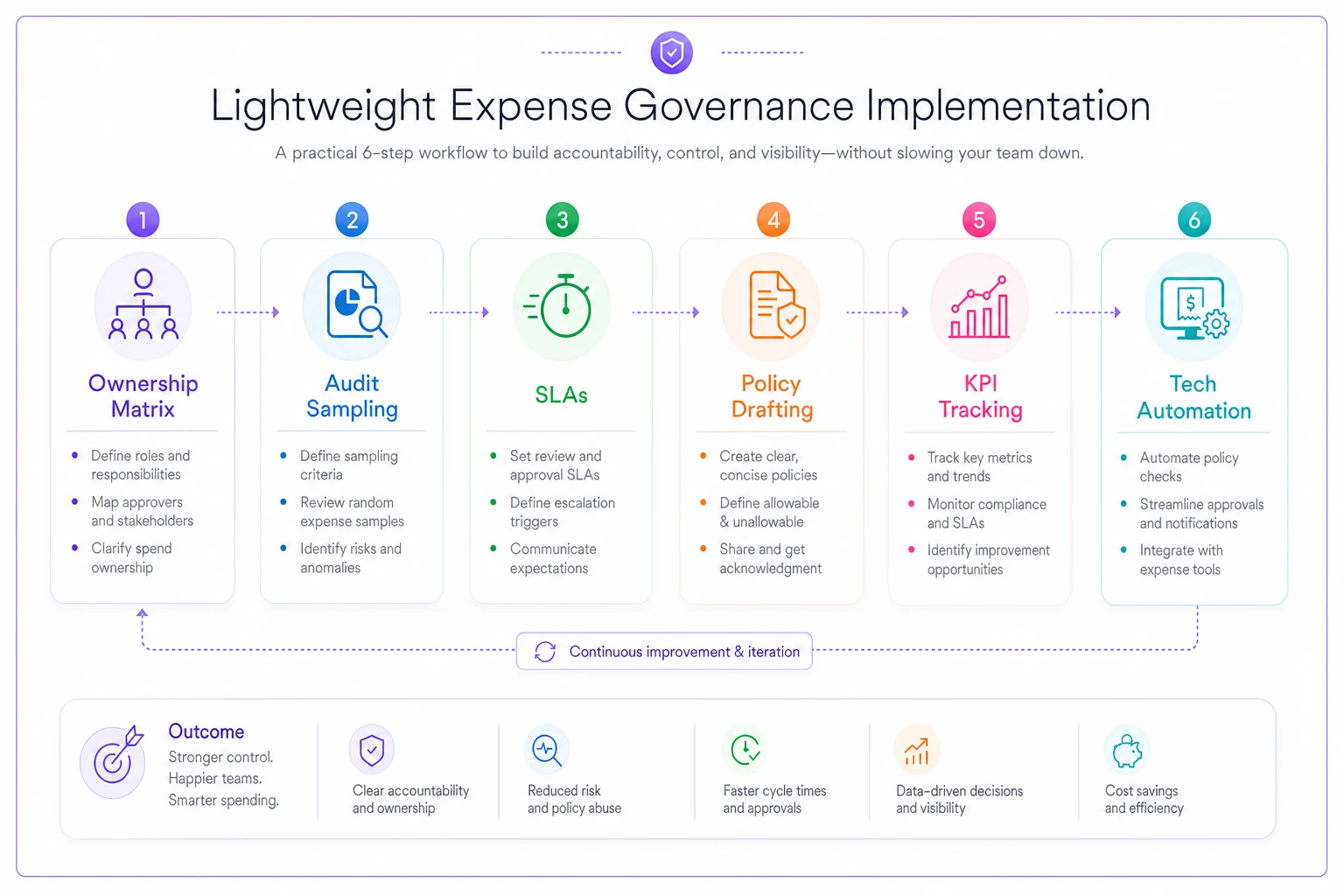
Next, establish your audit sampling approach. Begin with high-risk categories only. Get comfortable with the workflow, train the team, establish rhythm. This takes a month. Only then expand to medium and low-risk sampling.
SLAs come third. Start with generous timelines—better to hit easy SLAs than miss aggressive ones. After two months, you'll have data on actual remediation times. Then tighten based on reality, not theory.
Policy documentation happens in parallel but doesn't gate anything. Start with a FAQ document based on actual questions. Every time someone asks "can I expense this?", add the answer. After three months, organize it into a proper policy document.
KPI tracking starts day one but only for reporting, not judgment. You need baseline data before you can set targets. Give it a full quarter before using KPIs to drive decisions.
The tech stack that enables lightweight governance
Manual governance at scale is basically impossible. But most expense management systems designed for small businesses either lack governance features entirely or include enterprise-grade complexity you'll never use. You need the middle ground.
Your governance framework needs operational software that can handle policy matching without complex rule engines. Modern platforms use AI automation to flag violations based on context, not just rigid rules. Instead of writing 50 if-then statements for meal policies, the system learns what's normal and surfaces outliers for review.
For ownership and SLAs, you need workflow automation that routes based on your matrix. When an expense needs review, the system should know who owns it, what SLA applies, and when to escalate. This isn't complex—it's basic workflow logic that most modern expense platforms include.
The audit sampling gets interesting. AI-assisted platforms can identify risk patterns humans miss—vendors with gradually increasing invoices, employees whose expense patterns suddenly change, suspicious timing clusters around quarter-end. The system flags these for human review, effectively increasing your audit coverage without increasing workload.
For remediation tracking, automated follow-ups change everything. Instead of manually chasing missing receipts, the system sends reminders, escalates based on your SLAs, and temporarily suspends privileges when needed. One team reduced their average remediation time from 12 days to 3 just by automating follow-up emails.
Common governance pitfalls that look like good ideas
Some governance practices seem logical but actually make things worse for small teams. The steering committee is a classic example. In theory, having stakeholders meet monthly to review policies makes sense. In practice, these meetings become status updates that could've been emails, and actual decisions get delayed waiting for the next meeting.
Another trap: over-documenting edge cases. You find someone who expensed their dog's daycare as "off-site meeting facility." So you add a policy specifically about pet care. Then someone expenses their gym membership as "wellness program." Another policy. Soon you have a 50-page document of things not to expense, which nobody reads and which doesn't stop creative categorization anyway.
The approval matrix complexity spiral is brutal too. It starts simple: under $500 needs manager approval, over $500 needs director. Then you add categories—"except software needs IT approval" and "except travel needs" and "except customer entertainment"—and suddenly you need a flowchart to figure out who approves lunch.
Quarterly policy reviews sound responsible but usually waste time. Policies don't need reviewing on a schedule—they need fixing when they break. Track questions and violations. When patterns emerge, update the policy. That reactive approach is actually more responsive than scheduled reviews that happen whether needed or not.
The worst pitfall: implementing governance theater to impress auditors or investors. If you're creating documents nobody uses, running reports nobody reads, following processes that don't prevent problems—stop. Simple governance that works beats sophisticated governance that doesn't.
Scaling from 10 to 20 people without rebuilding everything
The governance framework that works for 10 people starts creaking around 15. By 20, it's usually broken. But if you build it right initially, scaling is evolution, not revolution.
The ownership matrix needs the most attention. At 10 people, one person can own all T&E. At 20, you need regional or departmental splits. The framework handles this—just add columns to your matrix. Same structure, more granular ownership.
Audit sampling naturally scales through risk stratification. As transaction volume doubles, the high-risk percentage usually stays flat or declines (most growth is in routine expenses). So your absolute review count increases, but at a slower rate than transaction growth. The 11–17 daily transactions at 10 people becomes 18–25 at 20—noticeable but manageable.
SLAs might need adjustment but not overhaul. What took 48 hours with 10 people might need 72 with 20, simply because of coordination overhead. Better to proactively extend SLAs than consistently miss them.
Where you'll feel real pain is in exceptions and edge cases. With 10 people, you can handle exceptions personally. With 20, you need documented escalation paths, exception tracking, pattern recognition. AI automation genuinely helps here—identifying patterns across exceptions that humans wouldn't catch on their own.
The technology component becomes critical at scale. Manual processes that worked at 10 people break at 20. That Excel-based audit tracker, the email-based approval workflow, the shared drive for receipts—they all need upgrading. But upgrade incrementally. Don't rip and replace everything at once.
Making governance sustainable for the long term
The best expense governance framework is one that people actually follow. That means balancing control with usability, compliance with efficiency, thoroughness with sustainability. For small finance teams, this balance is everything.
Sustainable governance adapts to your reality. When month-end hits, audit sampling might pause. When someone's on vacation, ownership temporarily shifts. When a new regulation drops, policies update. The framework shouldn't break under pressure—it should bend.
Training can't be a one-time event. Every new hire, every policy update, every process change needs reinforcement. Not hour-long sessions—five-minute refreshers, embedded help text, just-in-time reminders. The framework should teach itself.
Regular health checks matter more than annual overhauls. Every month, ask: What broke? What got skipped? What generated confusion? Small continuous improvements beat dramatic periodic redesigns.
Most importantly, governance should make work easier, not harder. When people understand who owns what, they stop wasting time figuring out who to ask. When SLAs are clear, follow-up happens automatically. When audit sampling is systematic, you stop worrying about what you might be missing.
Building an expense governance framework for a 5–20 person finance team isn't about mimicking enterprise practices or maintaining startup chaos. It's about finding the sweet spot where control meets efficiency, where policies guide without constraining, where audit provides confidence without exhausting the team.
The framework outlined here—clear ownership, systematic sampling, realistic SLAs, and focused KPIs—works because it acknowledges the reality of small finance teams. You don't have unlimited resources. You can't review everything. You will have competing priorities. The framework accounts for this.
Start with ownership clarity because confusion there breaks everything else. Add systematic audit sampling to replace random spot checks. Implement SLAs that people actually meet. Track KPIs that measure governance effectiveness, not just spending levels. Use technology to automate the repetitive parts so humans can focus on judgment calls.
Companies that get this right treat governance as operational infrastructure, not a compliance burden. They build it incrementally, adjust it regularly, and always prioritize what actually prevents problems over what looks good on paper.
When you hit 25, 30, 50 people, the bones of this framework should still hold. You'll add complexity, specialization, maybe dedicated audit staff. But the foundation—clear ownership, risk-based sampling, realistic SLAs, focused KPIs—stays intact.
That's the difference between governance that scales and governance you eventually abandon. Build for growth from the start, even when you're small, and you'll never have to choose between control and efficiency. You can have both. You just need the right foundation to build on.
Ready to master your business expenses?
Join 5,000+ businesses using Costyly to save time, reduce overspending, and improve financial visibility.