


The messiest part of card dispute handling for a small business isn't the dispute itself. It's the two-week gap between "we flagged the charge" and "the money actually landed back in our account" — where nobody quite knows who's chasing what, whether a provisional credit is real or temporary, and whether the vendor credit promised in an email ever showed up on a statement.
That gap is where month-end falls apart. You're reconciling and you hit a $480 charge with a matching $480 credit two lines below it — except one is a provisional bank credit that might get reversed, and the other is a partial vendor refund for something completely unrelated. Now you're spending forty minutes untangling two transactions that have nothing to do with each other, at 6pm on the last day of the month.
This is a fixable problem. Not with more discipline or "being more careful," but with a small set of decisions made once — how you classify disputes, how you book them provisionally, and how you track them to a close.
Start with the split: fraud vs billing error (they are not the same workflow)
The single biggest mistake small teams make is treating every disputed charge as one bucket. A fraudulent charge and a billing error look identical on a statement — both are "money that shouldn't have left." But they move through completely different processes, have different timelines, and require different evidence.
| Signal | Likely Fraud | Likely Billing Error |
|---|---|---|
| Cardholder recognizes the merchant | No | Yes |
| Charge amount differs from expected | Sometimes | Usually (duplicate, wrong tier, tax error) |
| Multiple unfamiliar charges in a cluster | Strong fraud signal | Rare |
| Recurring charge you meant to cancel | No | Yes (this is a subscription issue, not fraud) |
| Vendor already acknowledged the mistake | No | Yes |
| Card was recently used at a sketchy/new merchant | Possible fraud vector | No |
| First point of contact | Bank / card issuer | Vendor directly |
The recurring-charge row is worth pausing on. A lot of "disputes" that hit finance teams aren't disputes at all — they're subscriptions that should have been cancelled and never were. Filing a chargeback for those is the wrong move and can actually get your account flagged by the processor. If that's your pattern, the fix lives upstream in your monthly subscription audit process, not in your dispute queue.
The other thing this matrix does quietly: it forces you to check whether a "fraud" charge is actually fraud before you file. Filing a dispute on a legitimate charge you forgot about is called friendly fraud from the merchant's side, and repeat offenders lose dispute rights. Two minutes of triage protects you from that.
Book it provisionally — before you know the outcome
This is the part most small teams skip, and it's the root cause of the month-end mess.
Stop losing track of your business spending.
Costyly helps you record, monitor & control expenses—accurately and efficiently.
- Automated expense categorization
- Real-time budget tracking
- Detailed financial reports
No credit card required
When a charge is disputed, most people mentally file it as "pending" and move on. Nothing gets recorded. Then the statement closes, the disputed charge is sitting there as a real expense in the wrong category, and the eventual credit — if it comes — lands in a different period entirely. Your P&L now has a $600 expense in March and a $600 credit in May, and neither one is labeled as related to the other.
The fix is a provisional booking template: the moment a charge enters dispute, you book it against a dedicated holding account or contra-expense line, not the original expense category. You're parking it somewhere visible instead of leaving it embedded in real numbers.
-
Dispute ID (your own internal reference — even DISPUTE-2024-014 works)
-
Original transaction (date, amount, merchant, original category)
-
Type (fraud / billing error / vendor credit expected)
-
Holding account it's parked in
-
Expected resolution (full reversal / partial credit / vendor credit)
-
Provisional credit received? (yes/no + date — critical for fraud disputes where the bank fronts you the money temporarily)
-
SLA date (when this must be resolved or escalated)
That "provisional credit received" field matters more than people realize. When your bank issues a provisional credit during a fraud investigation, that money can be clawed back if the dispute is decided against you. If you booked it as final, you've overstated your cash and you'll get a nasty surprise. Keeping it in a holding line until the case genuinely closes keeps your real accounts clean.
A typical example: a design studio gets hit with three unfamiliar charges totaling around $1,900. They book all three into a "Disputed Charges — Holding" account, note the bank's provisional credits as they arrive, and leave them there. Two of the three disputes win permanently. One gets reversed a month later. Because nothing was ever booked to real expense or income, the reversal is a two-line adjustment inside the holding account — not a hunt across two months of statements.
Track it with SLAs, not memory
Disputes die in the gap between filing and resolution because nobody owns the follow-up. Banks and card networks have hard deadlines — usually somewhere between 60 and 120 days to file depending on the network and reason code, and once you've filed, the clock shifts to the merchant and issuer. Miss a window and you simply lose, regardless of who was right.
-
File-by date — the last day you can raise it with the bank or vendor
-
Follow-up date — when you chase if you've heard nothing (usually 10–14 days after filing)
-
Escalation date — when an unresolved dispute gets bumped to the owner or written off
For a lean team, this doesn't need software to start. A shared sheet with those three dates and a status column beats what most small businesses do today, which is nothing. The status column should be short and honest:
-
Filed
-
Provisional credit received
-
Awaiting vendor response
-
Awaiting bank decision
-
Won — credit final
-
Lost — expense confirmed
-
Written off
Teams that handle this well review open disputes once a week, for maybe ten minutes, alongside the rest of their finance rhythm. The ones that struggle only look at disputes when something falls out during reconciliation — which is exactly when it's most expensive to deal with.
One note specific to vendor credits versus bank disputes: vendor credits have no network deadline, which makes them worse, not better. There's no external clock forcing resolution, so a "we'll credit you next invoice" promise just evaporates. Those need the tightest internal follow-up because nothing external will ever chase them for you.
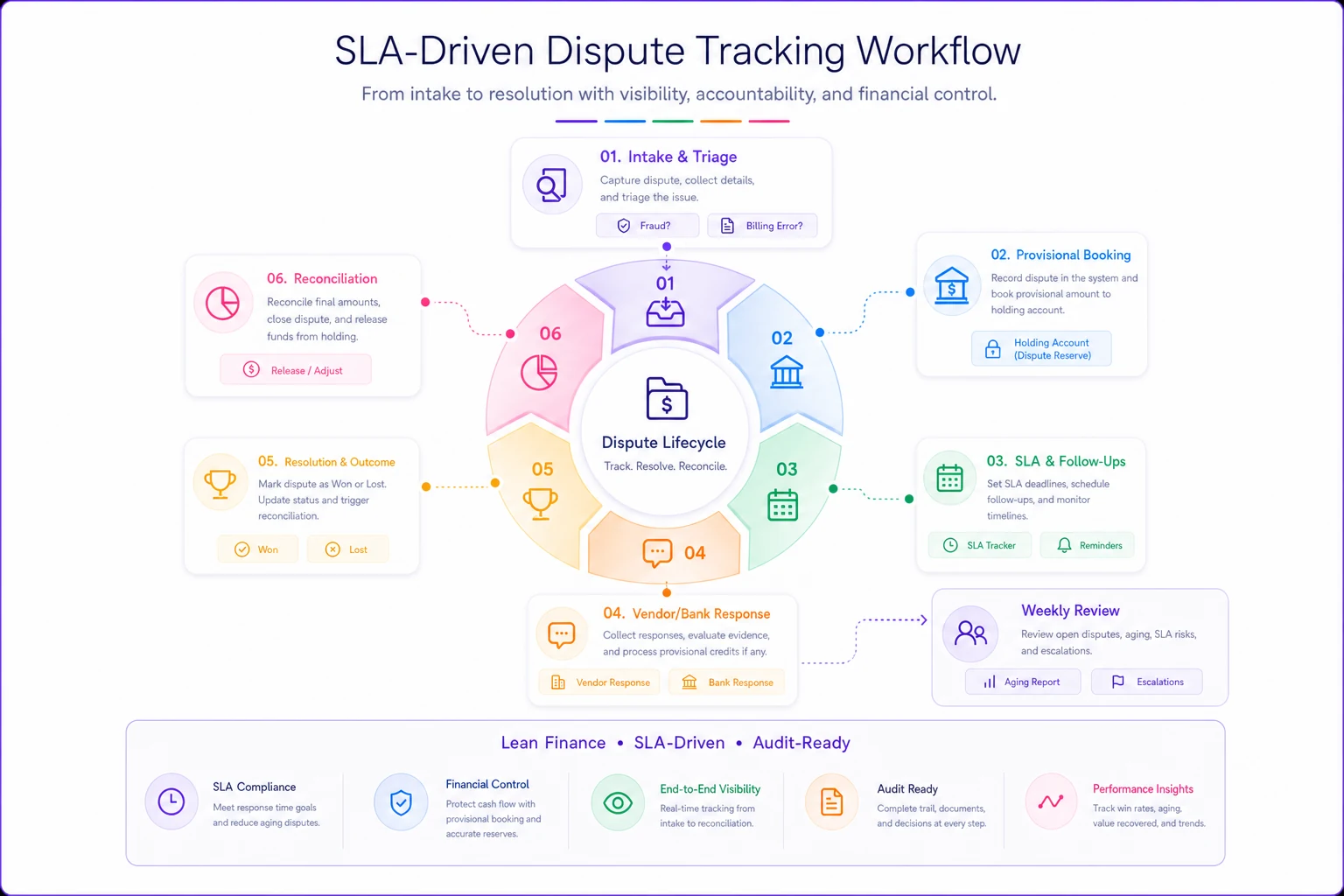
The visual maps intake, provisional booking, SLA follow-ups, and final reconciliation so the team knows who does what and when.
Allocation rules for credits (the part that breaks reconciliation)
When a credit finally lands, where does it go? This is where lean teams lose hours, and it's entirely preventable with a few standing rules.
The core question: does the credit go back to the same category and cost center the original charge came from? Get this wrong and your category spending looks distorted for months.
-
Fraud reversals → back to the exact original category and cost center. A fraudulent charge and its reversal should net to zero in the same place, same period if possible.
-
Full billing-error refunds → same treatment; reverse it against the original line so the category reads correctly.
-
Partial vendor credits → allocate the credited portion to the original category; the remainder stays as a real expense. Don't dump the whole thing anywhere convenient.
-
Goodwill / account credits (vendor gives you $200 off next month for the hassle) → this is not a reversal of the original expense. It's a discount on the next purchase and should be booked when applied, not against the disputed charge.
-
Credits spanning categories → if a $900 credit covers three original charges across two categories, split it proportionally. Booking the whole credit against one category to save time is the single most common reason a category suddenly looks negative.
That goodwill-credit distinction trips up a surprising number of teams. They treat a "sorry, here's $200 off" gesture as if it undoes the disputed charge, which double-counts the relief and leaves the original dispute technically unresolved in the tracker.
A reconciliation checklist sized for a lean team
If the steps above happened during the month, disputes should be the easy part of reconciliation at month-end. Here's the check that closes the loop:
-
[ ] Every disputed charge from this period appears in the holding account, not in a real expense line
-
[ ] Every provisional credit is flagged as provisional, not final
-
[ ] Every dispute marked "Won — credit final" has a matching credit that's landed and cleared
-
[ ] Every "Lost" dispute has the expense moved out of holding into its real category
-
[ ] No provisional credits older than the bank's clawback window are still sitting as provisional
-
[ ] Vendor credits promised over 30 days ago are either received or escalated
-
[ ] The holding account nets to only genuinely open disputes — nothing stale
-
[ ] Any partial or split credits reconcile back to their original charges
If the holding account balance equals the sum of your genuinely-open disputes, you're done. That's the whole reason for the structure — a single number to check instead of a statement to comb through.
A real scenario
A small e-commerce brand, roughly eight people, was processing a steady trickle of chargebacks and vendor refunds — nothing dramatic, maybe 12–18 dispute or credit events a month between fraud, duplicate charges from a fulfillment vendor, and shipping refunds.
Before they fixed the process, disputes lived in email and memory. Month-end reconciliation regularly ran an extra half-day because credits and original charges landed in different periods and different categories, and someone had to reverse-engineer which credit belonged to which charge. A few vendor credits — probably $600–$800 total over a few months — were simply never followed up on and quietly written off by accident.
After setting up a holding account, a provisional booking template, and a weekly ten-minute dispute review with SLA dates, two things changed. Reconciliation stopped surprising them — disputed items were already parked and labeled, so closing them was a checklist, not an investigation. And the "credits we forgot to chase" problem basically went away because the SLA follow-up date caught them. Not a huge dollar recovery, but the month-end time savings alone was worth it — they got that half-day back most months.
When this level of structure makes sense (and when it doesn't)
This makes sense when you're seeing more than a handful of disputes or vendor credits a month, or when disputes routinely cause month-end confusion. If credits and charges landing in different periods is a recurring reconciliation headache, the holding-account structure pays for itself fast.
This is overkill when you get maybe one dispute a quarter. Building a full triage matrix and SLA tracker for two events a year is process for its own sake — just book them carefully and move on.
Who should NOT bother yet: if you don't have a clean chart of accounts and consistent categorization to begin with, fix that first. A holding account only helps if your real categories mean something. And if disputed charges are frequently just forgotten subscriptions, the leverage isn't in dispute handling at all — it's upstream in your recurring-charge controls.
Where tooling quietly helps
None of this requires software, and you're better off nailing the process in a spreadsheet than buying a tool to skip the thinking. But once the volume is real, the manual version has one weak point: nobody remembers to check the SLA dates or move items out of holding.
That's the piece worth automating. Operational finance platforms with built-in workflow automation can flag when a provisional credit passes its clawback window, nudge you when a vendor credit is overdue for follow-up, and keep disputed transactions tagged and separated from real expense lines automatically. The value isn't intelligence — it's that the follow-up happens without depending on a person to remember. For teams already dealing with the harder edge of this, where disputed charges overlap with potential internal issues, it connects naturally to a broader detection-to-investigation approach for expense fraud.
Card dispute handling for a small business goes wrong not because disputes are hard, but because they're slow and easy to lose track of in the gap between filing and resolution. Split fraud from billing errors at intake, park disputed charges somewhere visible instead of leaving them buried in real numbers, put dates on every open case, and set your credit allocation rules once. Do that, and disputes stop being the thing that ruins your last day of the month.
Ready to master your business expenses?
Join 5,000+ businesses using Costyly to save time, reduce overspending, and improve financial visibility.