


Three months ago, a marketing agency owner discovered their operations manager had been submitting fake vendor invoices for eight months. Total damage: $47,000. The worst part? They had expense approval workflows, monthly reviews, everything you'd expect. The fraud slipped through because they were looking at individual expenses instead of patterns.
This keeps happening in small businesses. Not because owners are careless, but because expense fraud detection for small businesses requires a completely different approach than enterprise systems. You need detection workflows that match your actual staffing levels, investigation processes that don't consume entire weeks, and scoring systems that highlight what actually matters for a business your size.
The detection blind spots that cost SMBs thousands
Most small businesses catch expense fraud by accident. Someone notices a weird charge while looking for something else. A vendor calls about an unpaid invoice you thought was already settled. An employee mentions they never went on that business trip.
Small business expense fraud operates differently than the corporate fraud you read about in case studies. Your fraudsters aren't sophisticated criminals running complex schemes. They're regular employees who discovered gaps in your workflows and gradually escalated their taking.
A typical progression: Someone expenses a $30 Uber ride they took personally, claiming it was for a client meeting. Nobody catches it. Next month, they add a $75 "client dinner" that never happened. Still nothing. By month six, they're submitting entirely fictional conference registrations and equipment purchases. The amounts stay just below whatever threshold triggers extra scrutiny.
Meanwhile, you're drowning in legitimate expense noise. Real receipts, actual vendor invoices, genuine business charges. The fraudulent stuff blends right in because it looks exactly like normal business spending. That $200 "office supplies" charge? Could be real, could be fake. Without a detection system, you'll never know until it's too late.
Small business fraud compounds differently. One person getting away with it encourages others. Vendors start padding invoices when they realize nobody's checking. Employees become less careful with company cards when they see loose controls. What starts as a few hundred dollars monthly can turn into significant annual losses.
Why traditional fraud detection breaks at SMB scale
Enterprise fraud detection relies on dedicated teams, specialized software, and statistical models trained on millions of transactions. You have none of these things. More importantly, you shouldn't try to build them.
Stop losing track of your business spending.
Costyly helps you record, monitor & control expenses—accurately and efficiently.
- Automated expense categorization
- Real-time budget tracking
- Detailed financial reports
No credit card required
Detection patterns that work for companies processing thousands of expenses monthly completely fail when you're dealing with 50-200 expenses. Statistical anomalies mean nothing at low volumes. Machine learning needs massive datasets you don't have. Segregation of duties requires more people than your entire finance team.
Small businesses also face different fraud risks. You're not worried about sophisticated procurement fraud schemes or complex kickback arrangements. Your problems are simpler but harder to catch: duplicate expenses, personal charges miscategorized as business, inflated mileage claims, ghost vendors created by employees.
Traditional audit approaches assume you can afford to investigate lots of false positives. Check everything suspicious, interview people, pull documentation, verify with vendors. But when your finance team is two people who also handle AR, AP, and payroll, you need surgical precision.
Building detection signals that match your actual risks
Forget about detecting every possible fraud type. Focus on the patterns that actually hurt small businesses. Start with these high-value signals that consistently catch real problems:
Velocity changes matter more than amounts. When someone's monthly expense submissions jump from 5 to 15, or their average receipt amount doubles, something changed. Maybe legitimate, maybe not. But worth flagging.
Track these specific velocity patterns:
-
Submission frequency increases of 40% or more
-
Average expense amount changes by 35% or more
-
New expense categories appearing after 6+ months of history
-
Weekend/holiday submissions when that wasn't normal before
Merchant patterns reveal intent. Fraudulent expenses cluster around certain merchant types because they're easier to fake or harder to verify:
-
Generic merchants (Amazon, Walmart, Office Depot)
-
Digital services without physical delivery
-
Subscription services that are hard to audit
-
Cash-heavy businesses (restaurants, gas stations)
Build a simple risk score: High-risk merchant + round dollar amount + no detailed receipt = investigation priority.
Timing patterns expose coordination. Real business expenses follow natural patterns. Fraud often doesn't:
-
Expenses submitted exactly at reimbursement deadlines
-
Charges that happen just before budget periods reset
-
Multiple similar amounts submitted across different categories
-
Expenses that cluster right after approval threshold changes
One construction company noticed their project manager always submitted exactly $490 equipment purchases, just under the $500 approval threshold. Turned out he had a deal with a hardware store employee to create fake receipts.
In small datasets, prioritize velocity and pattern signals over single large amounts—they reveal gradual fraud escalation.
Build detection that surfaces these patterns rather than chasing every anomalous dollar figure.
The investigation workflow that actually works with two-person teams
When you detect a suspicious pattern, you need an investigation process that provides answers fast without destroying team relationships or consuming weeks of work.
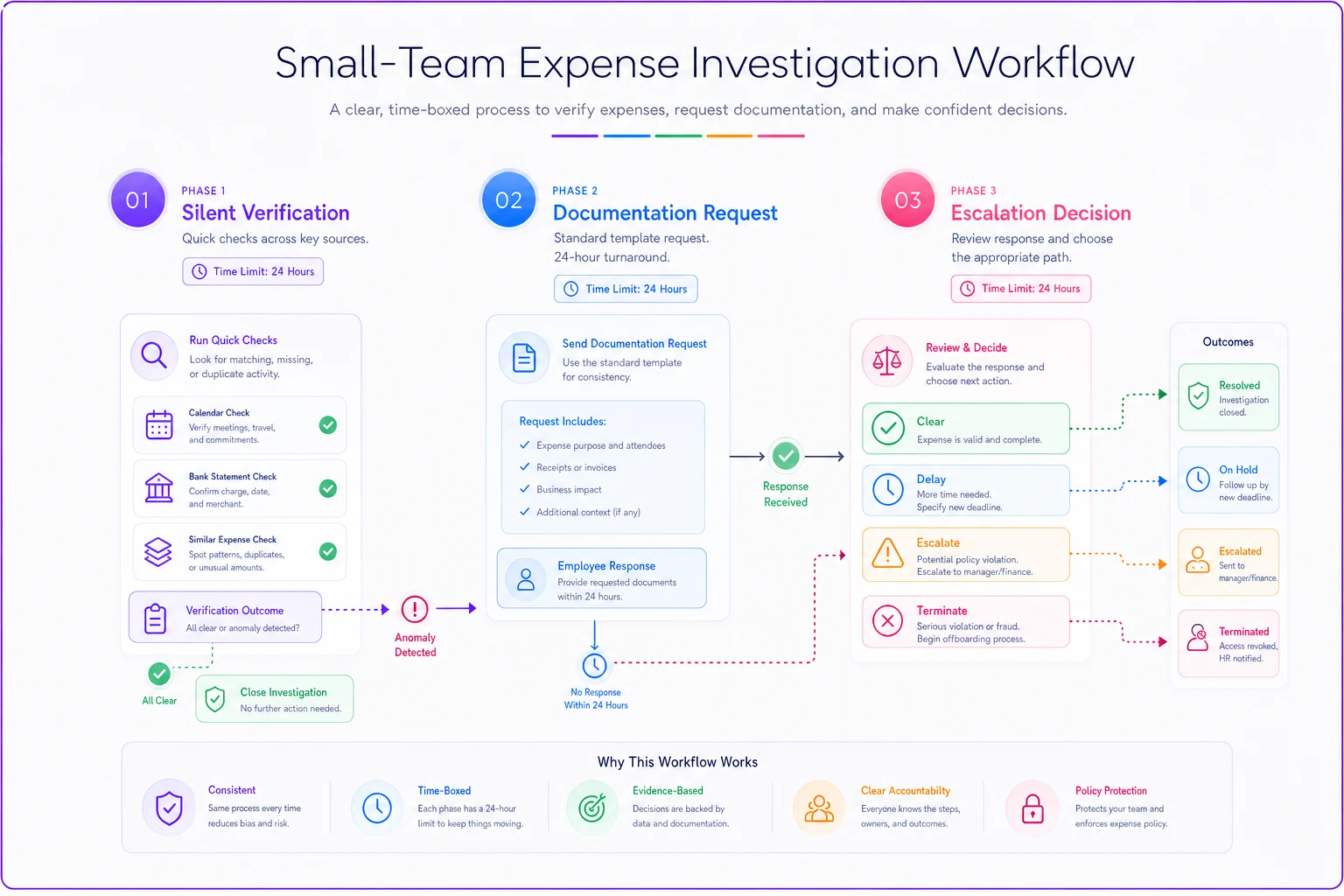
Phase 1: Silent verification (2 hours max) Before alerting anyone, verify what you can independently:
-
Cross-reference the expense against calendar entries
-
Check if similar expenses exist from other employees
-
Verify the vendor is real and the amount matches their pricing
-
Look for the transaction in bank/card statements
This phase eliminates many false positives without creating drama.
Phase 2: Documentation request (24-hour turnaround) If concerns remain, request additional documentation with a standard template:
-
"Hi [Name], We're updating our expense documentation for audit purposes. Could you provide [specific item] for your [date] expense? We need this by [deadline] to process your reimbursement."
-
Keep it routine, not accusatory. Request the same documentation from 2-3 other employees to avoid singling someone out.
Phase 3: Escalation decision (1 hour) Based on their response, decide whether to:
-
Clear the expense (documentation provided, story checks out)
-
Delay reimbursement pending further review
-
Escalate to ownership/leadership
-
Begin termination discussions
Document your decision reasoning. You'll need it later.
Here's a simple visual of the three-phase investigation workflow for small teams.
Keep interactions routine and avoid accusatory language to preserve relationships while gathering facts.
Triage scoring that prevents both fraud and false accusations
Not every suspicious expense deserves the same attention. You need a scoring system that prioritizes investigations based on actual risk and impact.
Score each suspicious expense from 0-10 on:
| Criteria | Scoring |
|---|---|
| Financial impact (0-3 points): | - Under $100: 0 points - $100-500: 1 point - $500-1500: 2 points - Over $1500: 3 points |
| Pattern strength (0-3 points): | - Single occurrence: 0 points - 2-3 similar instances: 1 point - 4-6 instances: 2 points - Ongoing pattern: 3 points |
| Documentation quality (0-2 points): | - Full documentation: 0 points - Partial/unclear documentation: 1 point - Missing documentation: 2 points |
| Employee history (0-2 points): | - Clean history, 2+ years: 0 points - Minor previous issues OR under 6 months: 1 point - Previous violations OR brand new: 2 points |
Investigation priorities:
-
Score 8-10
Investigate immediately
-
Score 5-7
Investigate within current period
-
Score 3-4
Flag for next quarterly review
-
Score 0-2
Note but don't pursue
This scoring keeps you focused on cases that matter while building documentation for patterns that might escalate.
Evidence collection that holds up without a legal team
When you find actual fraud, you need evidence that supports action even without lawyers involved. Small businesses can't afford lengthy legal battles, so your evidence needs to be clear enough to support immediate termination and potential criminal referral.
Essential evidence checklist:
Transaction evidence:
-
Original receipts or invoices
-
Bank/credit card statements showing the charge
-
Expense report submissions
-
Approval emails or system logs
-
Any modified versions of documents
Pattern documentation:
-
Spreadsheet showing all similar transactions
-
Timeline of when patterns started/escalated
-
Comparison to other employees' similar expenses
-
Policy violations mapped to specific instances
Communication records:
-
Emails discussing the expenses
-
Text messages or chat logs related to purchases
-
Calendar entries that contradict expense claims
-
Vendor communications confirming or denying transactions
Witness information:
-
Who else knew about the expenses
-
Who might have seen the employee during claimed travel
-
Vendors who can verify or dispute charges
-
Other employees with similar legitimate expenses
Keep everything in a single folder with clear naming conventions. You might need to hand this to law enforcement, insurance, or legal counsel quickly.
Remediation templates that protect the business
When you confirm fraud, you need quick, decisive action that protects the business while minimizing disruption.
Scenario 1: Employee padding legitimate expenses (under $5K total)
-
Calculate total fraudulent amount
-
Offer choice
immediate termination OR repayment plan with final warning
-
Revoke expense privileges regardless of choice
-
Implement additional approval for their department
-
Audit all their expenses from past 12 months
Most of these cases result in repayment arrangements rather than termination.
Scenario 2: Fake vendor or invoice fraud (over $5K)
-
Immediate termination (no negotiation)
-
File police report with evidence package
-
Contact business insurance about coverage
-
Audit all vendors added in past year
-
Implement vendor verification process
-
Consider legal action if amount justifies cost
Scenario 3: Credit card misuse for personal expenses
-
Cancel card immediately
-
Document all personal charges
-
Demand immediate repayment
-
Terminate if not repaid within 48 hours
-
Report theft to card company if unpaid
-
Implement receipt requirements for all card users
Scenario 4: Collusion with external vendor
-
Terminate employee immediately
-
Terminate vendor relationship
-
Audit all vendor's invoices from past 2 years
-
Send formal demand letter to vendor
-
Report to relevant trade associations
-
Consider civil lawsuit if amount warrants
Each template includes specific language for termination letters, demand notices, and insurance claims.
Monthly detection queries that catch problems early
Running these queries monthly will catch most fraud patterns before they explode:
-
"Show all employees whose expense submissions increased by 40% or more compared to their 6-month average"
-
"Flag all expenses that are exact multiples of $10 over $50"
-
"Find all expenses within $5 of each other submitted within 30 days"
-
"List all expenses submitted on weekends or holidays by employees who normally submit on weekdays"
-
"Identify employees using new expense categories they've never used before"
These queries work in Excel with basic filters. You don't need specialized software, just consistency in running them.
Building investigation discipline without paranoia
Set clear investigation triggers based on your expense KPI thresholds. Not every anomaly deserves investigation. Not every investigation needs to be exhaustive. Create monthly investigation budgets: "We'll investigate the top 3 scored concerns each month, period." This prevents investigation creep while ensuring you're checking the highest-risk items.
Train whoever handles investigations (usually one person in small businesses) to separate pattern detection from accusation. Finding something suspicious doesn't mean fraud is happening. It means something changed and needs explanation. Approach investigations as "help me understand" conversations rather than interrogations.
Communicate about your detection processes without revealing specific methods. Let employees know you actively monitor for fraud without telling them exactly what you're watching. Something like: "We've implemented systematic expense auditing to ensure policy compliance and protect everyone from false accusations." This creates deterrence without paranoia.
When AI-powered detection makes sense for SMBs
Manual detection works fine when you're processing under 100 expenses monthly. Beyond that, patterns become impossible to spot without help. This is where AI-enhanced operational platforms actually solve real problems rather than just adding complexity.
Modern expense management platforms can automatically flag the velocity changes, merchant patterns, and timing anomalies we've discussed. They don't replace human judgment but they surface the patterns humans need to investigate. Instead of manually running queries and calculating risk scores, the system highlights what needs attention.
Choose platforms designed for small business operations rather than enterprise tools scaled down. You need detection that understands your actual fraud risks, investigation workflows that match your team size, and remediation processes that protect the business without requiring a legal department.
Good AI-powered detection also learns from your investigation outcomes. When you mark something as legitimate after investigation, the system adjusts its pattern recognition. This reduces false positives over time while maintaining sensitivity to real fraud.
The investigation framework that scales with growth
As your business grows from 10 to 50 to 100 employees, your fraud risks evolve. The investigation framework needs to scale accordingly without requiring complete overhauls.
Start with detection basics when you're small: monthly queries, simple scoring, template-based remediation. As you grow, layer in automated detection, dedicated investigation time, and formal policies. The core framework stays the same, but the execution gets more sophisticated.
This scalability is why building proper detection workflows early matters. The patterns you establish with 10 employees become the foundation for handling 100. The investigation discipline you develop now prevents much larger fraud later.
Building effective approval bottleneck prevention becomes critical as you scale, since complicated approval chains create more opportunities for fraud to slip through.
Expense fraud detection for small businesses isn't about catching every possible issue. It's about catching the expensive ones before they spiral, maintaining enough deterrence to prevent casual fraud, and building investigation processes that don't consume more resources than the fraud itself would cost.
The businesses that succeed long-term aren't the ones that never experience fraud. They're the ones that catch it early, handle it professionally, and learn from it systematically. A well-designed repeatable expense management system forms the foundation of effective fraud prevention by creating clear processes and reducing the ambiguity that fraudsters exploit.
Ready to master your business expenses?
Join 5,000+ businesses using Costyly to save time, reduce overspending, and improve financial visibility.