


Most reimbursement pain isn't caused by dishonest people or bad policy. It's caused by a fuzzy lifecycle. A receipt lands somewhere, an approver is on vacation, finance is waiting on a category code, and the person who paid $340 for a client dinner is quietly furious two weeks later. Nobody did anything wrong. The process just has no clock and no owner at each stage.
The fix isn't "be faster." It's building an actual lifecycle with defined stages, service-level agreements (SLAs) at each handoff, and rules for what happens when a stage stalls. That's what this post covers—submission templates, what to accept when a receipt is missing, checks worth automating, exception handling, and a short reconciliation routine you can run without dread.
This is deliberately narrow. We're not covering approval matrices or expense analytics. Just the reimbursement lifecycle itself, from submission to money-in-the-bank.
Where reimbursements actually break
Before templates, it helps to see the specific failure points. In real operations, a reimbursement dies in one of five places:
-
Submission — missing receipt, no business purpose, wrong amount typed, personal card mixed with company card.
-
Validation — finance can't tell what account it hits, or the amount doesn't match the receipt.
-
Approval — the approver doesn't know it's waiting, or doesn't know their limit.
-
Payment — approved but sitting in a queue nobody runs on a schedule.
-
Reconciliation — paid, but never matched against the bank line, so it floats as an unexplained debit at month-end.
Only one of these (submission) is really the employee's fault. The other four are lifecycle-design failures. That's the reframe: if reimbursements are slow, the problem is usually between people, not with people.
One pattern worth calling out specifically: the single biggest silent delay is the gap between "approved" and "paid." Teams obsess over approval speed and then let approved reimbursements sit for a full pay cycle because payment runs are ad hoc. You can approve something in four hours and still pay it eleven days later.
The submission template that kills half your rework
Rework at the submission stage is where most of the calendar time gets eaten. A reimbursement that comes in incomplete bounces back, waits for the employee to respond, comes back missing something else, and now you're on day six of a request that should've taken a day.
Stop losing track of your business spending.
Costyly helps you record, monitor & control expenses—accurately and efficiently.
- Automated expense categorization
- Real-time budget tracking
- Detailed financial reports
No credit card required
The goal is to make submission structured enough that incomplete requests basically can't be submitted. Here's the minimum field set worth enforcing:
-
Date of expense (not date of submission)
-
Amount and currency
-
Business purpose — one sentence, specific ("client lunch, Acme renewal discussion," not "meals")
-
Category — chosen from a fixed list, not free text
-
Payment method used — personal card, personal cash, personal check
-
Receipt or approved evidence alternative (more on this below)
-
Project or cost center if you allocate
The category field matters more than people realize. When employees type "meals" or "travel stuff" as free text, finance has to translate every single line into your chart of accounts by hand. Forcing a pick-list at submission means the coding is mostly done before it ever reaches finance. If you haven't standardized how spend maps to your books yet, that's worth fixing first—we walk through it in mapping expense categories to your chart of accounts, and it makes every downstream reimbursement check simpler.
A small but real observation: date-of-expense vs. date-of-submission trips up more teams than you'd expect. People submit a batch of receipts from a three-week trip, date them all "today," and now your month-end cutoff is wrong and your reconciliation won't tie. Make date-of-expense mandatory and separate.
When there's no receipt: evidence alternatives that don't invite fraud
Half the friction in reimbursements is the missing receipt. Someone lost the parking stub, the restaurant didn't email it, the toll was cash. If your only rule is "no receipt, no reimbursement," you generate endless exceptions and resentful employees. If your rule is "eh, just tell me the amount," you've opened a fraud lane.
The middle path is a tiered evidence policy—clear about what substitutes for a receipt and at what dollar threshold.
| Situation | Acceptable evidence | Threshold |
|---|---|---|
| Standard purchase | Itemized receipt | Any amount |
| Receipt lost, card used | Card/bank statement line + written purpose | Under ~$75 |
| Cash purchase, no receipt | Signed missing-receipt declaration + purpose | Under ~$25 |
| Recurring/known vendor | Vendor confirmation email or invoice | Any amount |
| Mileage | Trip log with date, route, purpose | Standard rate |
The thresholds are yours to set—these are typical for a small team. The point is that the evidence alternative is defined in advance, so a missing receipt becomes a routine path instead of a case-by-case argument. A missing-receipt declaration works because it puts a name and a signature on the claim; people are far more careful when they're attesting rather than casually asking.
One mistake to avoid: don't let the same person submit missing-receipt declarations every week. A quiet check—flagging anyone whose no-receipt claims exceed, say, three per month—catches the drift before it becomes a habit. You're not accusing anyone; you're just watching the pattern.
Automation-friendly checks (what to verify before human eyes)
Not every reimbursement needs a human to touch it. The ones that need a human need it because a check failed—not because everything requires manual review. The goal is to let clean requests flow and route only the exceptions to a person.
-
Completeness — are all required fields present? If not, reject at submission, don't queue.
-
Amount-to-evidence match — does the number entered match the receipt total (within a small tolerance for tips or rounding)?
-
Duplicate detection — same amount, same date, same vendor as an existing claim? Flag it. Duplicates are usually accidental double-submissions, not fraud, but they still cost real money.
-
Threshold routing — does the amount exceed the submitter's auto-approve limit? Route to the right approver.
-
Category-to-account sanity — does the chosen category map cleanly to a GL account? If it's ambiguous, hold for coding.
-
Policy limits — is the per-meal or per-night amount within policy? Flag overages for approval, don't auto-reject.
The ordering matters: completeness first means you never waste a human on a request that was going to bounce anyway. Teams that run these checks up front typically find that more than half of requests clear with no manual touch at all. Finance only sees the genuine judgment calls.
Run completeness first so humans only see valid submissions.
This is exactly the kind of repetitive, rule-based work that AI-assisted expense platforms handle well. A tool that reads the receipt, extracts the amount, matches it to the submitted figure, checks for duplicates, and applies your thresholds turns validation from a manual chore into a background step. You're not replacing judgment—you're removing the twenty minutes of eyeballing that happens before judgment. The human still decides on the flagged $600 dinner; they just don't have to hand-verify the fifteen clean $40 lunches around it.
Exception rules: define the weird cases before they happen
Every reimbursement system runs fine until an exception shows up and there's no rule for it. Then it sits. The person who owns the queue doesn't want to make a call they're not authorized to make, so it waits for a meeting.
Write down the exceptions in advance. The most common ones for small teams:
-
Over-limit spend (someone booked a $500 hotel when policy says $250): who approves the overage, and do they need a reason in writing?
-
Late submission (expense from four months ago)
is there a hard cutoff, and who can waive it?
-
Foreign currency
which exchange rate—transaction date or submission date? Pick one and never argue about it again.
-
Mixed personal/business receipt (grocery run with two client snacks in it): does the employee circle the business items, or is the whole thing rejected?
-
Advance vs. reimbursement
if someone got a cash advance, the reimbursement has to net against it, not pay twice.
Exceptions don't slow you down because they're hard. They slow you down because nobody decided the answer before the exception appeared. Ten minutes writing down "over-limit needs the department head's written OK, waivable only by the owner" saves you the recurring stall.
A compact reconciliation routine (with timings and owners)
Reconciliation is where reimbursements go to die quietly. They get paid, and then nobody matches the payment against the bank statement, so at month-end you've got mystery debits. A tight routine fixes this—and it doesn't need to take long.
-
Weekly (owner
AP/finance lead, ~20 min) — Pull all reimbursements marked "paid" this week. Match each to a bank or card line. Anything unmatched gets flagged with a reason.
-
Weekly (owner
same, ~10 min) — Review the exception queue. Every item either gets a decision or an explicit "waiting on X, ETA date." Nothing sits without a next step.
-
Bi-weekly (owner
submitter's manager, ~5 min) — Clear any missing-receipt declarations older than two weeks. Either the evidence arrives or the item gets escalated.
-
Month-end (owner
finance lead, ~30 min) — Confirm all reimbursements dated within the period are either paid or explicitly accrued. Tie the total to the GL account. No floating unexplained lines.
The whole thing is under an hour a week for a small team, and it prevents the ugly month-end scramble where you're chasing three-week-old $80 debits. If you want the broader month-end context this plugs into, the repeatable expense management system for faster month-end covers how reimbursement reconciliation fits alongside the rest of your close.
On timing: the weekly cadence matters more than the duration. A 20-minute reconciliation every Friday beats a two-hour one at month-end, because fresh transactions are easy to match and stale ones aren't. The longer a debit floats, the harder it is for anyone to remember what it was.
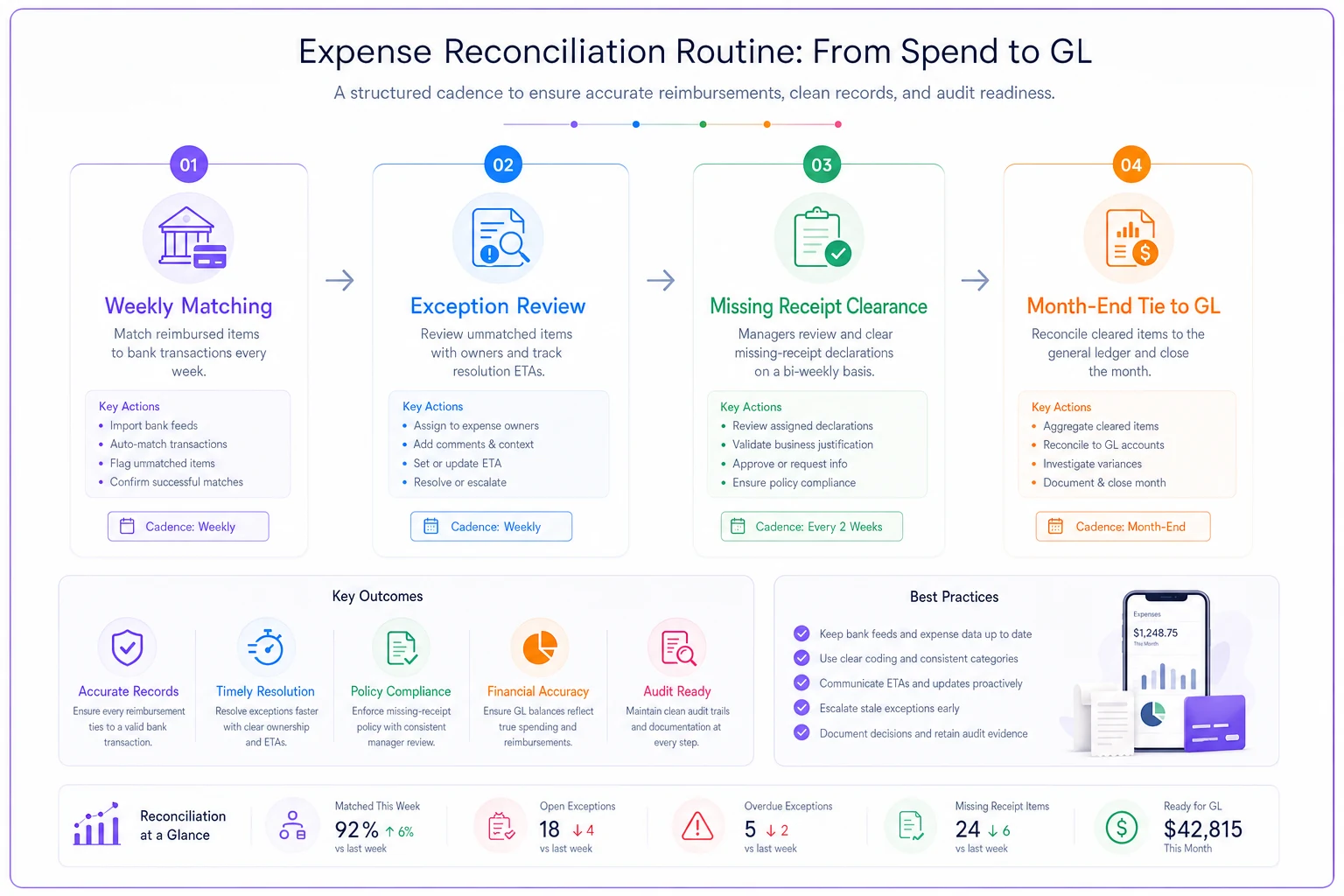
This diagram shows the reconciliation steps, owners, and timing in a simple flow.
Real scenario: a 14-person agency
A small creative agency—about 14 people, heavy on client travel and dinners—was running reimbursements through email and a shared spreadsheet. The typical request took somewhere around 12–16 days from submission to payment. Not because approvals were slow, but because incomplete submissions bounced back and forth, and payment runs happened whenever someone remembered to run them.
They made three changes. First, a structured submission form that rejected incomplete requests up front. Second, a tiered evidence policy so missing receipts under $75 stopped becoming week-long arguments. Third, a fixed weekly payment run every Thursday plus the reconciliation routine above.
Within about two months, the average turnaround dropped to roughly 4–5 days. The bigger win was quieter: month-end stopped surfacing mystery debits, because the weekly match caught everything while it was fresh. The finance person estimated they got back somewhere around three to four hours a week that used to go into chasing receipts and re-explaining the process to people.
Nothing here was fancy. The gain came almost entirely from putting a clock and an owner on each stage.
When this level of structure makes sense (and when it doesn't)
This lifecycle is worth building if you're processing more than a handful of reimbursements a month, or if reimbursements are a recurring source of complaints. Once you've got travel, client entertainment, or people regularly fronting costs, the ad hoc approach quietly costs you goodwill and clean books.
When it's overkill: if you reimburse maybe one or two things a month and everyone's in the same room, a full SLA lifecycle is more process than you need. A shared folder and a Friday check will do fine.
Who should skip most of this: very early, very small teams where the owner personally sees every expense. The value of defined stages and owners shows up when the person paying, the person approving, and the person reconciling are three different people. When they're the same person, the overhead isn't worth it.
The signal to build the lifecycle is usually simple: employees start asking "where's my reimbursement?" more than once a month. That question means your process has no visible clock. Give it one.
Reimbursements don't get slow because people are careless. They get slow because the lifecycle has no defined stages, no clocks between handoffs, and no owner for the boring middle steps—especially the gap between approved and paid, and the reconciliation nobody wants to run. Structure the submission so incomplete requests can't enter. Define your evidence alternatives before the missing receipt shows up. Automate the checks that don't need a human. Write down the exceptions in advance. Run a short weekly reconciliation with a real name on it.
Do that, and the person who fronted $340 for a client dinner gets paid in days, not weeks—and your month-end stops surprising you.
Ready to master your business expenses?
Join 5,000+ businesses using Costyly to save time, reduce overspending, and improve financial visibility.