
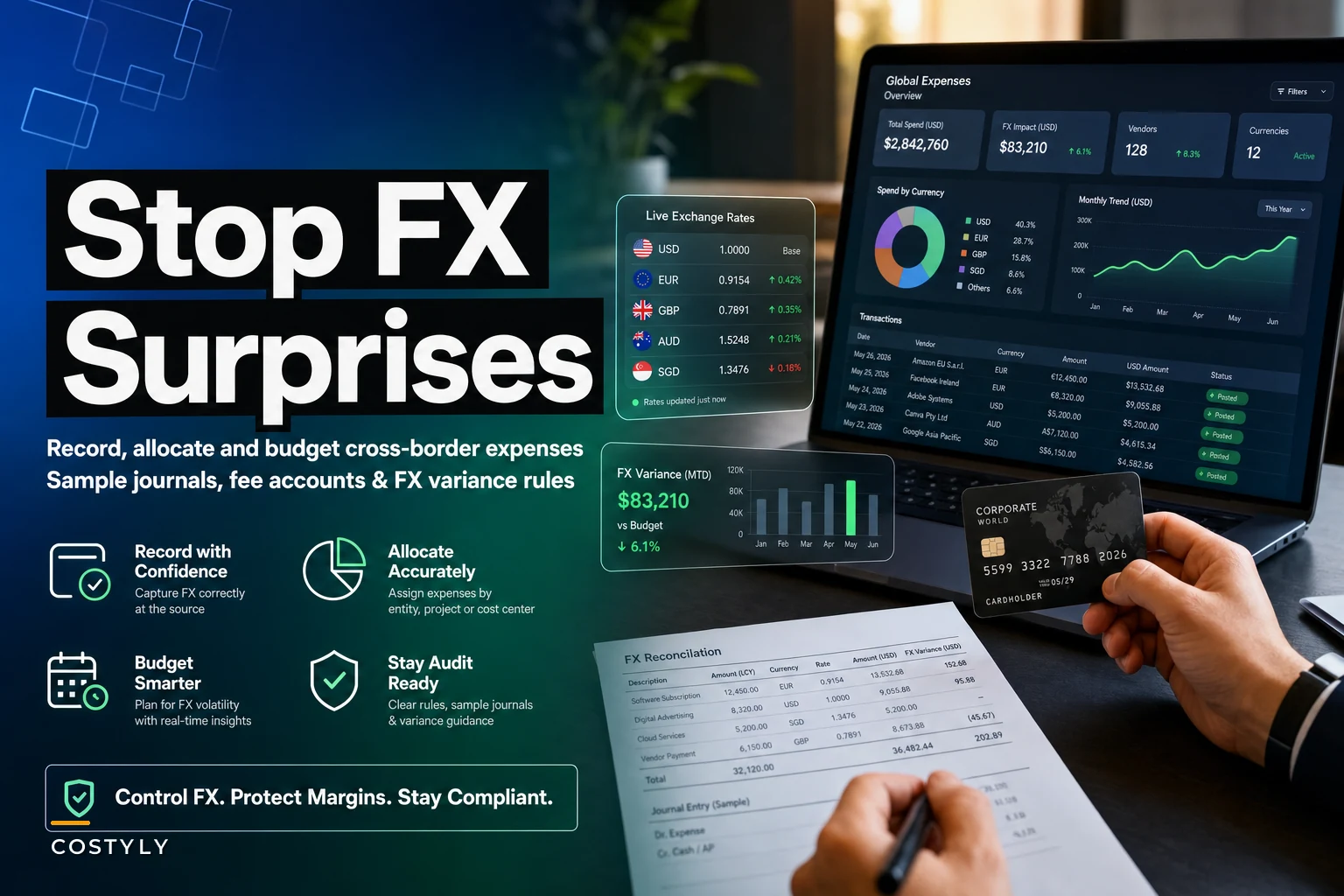

The tricky thing about cross-border expenses isn't the exchange rate. It's the gap between what your card statement says, what your accounting software books, and what your budget assumed. Three different numbers for the same transaction, none of them agreeing.
For a small finance team, the gap turns into hours of manual reconciliation every month, plus a slow leak of fees nobody ever formally budgeted for. Because the amounts per transaction are small — a few dollars here, a percent-and-a-half there — it stays invisible until someone finally adds it up across a year.
This piece covers the whole chain: how to record FX, how to allocate fees fairly, what your journal entries should actually look like, and how to set variance thresholds so cross-border spend stops blowing up your budget.
Where the numbers stop matching
Here's the sequence that causes most of the mess. You buy a €400 software subscription. Your provider bills in EUR. Your card issuer converts it, and your statement shows something like $442. Your accounting system books it at whatever rate it pulls on the transaction date — say $436. Now you've got a $6 difference floating around, and you're not even sure whether the FX markup and the foreign transaction fee are the same charge or two separate ones.
This usually happens because three systems apply their own rate at slightly different moments:
-
The payment provider applies a spot rate plus a spread at authorization
-
The card issuer applies a foreign transaction fee (often 1–3%) at settlement, which can be a day or two later
-
Your accounting software applies its own reference rate when you import the transaction
None of these are wrong. They're measuring different things at different times. When you have 30–40 cross-border transactions a month across a handful of vendors, that's 30–40 tiny discrepancies to chase.
The mistake most small teams make is treating each discrepancy as a one-off to reconcile manually. That's how a straightforward month-end turns into a two-day slog.
Rule one: separate the true cost from the fee
The single most useful habit is splitting every cross-border transaction into two components at the point of recording:
Stop losing track of your business spending.
Costyly helps you record, monitor & control expenses—accurately and efficiently.
- Automated expense categorization
- Real-time budget tracking
- Detailed financial reports
No credit card required
-
The base expense — the vendor's actual charge, converted at a consistent rate
-
The FX and card fees — the markup, the foreign transaction fee, and any spread
These two numbers answer completely different questions. The base expense tells you what you spent on the thing. The fee tells you what you spent on the method of payment. Lump them together and you can never see how much your payment setup is quietly costing you.
A typical example: say your team spends roughly $8k–$9k a month on foreign-billed vendors. At a blended 2.2% in FX and card fees, that's around $180–$200 a month, or somewhere close to $2,300 a year, just on the mechanics of paying. That number is very hard to argue for reducing if it's buried inside your software and travel line items. Pull it into its own account and suddenly it's a decision you can actually make.
Put FX & card fees in a single dedicated account so you can report and budget for them separately without changing your expense categories.
Being consistent here matters more than being technically perfect. A slightly imprecise rate applied consistently every month is far easier to manage than a precise rate applied differently each time.
Sample journal templates
Keep these consistent and reconciliation gets dramatically simpler. The goal is one repeatable pattern per transaction type, not a custom entry every time.
Foreign vendor invoice paid by card (single-currency card):
| Account | Debit | Credit |
|---|---|---|
| Software Expense (base) | $436.00 | |
| FX & Card Fees | $6.20 | |
| Card Clearing / Payable | $442.20 |
When settlement rate differs from booking rate (realized FX gain/loss):
| Account | Debit | Credit |
|---|---|---|
| Card Clearing / Payable | $442.20 | |
| FX Gain/Loss | $1.40 | |
| Cash / Bank | $443.60 |
The clearing account is the piece most small teams skip, and it's the piece that saves you. You book the expense against clearing when the charge appears, then clear it against actual cash when the statement settles. Any rate movement between those two moments lands cleanly in FX Gain/Loss instead of getting smeared across your expense categories.
If you're mapping these to your books for the first time, it's worth being deliberate about which accounts these hit — the same discipline that makes a chart of accounts usable everywhere else. There's a fuller treatment of that in mapping expense categories to your chart of accounts, and the FX and fee accounts should slot into that same structure rather than living as one-off catchalls.
Being consistent here matters more than being technically perfect. A slightly imprecise rate applied consistently every month is far easier to manage than a precise rate applied differently each time.
Rule two: pick one recording rate and stick to it
You have three realistic options for what rate to record the base expense at:
-
Transaction-date spot rate — clean and defensible, but won't match your statement exactly
-
Card issuer's applied rate — matches your statement, but bakes the fee into the base
-
Monthly average rate — simplest for high-volume, low-value transactions, but loses precision
For most small teams, the transaction-date spot rate for the base plus a separate fee line is the sweet spot. It keeps your expense clean, isolates the fee, and the small settlement difference flows to FX Gain/Loss where it belongs.
The one rule that actually matters: don't switch methods mid-year. Inconsistency is what makes variance analysis useless. If half your transactions use the issuer rate and half use spot, you can never tell whether a budget miss is real spending or just rate noise.
Allocating fees when the expense is shared
Fees get messy fast when a foreign charge belongs to more than one team or project. A €1,200 conference registration split across three departments shouldn't dump the entire FX fee on whoever happened to hold the card.
The clean approach is to allocate the fee in the same proportion as the base expense. If department A takes 50% of the base, it takes 50% of the fee. Simple, defensible, and it survives an audit.
Where teams overcomplicate this is trying to allocate fees based on separate logic — like assigning all FX costs to a central finance cost center. That feels tidy but it hides the true cost of each department's cross-border activity. A team that consistently buys from foreign vendors should see that reflected in their numbers. If you want fee visibility to actually change behavior, it has to land on the team that generated it.
Variance thresholds that account for FX noise
Standard budget variance thresholds break down for cross-border spend because part of every miss is just currency movement, not overspending. If you flag every 5% variance, you'll drown in false alarms driven by a euro that moved two cents.
-
Base expense variance — flag at your normal threshold (say 8–10%), because this reflects real spending behavior
-
FX/fee variance — flag only if it exceeds roughly 15–20%, since smaller moves are usually rate-driven and not actionable
-
Combined absolute floor — ignore any variance under a set dollar amount (e.g., $150) regardless of percentage, so tiny lines don't generate noise
The point is to hold your team accountable for the base expense and hold the market accountable for FX movement. Mixing both into a single variance number is how good managers end up chasing ghosts. Splitting them, using the same discipline you'd apply to any expense KPI dashboard, keeps the alerts meaningful.
Most teams that get this right aren't doing anything sophisticated — they've just decided in advance what they're going to ignore, so the alerts they do get are worth acting on.
When multi-currency cards actually make sense
When a multi-currency card makes sense:
-
You have recurring spend in one or two foreign currencies (e.g., steady EUR software subscriptions or GBP contractor payments)
-
Your monthly foreign-billed volume is consistent enough that the 1.5–3% in fees adds up to real money
-
You want to lock in a rate by pre-funding the currency rather than eating conversion on every charge
When it's a bad idea:
-
Your foreign spend is scattered across many currencies with no single dominant one — you'll just manage multiple balances for marginal benefit
-
Your total cross-border volume is low enough that fee savings won't cover the operational overhead
-
Nobody on your team will actually monitor and top up the currency balances
A rough rule of thumb: if you're spending more than about $5k–$6k a month in a single foreign currency, a dedicated balance in that currency usually pays for itself. Below that, a good standard card with low FX markup is simpler and cheaper to run.
Who should skip this entirely: a two-person team with occasional foreign purchases. The savings are real but small, and the extra reconciliation of a second currency balance will eat whatever benefit you'd get. Keep it simple until the volume justifies the complexity.
Vendor and provider considerations
A few things worth checking before assuming your fees are unavoidable:
-
Ask foreign vendors if they can bill in your home currency. Some will, and if their rate is reasonable it removes FX handling entirely. Just watch for vendors who bill in your currency but bake in a worse rate than your card would apply.
-
Compare your card issuer's foreign transaction fee against alternatives. A 3% fee versus a 1% fee on $8k of monthly foreign spend is a difference of roughly $160 a month — not nothing.
-
Check settlement timing. Providers that settle same-day give you a cleaner match between booking and settlement rates, which means fewer FX gain/loss entries to explain.
The pattern worth watching: the provider with the flashiest "no FX fees" marketing often makes it back on the spread. Always compare the effective rate you actually received, not the advertised fee — divide what you were charged by the vendor's original amount and see what the real number is.
A real scenario
A small design agency, around 12 people, was paying a mix of European software vendors and a couple of overseas contractors. Monthly foreign spend ran roughly $9k–$11k, and everything got booked at the card's applied rate straight into software and contractor expense lines. Fees were invisible.
When they split out FX and card fees into a dedicated account, the total surprised them: close to $2,600 over the prior year, all in fee and spread costs they'd never budgeted. About 70% of it came from a single EUR-billed vendor they paid every month.
They moved that one recurring vendor to a pre-funded EUR balance and standardized on transaction-date spot rate for booking with a separate fee line. The fee visibility didn't magically eliminate the cost, but it cut the recurring-vendor portion by roughly half. Just as importantly, month-end reconciliation of foreign charges dropped from most of a day to under an hour. The discrepancies weren't gone — they were just landing predictably in FX Gain/Loss instead of getting chased one by one.
The bigger takeaway wasn't the cost savings. It was that once the fees had their own account, the conversation about payment setup actually happened. Before that, nobody could point to a number worth discussing.
Pulling it together
Cross-border expenses stop being a surprise the moment you stop treating each transaction as a special case. Split the base from the fee. Pick one recording rate. Route settlement differences to a clearing and FX gain/loss account. Allocate fees proportionally. Set variance thresholds that separate real spending from currency noise. And only reach for multi-currency cards when a single currency's volume actually justifies the extra operational work.
Here's a simple workflow to make this repeatable across your transactions.
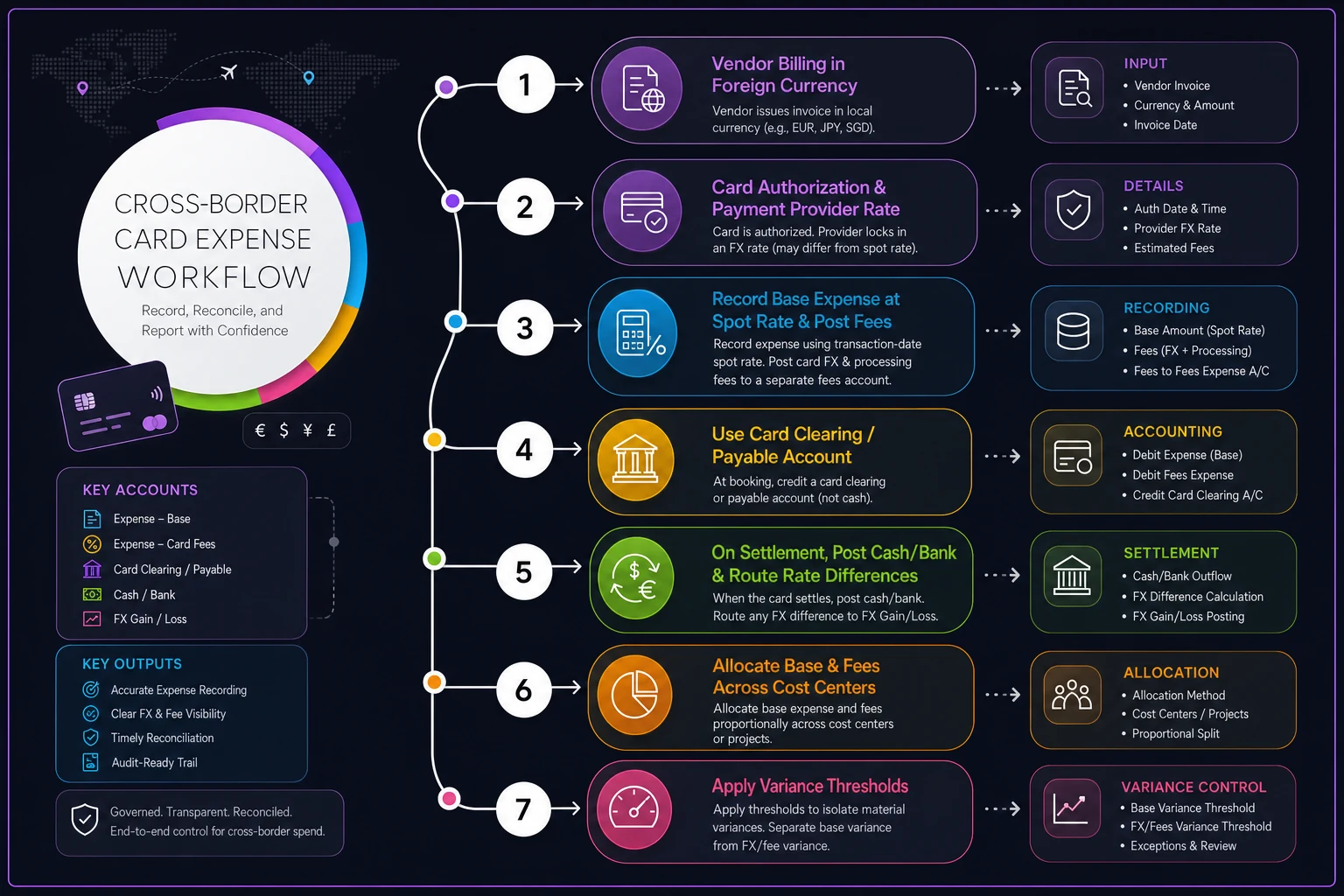
The teams that handle this well aren't doing anything clever with exchange rates. They just have a consistent, repeatable recording pattern that makes the invisible costs visible — and once those costs are visible, they're something you can manage instead of absorb.
The teams that handle this well aren't doing anything clever with exchange rates. They just have a consistent, repeatable recording pattern that makes the invisible costs visible — and once those costs are visible, they're something you can manage instead of absorb.
Ready to master your business expenses?
Join 5,000+ businesses using Costyly to save time, reduce overspending, and improve financial visibility.