

The AP list rarely breaks in one dramatic moment. It rots slowly. You start with a clean 200-vendor file, and eighteen months later you've got "Amazon," "Amazon.com," "AMZN Mktp US," "Amazon Web Services," and "amazon marketplace" all sitting in the same ledger — each attached to a slightly different payment history, a different tax ID field, and a different set of open POs.
That's the actual shape of the vendor master data deduplication problem for SMBs. It's not a technology gap. It's a maintenance gap. And the teams that stay clean aren't the ones with fancy MDM tools — they're the ones who set a few boring rules and actually stick to them.
This is a focused walkthrough of those rules, the weekly cadence, and the merge safety checks that keep a vendor list from turning into a swamp. No enterprise stack required.
Where the duplicates actually come from
If you trace back most vendor duplicates, they don't come from careless data entry. They come from legitimate-looking variation that no one was watching for.
-
Onboarding by different people. One person types "Staples Inc," another types "Staples," a third pastes "STAPLES 00456" straight off a receipt. All three feel correct in the moment.
-
Payment-processor names bleeding into the master. Card feeds and bank imports drop the merchant descriptor as-is — "SQ BLUE BOTTLE," "TST Blue Bottle," "Blue Bottle Coffee LLC." Nobody decided to create three vendors; the feed did it for them.
-
Legal-entity vs. trade name confusion. The invoice says "Meta Platforms Inc." The account rep calls it "Facebook Ads." The card statement says "FACEBK." Same money, three records.
-
Rush payments. Someone needs to cut a check today, can't find the existing vendor fast enough, and just creates a new one. That's probably the single most common cause in real operations — urgency beats hygiene every time.
Duplicates are a workflow artifact, not a data-entry mistake. If your onboarding path makes it faster to create a new vendor than to find an existing one, you will get duplicates forever, no matter how many times you clean up.
Why this quietly costs you money
Most owners underestimate the cost because it never shows up as a single line item. It's spread out.
Stop losing track of your business spending.
Costyly helps you record, monitor & control expenses—accurately and efficiently.
- Automated expense categorization
- Real-time budget tracking
- Detailed financial reports
No credit card required
Duplicate vendors distort spend reporting — you think you spend $40k a year with a supplier when you actually spend $70k across three records, so you never qualify for the volume discount you've already earned. They break 1099 reporting, because payments to the same TIN are split across records and none of them individually cross the threshold cleanly. They create duplicate-payment risk, since an invoice can get keyed against the "wrong" copy of a vendor and slip past a control that only checks within a single record.
And they make reconciliation slower every single month. When your team can't trust that one vendor equals one row, every close turns into detective work. This is the same failure mode that trips up teams trying to move a dirty ledger forward — the reasons not to migrate messy expense history without a cleanup pass apply just as hard to the vendor master.
Lightweight fuzzy-match rules that actually work for small teams
You don't need machine learning to catch 80% of duplicates. You need a handful of normalization rules and a similarity threshold you can run in a spreadsheet or a simple script.
-
Lowercase everything.
-
Remove common legal suffixes — inc, llc, ltd, corp, co, gmbh.
-
Strip processor prefixes — SQ, TST, PP, POS, and the asterisk junk from card feeds.
-
Remove punctuation and extra spaces.
-
Collapse known aliases — a small lookup table that maps "facebk" and "meta platforms" to "facebook," for example.
Once names are normalized, run a similarity score. A simple approach that holds up:
| Match signal | What it catches | Confidence |
|---|---|---|
| Exact normalized name match | Spacing/case/suffix variants | High — safe to auto-flag |
| Same tax ID (TIN/VAT) | Legal vs. trade name, processor variants | Very high — strongest single signal |
| Same bank account / routing | Renamed vendors, acquisitions | Very high |
| Name similarity ≥ 90% + same ZIP | Typos, abbreviations | Medium — needs human review |
| Name similarity 80–89% | Loose matches, common words | Low — review only, never auto |
The operational rule that saves you: tax ID and bank account are trust signals; name is a hint. Two records with different names but the same TIN are almost always the same vendor. Two records with a 95% name match but different bank accounts might be two real, separate entities — think franchise locations. Weight the identifiers, not the string.
One mistake to avoid: setting the fuzzy threshold too low. Drop it to 70% and you'll match "Northwest Plumbing" to "Northeast Plumbing" and create a merge that's worse than the duplicate. Start strict, review near-misses by hand, and only loosen when you trust the data.
The weekly tidy cadence
Big annual cleanups feel productive and accomplish almost nothing lasting, because the list re-dirties within a quarter. The teams that stay clean run a small, boring weekly pass instead — usually somewhere around 20 to 30 minutes.
-
Every Friday, pull the list of vendors created in the last seven days. That's usually a handful — five to fifteen for most SMBs.
-
Run each new vendor through the normalized fuzzy match against the existing master.
-
Anything scoring high-confidence gets flagged for merge review immediately, while the person who created it still remembers the context.
-
Log anything legitimately new so you're not re-reviewing it next week.
Catching duplicates at one week old is dramatically easier than at one year old. A week-old duplicate usually has one invoice attached and no payment history. A year-old one has POs, payments, credits, and 1099 amounts tangled into it — merging that safely takes real work.
Do the review while the creator still remembers the context.
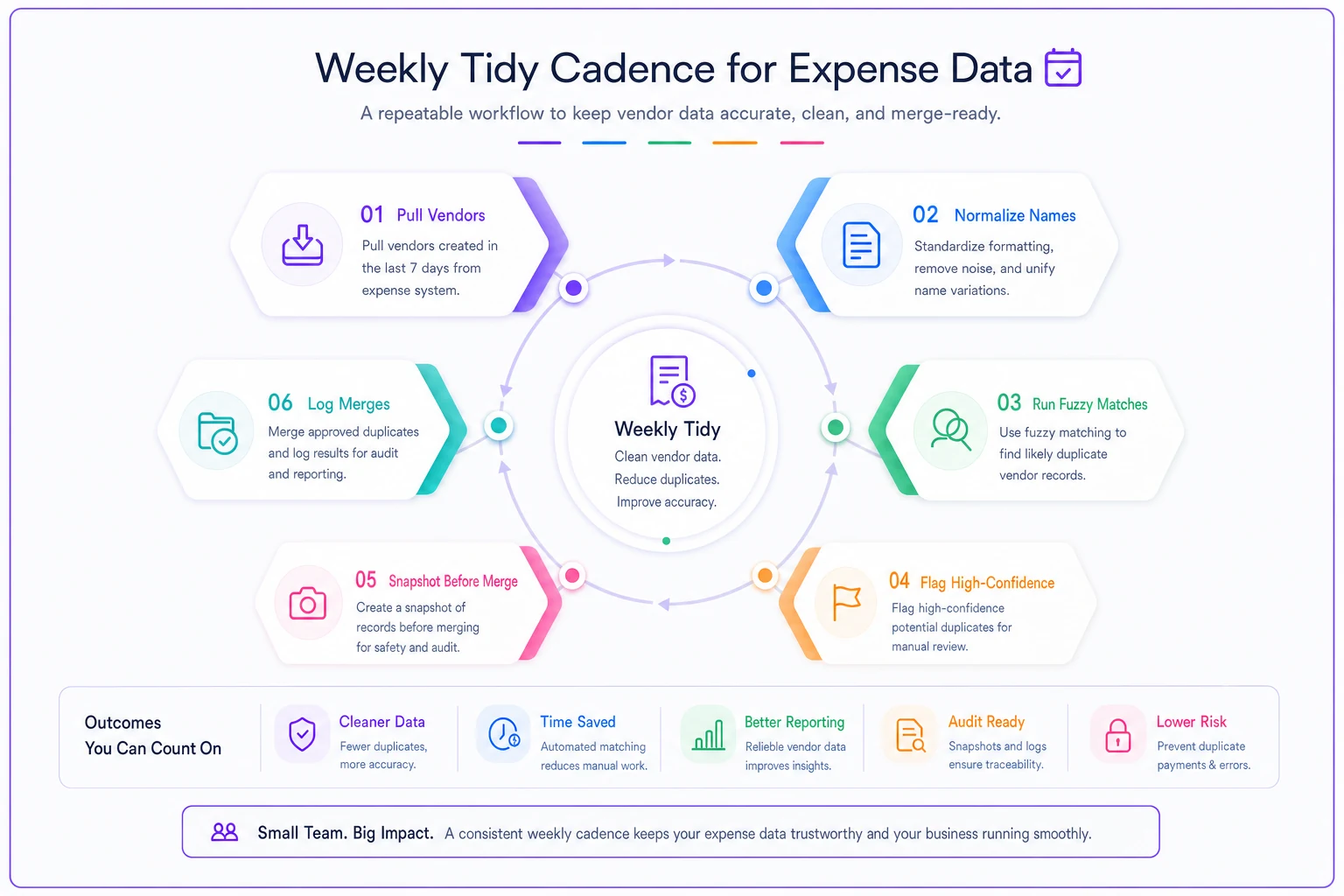
A simple diagram showing the weekly tidy steps.
The cadence matters more than the tooling. A weekly 30-minute review with a rough spreadsheet beats a perfect deduplication engine you run once a year.
Trusted-source policy: decide what "true" means
Before you merge anything, your team has to agree on which field wins when two records disagree. Without this, merges become arguments, and arguments become "we'll deal with it later."
-
Legal name comes from the W-9 / tax document, not the invoice, not the card feed.
-
Tax ID comes from the W-9. Full stop.
-
Remittance / bank details come from a verified vendor form or a call-back to a known number — never from an emailed change request alone (that's a classic fraud vector).
-
Contact info can come from the most recent verified interaction.
Write this down. One page. When two records conflict, the policy decides — not whoever's doing the merge that day. This is the same discipline that keeps a chart of accounts from drifting. The ideas in mapping expense categories to your chart of accounts carry straight over: define the source of truth once, then let it settle disputes automatically.
Merge safety checks before you combine records
Merging is the dangerous part. A bad merge can point historical payments at the wrong entity, break audit trails, or wipe a tax ID you needed for 1099s. Never merge blind.
-
[ ] Do the tax IDs match, or is one blank? Two different, non-blank TINs = do NOT merge. Investigate first.
-
[ ] Do open POs or unpaid invoices exist on both records? Note them so nothing gets orphaned.
-
[ ] Is there payment history on both? Confirm the combined history will still reconcile.
-
[ ] Which record survives? Pick the one with the cleanest legal name and correct TIN as the "keep" record.
-
[ ] Are bank details identical or verified? If they differ, stop — you might be merging two real entities.
-
[ ] Snapshot both records before merging. Export them so you can reverse the merge if something looks wrong later.
-
[ ] Check for active recurring payments pointed at the record you're about to retire.
The single most important habit: always keep a pre-merge snapshot. Merges are hard to undo cleanly in most accounting systems. A saved export of both records — even just a CSV in a dated folder — is your undo button.
A small-team runbook to reduce mapping exceptions
Mapping exceptions are what you get downstream when your vendor list is messy — imports that won't post, feeds that don't match, reports that need manual patching. Cutting them at the source means giving the team a repeatable path.
-
New vendor request comes in. Requester searches the existing master by normalized name and tax ID before creating anything.
-
If a likely match exists, they route the invoice to the existing vendor instead of creating a new one.
-
If genuinely new, they collect the W-9 first, then create the record with the trusted-source fields populated.
-
Friday review runs the fuzzy match over the week's additions.
-
Flagged duplicates go through the merge safety checklist, snapshot included.
-
Merges get logged — who, when, which records, why — in a running sheet.
Operational software can help here mostly by removing the manual matching grind. A workflow platform with fuzzy-match rules built in can surface likely duplicates the moment a vendor is created and hold it for review before it ever hits the ledger — which turns the weekly tidy pass into a quick approval queue instead of a hunting expedition. But the runbook is what matters. The tool just enforces it consistently.
A real scenario
A regional catering company — around 18 staff, one part-time bookkeeper, roughly 240 active vendors on paper — kept overpaying on food supply orders. Their books showed spend split across "Restaurant Depot," "Rest Depot #12," and "RD Wholesale," none individually large enough to trigger the loyalty rebate tier.
They ran a one-time normalized match, found around 30 duplicate clusters, and consolidated the main ones. The supplier consolidation alone qualified them for a volume rebate they'd been leaving on the table — somewhere in the low thousands annually. Equally useful, their monthly close dropped by a few hours because the bookkeeper stopped chasing "which Restaurant Depot is this invoice for."
They didn't buy anything fancy. They set up the weekly Friday review, wrote a one-page trusted-source policy, and kept a merge log. Six months later the duplicate rate on new vendors was near zero, because the review caught them at a week old instead of a year.
When this makes sense — and when to skip it
The full cadence is worth running once you're past roughly 100 to 150 active vendors, or when duplicates start affecting real decisions — missed discounts, 1099 headaches, unreliable spend reports.
When it's a bad idea: if you've got 30 vendors and a tight team, a formal weekly runbook is overkill. Just do a quick search before creating a new vendor and a light quarterly scan. Don't build governance you don't need.
Who should NOT bulk-merge: anyone without pre-merge snapshots and a trusted-source policy already in place. Merging first and figuring out the rules later is how you turn a duplicate problem into a data-loss problem. Get the policy written, get the checklist habit, then start merging.
Vendor master hygiene isn't glamorous, and it never fully "finishes." But a strict-enough match rule, a 30-minute weekly pass, and a merge checklist with snapshots will keep your list clean with far less effort than the annual heroics most teams put themselves through — and it quietly pays for itself in recovered discounts, cleaner reporting, and faster closes.
Ready to master your business expenses?
Join 5,000+ businesses using Costyly to save time, reduce overspending, and improve financial visibility.