


Most small finance teams don't fail an audit because their numbers are wrong. They fail because they can't prove the numbers quickly enough. The transactions are legitimate, the receipts exist somewhere, the approvals happened — but reconstructing the chain from a charge on a card statement all the way back to "who said yes and why" turns into a two-week archaeology project. Auditors working on tight SMB engagements don't have two weeks.
What separates a smooth audit from a painful one is whether you can hand over a clean evidence pack on day one. Not a shoebox of PDFs. A structured, traceable set of exports where every line of spend connects to its receipt, its approval, and the policy it was checked against. That's what expense audit readiness actually means in practice — not more documentation, but connected documentation.
This article covers how that evidence system holds together, where it breaks as you grow, and how to build the export templates and traceability maps that let a reviewer close out your section in a morning instead of a week.
Why "we have the receipts" isn't enough
Nobody tells you until you're mid-audit: having every receipt and still failing to produce a clean trail is incredibly common. The receipts exist. The approvals existed. But they live in four different systems — the card provider, the email inbox where a manager replied "approved," the accounting ledger, and whatever folder someone dumped scans into.
An auditor doesn't want four systems. They want one question answered repeatedly: show me this transaction, prove someone with authority approved it, and prove the receipt matches the amount and date. When your answer requires opening three tabs and a Slack search, you've already lost the efficiency battle.
What breaks most small teams isn't the individual pieces — it's the joins. A $4,200 vendor payment is in the ledger. The receipt is in Drive. The approval is a forwarded email. Each exists, but nothing links them with a shared identifier, so someone has to manually re-establish the connection every single time. Multiply that by 300 transactions in a sample and you understand why audits run long and expensive.
The core problem isn't missing evidence. It's missing relationships between evidence.
What an auditor actually asks for (and the order they ask it)
Before building any template, it helps to understand the sequence a reviewer works through. SMB auditors on short timelines almost always move the same way:
Stop losing track of your business spending.
Costyly helps you record, monitor & control expenses—accurately and efficiently.
- Automated expense categorization
- Real-time budget tracking
- Detailed financial reports
No credit card required
-
1. Give me the population. The full list of transactions for the period — every expense, with dates, amounts, vendors, categories, and GL coding.
-
2. Let me pick a sample. They'll select a subset, often 25–60 items depending on risk and materiality.
-
3. For each sampled item, prove it. Receipt, approval, business purpose, policy compliance, correct coding.
-
4. Show me the exceptions. Anything flagged, overridden, duplicated, or manually adjusted — and the reasoning.
-
5. Reconcile it. Tie the expense population back to the ledger and to the bank/card statements.
If your evidence pack is organized around that flow, the audit moves fast. If it's organized around how your internal systems happen to store things, every step requires translation. That mismatch is where days disappear.
One pattern worth noting: auditors rarely complain about the quality of a single receipt. They complain about inconsistency — some items have crisp trails, others have gaps, and they can't predict which. Predictability lowers their testing effort because they can trust the system. Inconsistency forces them to test everything manually.
The traceability map: transaction → receipt → approval
The backbone of an audit-ready system is a traceability map. In plain terms, it's a single structure where every transaction carries pointers to the evidence that justifies it. Not stored in different places — referenced from one record.
A minimal traceable expense record needs these linked elements:
-
- Transaction ID — a stable, unique key that never changes
-
- Source reference — the card auth code, bank reference, or invoice number it came from
-
- Receipt reference — a document ID and a hash or version so you can prove the file wasn't swapped later
-
- Approval reference — who approved, when, at what authority level, and against which policy version
-
- GL coding — the account and cost center it landed in
-
- Exception flags — duplicate checks, policy overrides, manual edits
The magic isn't in any one field. It's that each record is self-contained. Hand an auditor one row and they can walk the entire chain without asking a single follow-up question. That's the real test: can a reviewer resolve a transaction end-to-end from the row alone? If yes, you're audit-ready. If they have to come back to you, you're not.
If your transaction records and your document records don't share clean keys, you can't build the map — you can only fake it manually each cycle. This is why the groundwork in a solid expense data model matters so much; traceability is only as strong as the identifiers connecting your systems. Same goes for coding consistency — a traceability map falls apart if the same expense type lands in three different GL accounts depending on who entered it, which is where disciplined chart-of-accounts mapping pays off during testing.
How a single transaction should flow
The diagram below shows how a traceable expense record connects its key elements from charge to coded entry:
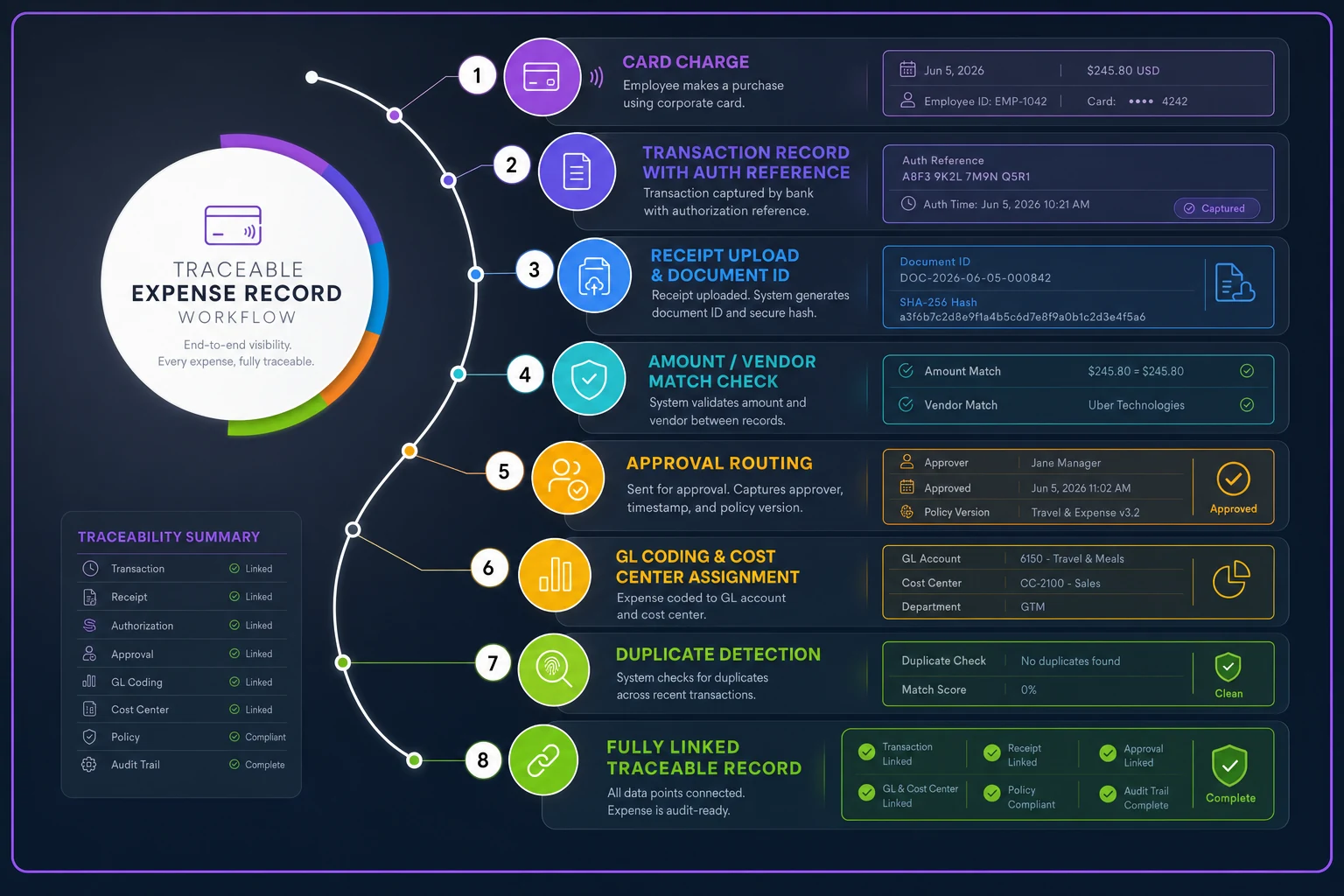
Walk through how a $1,850 software renewal moves through this in practice. The charge hits the corporate card and lands in the expense system with its own ID and the card auth reference attached. The employee uploads the invoice; the system assigns it a document ID, stores a content hash, and links it to the transaction ID. A matching routine confirms the amount and vendor align, then routes it to the department head because it exceeds the $1,000 approval threshold. The approver clicks approve; the system stamps the approver, timestamp, authority tier, and the policy version in effect. The item gets coded to the right GL account and cost center, and a duplicate-detection check runs and marks it clean.
At the end of that flow, the record is the evidence. No reassembly needed. The approval, receipt, and policy context are already welded to the transaction. When an auditor samples that item six months later, everything they need travels with the row.
Export templates: CSV and JSON that reviewers don't have to decode
Auditors work in spreadsheets and increasingly in data tools. Your job is to give them clean, flat, well-named exports — not a proprietary report dump with merged cells and subtotals baked in.
| Format | Best for | Why it works |
|---|---|---|
| CSV | The transaction population, sampling worksheets, reconciliation tie-outs | Opens anywhere, filters and pivots easily, auditors already live in it |
| JSON | Full traceability records with nested receipt/approval objects | Preserves the relationships and nesting; good for data-driven reviewers and re-import |
A useful CSV transaction population export should carry one row per transaction with columns like: transaction ID, date, vendor, amount, currency, GL account, cost center, category, approver, approval date, receipt document ID, policy version, and exception flag. Flat. No merged headers. Dates in ISO format. Amounts as plain numbers with a separate currency column.
A JSON traceability export does something the CSV can't — it keeps the full nested structure. One transaction object contains the receipt object (with document ID, hash, upload timestamp) and the approval object (approver, authority level, timestamp, policy reference) as children. That's what lets a reviewer verify the whole chain for a sampled item without stitching rows together.
Include a manifest file alongside CSV/JSON exports so reviewers can check completeness before testing begins.
One small but genuinely useful addition: include a manifest. One extra file that lists what's in the pack, the date range, row counts, control totals, and the export timestamp. Auditors appreciate this because it tells them whether the data is complete before they start testing. A manifest that says "4,312 transactions, total $1,284,006.42, period 2024-01-01 to 2024-03-31" lets them reconcile the population to the ledger in thirty seconds.
Validation checks before you hand anything over
The worst audit outcome isn't a tough question — it's handing over an export riddled with gaps the auditor finds for you. Run your own validation first. Every exception you catch and explain is one you control the narrative on.
-
- [ ] Completeness
does the export row count match the ledger transaction count for the period?
-
- [ ] Control totals
does the sum of exported amounts tie to the GL and to card/bank statements?
-
- [ ] Orphan receipts
any receipt documents not linked to a transaction?
-
- [ ] Missing receipts
any transactions above the receipt threshold with no linked document?
-
- [ ] Approval coverage
any transaction over its approval threshold with no approval record?
-
- [ ] Authority check
did any approval come from someone below the required authority tier?
-
- [ ] Duplicate scan
any same-vendor, same-amount, same-date pairs not already flagged?
-
- [ ] Coding consistency
any vendor coded to multiple GL accounts without a documented reason?
-
- [ ] Date integrity
any approval timestamps that predate the transaction or postdate the export?
-
- [ ] Hash integrity
do stored receipt hashes still match the files in the pack?
Running these isn't about perfection. It's about knowing your own exceptions before someone else does. A pack that arrives with a short note — "14 transactions under $25 lack receipts per our policy threshold; here's the policy" — reads as a controlled environment. A pack where the auditor discovers 14 missing receipts reads as a control failure, even though it's the identical situation.
The handoff runbook: a one-page system for short timelines
SMB audits often happen fast and with whoever's available. The person who built the expense system might be on vacation during fieldwork. A minimal handoff runbook — one page — keeps the audit moving regardless of who's in the room.
-
1. What's in the pack — the file list, formats, period, and control totals (your manifest, essentially).
-
2. How to read the traceability record — a short key explaining each field and how transaction, receipt, and approval link together.
-
3. Where the samples resolve — how to take a transaction ID and find its receipt and approval, step by step.
-
4. Known exceptions — the documented gaps, overrides, and policy thresholds, with the reasoning for each.
-
5. Who to contact — primary and backup, with what each person actually knows.
-
6. Policy references — approval matrix, receipt thresholds, and retention rules in effect for the period.
The point of the runbook is that it answers the questions an auditor would otherwise interrupt you with. Every interruption answered in advance is time saved on both sides. For teams that also need to demonstrate how long records are kept and how access is controlled, tying the runbook to a documented expense security and retention framework closes another common line of questioning before it's even asked.
Sample export timeline: what "ready" looks like on a calendar
Below is a realistic sequence for pulling an evidence pack together when an audit request lands, assuming your system already maintains traceability throughout the year. If it doesn't, the timeline balloons — which is the entire argument for maintaining this continuously rather than scrambling when the request arrives.
| Day | Activity | Output |
|---|---|---|
| Day 1 | Generate transaction population export (CSV), confirm date range and control totals | Population file + manifest |
| Day 1–2 | Run full validation checklist, document exceptions | Validation report |
| Day 2 | Generate JSON traceability export with linked receipts and approvals | Traceability pack |
| Day 3 | Resolve or explain flagged exceptions, finalize known-exceptions list | Exception memo |
| Day 3 | Assemble handoff runbook, verify contact info and policy references | Runbook |
| Day 4 | Internal review — can someone unfamiliar resolve 5 random samples from the pack alone? | Go/no-go |
| Day 4 | Deliver pack to auditor | Complete evidence pack |
That "Day 4 internal review" step is the one teams skip and regret. Pull five random transaction IDs, hand the pack to someone who didn't build it, and ask them to trace each one end-to-end. If they can't, your auditor won't either. It's a cheap dress rehearsal that catches the gaps your familiarity hides, and it takes maybe an hour to run.
A real scenario
A roughly 35-person design agency with around $1.4M in annual expenses went through their first real audit after landing an investor who required reviewed financials. Their first attempt at producing evidence was the usual mess — card statements in one place, receipts in a shared drive organized by nobody's logic, approvals buried in email threads.
The initial sample of 40 transactions took their controller close to nine working days to support, because every item meant hunting down a receipt and digging up an approval email. Three items had no recoverable approval trail at all — the spend was legitimate, but they simply couldn't prove who authorized it. That turned into an audit finding and an awkward conversation with the investor.
Before the next cycle, they rebuilt the system around traceability: every transaction carried a linked receipt ID and a stamped approval record from the moment it entered the system. The following year, producing the evidence pack for a similar-sized sample took under two days, most of which was validation and assembling the runbook rather than hunting. The auditor's testing hours dropped noticeably, which showed up directly in a lower fee. No findings on documentation that round.
The spend didn't change. The connections between the evidence did.
When this level of rigor makes sense — and when it doesn't
When it's worth building fully: You're facing investor-required reviews, a bank covenant audit, a grant compliance check, or you're scaling past the point where one person remembers every transaction. Any time someone external will test your spend, structured traceability pays for itself in reduced audit hours and fewer findings.
When it's overkill: A three-person shop with 40 transactions a month and no external reporting obligation doesn't need a JSON traceability schema. A tidy folder structure and consistent receipt capture is enough. Building a formal evidence-pack system before anyone's auditing you is effort spent on a problem you don't have yet.
Who should hold off: If your underlying expense data is a mess — inconsistent coding, no stable transaction IDs, vendors entered six different ways — don't start by building export templates. You'll just export the mess faster. Fix the data foundation first, then layer traceability on top of clean records. A traceability map built on inconsistent data is a traceability map that lies convincingly.
The real shift
The teams that breeze through audits aren't working harder during fieldwork — they're maintaining the trail continuously so there's almost nothing to assemble when the request comes. Traceability isn't a project you do once a year under pressure. It's a property your expense system either has or doesn't, built from the quiet discipline of linking every transaction to its receipt and its approval as it happens.
Get the identifiers right, keep the relationships intact, run your own validation before anyone else does, and write down how it all fits together. Do that, and audit readiness stops being a scramble and becomes a byproduct of how you already operate. The evidence pack almost assembles itself — because the hard work was already done, one connected transaction at a time.
Get the identifiers right, keep the relationships intact, run your own validation before anyone else does, and write down how it all fits together. Do that, and audit readiness stops being a scramble and becomes a byproduct of how you already operate. The evidence pack almost assembles itself — because the hard work was already done, one connected transaction at a time.
Ready to master your business expenses?
Join 5,000+ businesses using Costyly to save time, reduce overspending, and improve financial visibility.