

Most expense messes don't come from bad rules. They come from good rules deployed badly. Someone tweaks a categorization rule on a Tuesday afternoon, it silently miscodes 200 transactions over the next two weeks, and nobody notices until the controller is staring at a variance report wondering why "Software" doubled and "Office Supplies" dropped to zero.
That's the real risk with expense automation. The rules themselves get all the attention, but the lifecycle of a rule — how it gets proposed, tested, approved, released, and rolled back — is where things actually break. And in an SMB, where one person often owns the whole system, there's usually no change-control process at all. You just... change things.
This is a playbook for building exactly that: a lightweight but real process for shipping rule changes safely, borrowing the discipline software engineers use for deployments and shrinking it down to something a 6-person finance team can actually run.
Why expense rules quietly rot
A single expense rule looks harmless. "If merchant contains 'UBER' and amount < $75, categorize as Travel–Ground." Fine. But rules don't live alone. They live in a stack, and they interact.
The problem starts when the stack grows. In real operations, this usually happens around the point where a business hits 50–100 transactions a week and someone decides to "just add a rule" every time a miscategorization annoys them. Six months later there are 40 rules, three of them contradict each other, and the order they fire in determines the outcome. Nobody documented the order. Nobody remembers why rule #17 exists.
The pattern we've seen across a lot of small finance teams: rules get treated as configuration, not as code. Configuration feels casual — you flip a setting, you move on. Code gets tested. The moment you accept that expense rules behave like code — they have logic, dependencies, side effects, and downstream consumers — the whole safety problem becomes obvious.
And the downstream part matters more than people think. A categorization rule doesn't just affect a category. It feeds your reporting, your budget-vs-actuals, your tax prep, sometimes your client rebills, sometimes VAT reclaim. When a rule changes, everything that reads from it inherits that change, whether you meant it to or not. If you haven't already mapped what reads from your expense data, the expense data model checklist for SMB integrations is worth walking through first — you can't control changes to a system whose consumers you can't name.
What breaks specifically as you scale
The failure modes shift depending on size. It's useful to see them laid out, because the fix for a 5-person team is genuinely different from the fix for a 20-person team.
Stop losing track of your business spending.
Costyly helps you record, monitor & control expenses—accurately and efficiently.
- Automated expense categorization
- Real-time budget tracking
- Detailed financial reports
No credit card required
| Team stage | Typical rule count | What usually breaks | Root cause |
|---|---|---|---|
| 3–5 people | 5–15 rules | One person changes rules live; no one else knows | No visibility, no record |
| 6–12 people | 15–40 rules | Rules contradict; firing order matters; silent miscoding | No testing, no ordering discipline |
| 12–20 people | 40+ rules | Changes break reports and integrations downstream | No schema contract, no impact review |
| 20+ people | 60+ rules | Rollbacks are impossible; nobody knows the "good" state | No versioning, no rollback path |
What jumps out here: the problems don't stack, they transform. A small team's problem is visibility. A mid-size team's problem is testing. A larger team's problem is coordination and reversibility. If you copy a big company's heavy change board onto a 5-person team, you'll strangle it. If you run a 20-person team on the honor system, you'll get chaos. Change control has to match the stage.
There's a specific mistake worth calling out: teams tend to build controls for the stage they just left, not the stage they're entering. They finally document their rules right as documentation stops being the bottleneck and testing becomes the real gap. Build slightly ahead.
The core idea: treat rule changes as staged releases
The whole playbook rests on one shift — stop editing production rules directly. Every change moves through stages before it touches live data. This is the single highest-leverage habit, and it costs you almost nothing except patience.
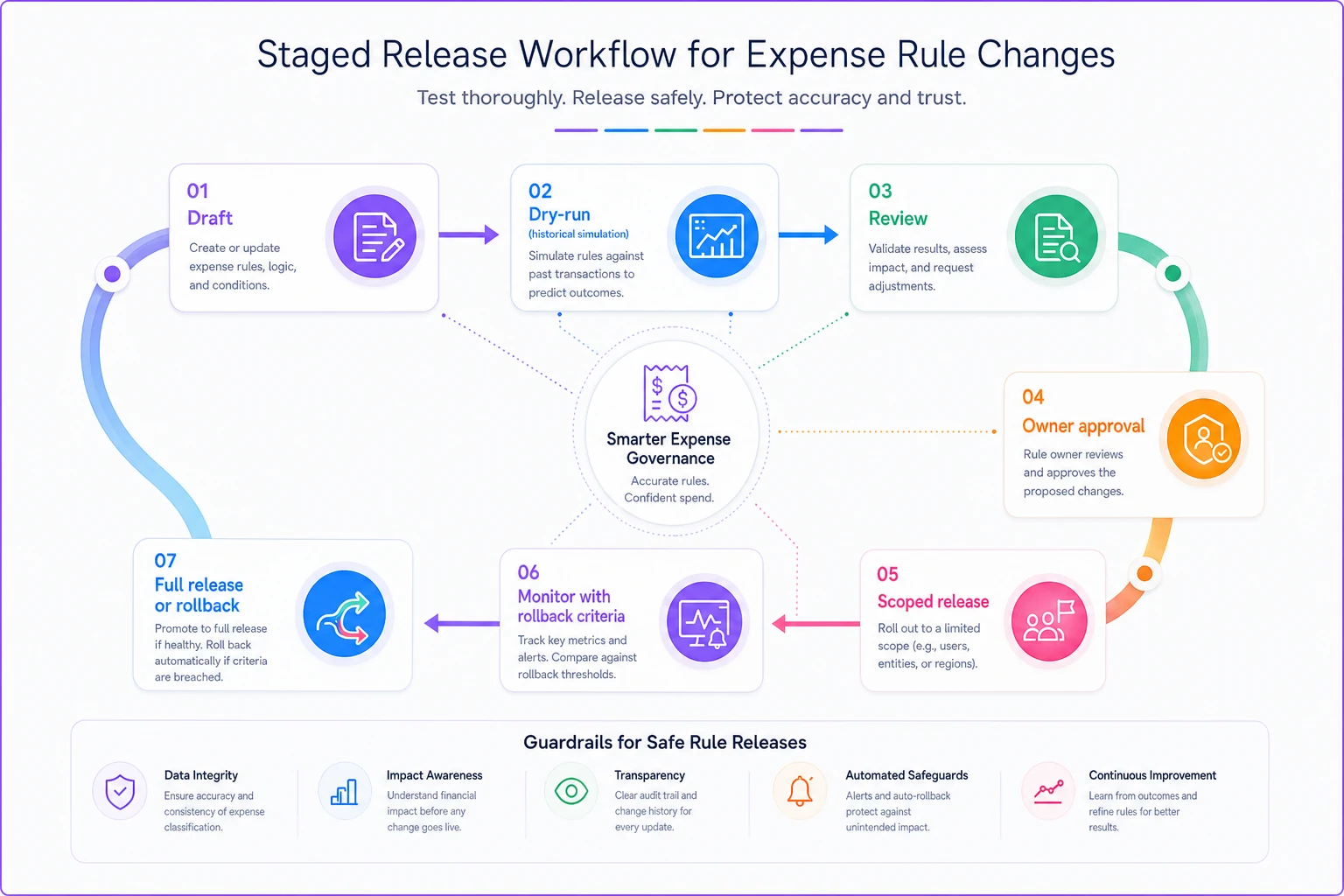
A staged release for an expense rule looks like this:
-
Draft. The change is written down somewhere reviewable — what rule, what it does, why, and what it might affect. Not in someone's head.
-
Dry-run. The rule runs against real historical transactions without saving anything. You export what it would have done.
-
Review the dry-run. Someone looks at the diff. Not the rule logic — the actual outcomes.
-
Owner approval. The person who owns the affected category or report signs off.
-
Release, scoped. The rule goes live, but ideally on a limited slice first — one card, one department, one week going forward.
-
Monitor against rollback criteria. You've defined in advance what "this went wrong" looks like.
-
Full release or rollback. Either widen it, or pull it and go back to the known-good state.
Most SMBs skip straight from step 1 to step 5. The two steps that save you are the dry-run and the pre-defined rollback criteria. Everything else is supporting cast.
The dry-run is non-negotiable
A dry-run export is just: "run this new rule against the last 60–90 days of transactions and show me what would have changed." No writes. No commits. Just a diff.
This is where you catch the disasters. A typical example: a team wanted to route all transactions from a certain vendor to "Contractors." Reasonable. The dry-run showed it would also re-categorize 38 historical transactions that were legitimately software subscriptions from the same parent company, because the merchant string overlapped. That's a five-minute catch on a dry-run versus a two-hour cleanup after the fact, plus a distorted month.
Rules that read clean in the abstract behave badly against messy real data — and expense data is always messier than the rule author imagines. If you're actively cleaning up categorization logic, pair this with the approach in maintainable smart rules to auto-categorize expenses; dry-runs are how you keep those rules maintainable instead of letting exceptions pile up.
Here's a simple workflow illustration.
Most SMBs skip straight from step 1 to step 5. The two steps that save you are the dry-run and the pre-defined rollback criteria. Everything else is supporting cast.
Schema contracts: the part nobody does but everybody needs
A schema contract is a written agreement about the shape of your expense data that downstream consumers can rely on — category names, tag structures, required fields, allowed values.
Why does this matter for rule changes? Because a lot of rule changes quietly break the contract without anyone realizing there was a contract. Someone renames a category from "Travel – Air" to "Air Travel" because it reads better. Clean move, right? Except three saved reports, a budget mapping, and a client-rebill filter were all keyed on the old string. They don't error out. They just silently return nothing, or drop transactions, and now the numbers are wrong and no one knows why.
A schema contract for an SMB doesn't need to be fancy. It's a single maintained document that lists:
-
The canonical category names (and that renaming them requires a migration, not a casual edit)
-
Required tags and their allowed values
-
Which fields downstream systems depend on
-
Who owns each part of the schema
The rule is simple: rule changes are allowed to change how transactions get sorted into the schema. They are not allowed to silently change the schema itself. If a change touches the schema — new category, renamed tag, changed structure — that's a bigger deal and needs its own migration plan. Reporting reliability lives or dies on this distinction, which is why the expense analytics operating model for clean, testable metrics leans so heavily on stable definitions. You can't build testable metrics on top of a schema that keeps shifting.
When renaming categories, treat it as a migration—update the contract, notify owners, and run dry-runs on dependent reports before releasing.
The rule is simple: rule changes are allowed to change how transactions get sorted into the schema. They are not allowed to silently change the schema itself. If a change touches the schema — new category, renamed tag, changed structure — that's a bigger deal and needs its own migration plan. Reporting reliability lives or dies on this distinction, which is why the expense analytics operating model for clean, testable metrics leans so heavily on stable definitions. You can't build testable metrics on top of a schema that keeps shifting.
Rollback criteria: decide what "broken" means before you deploy
Rollback criteria are the thing teams always plan to figure out "if something goes wrong." But if you define them after something goes wrong, you'll rationalize. You'll stare at a weird-looking number and talk yourself into "eh, that's probably fine."
Define the tripwires up front. Good rollback criteria for an expense rule change are concrete and boring:
-
More than X% of transactions in a category shifted week-over-week without a known reason
-
Any category that was populated dropping to zero
-
A previously-empty category suddenly absorbing large volume
-
Any change to transactions that feed client rebills or payroll
-
Owner of an affected report flags a number they can't explain
The point of writing these down isn't the list itself. It's that you've pre-committed to acting when a tripwire fires, instead of debating whether it counts. And "rollback" needs to be a real button, not a wish — which means you need the previous state saved, so you can revert cleanly. If your setup can't tell you what the rules looked like last month, you don't have rollback. You have manual reconstruction under pressure.
Owner approvals without creating a bureaucracy
The instinct when adding control is to add approvers. Resist that. Every extra approval is a delay, and in a small team the approver is usually busy with something more important than blessing a categorization tweak.
The right model is owner-scoped approval: each part of the expense system has exactly one owner, and only changes affecting their area need their sign-off. Change a Travel rule, the Travel owner approves. It doesn't go to everyone. Most changes touch one area and need one yes.
A workable ownership map for a growing SMB:
-
Category owners — usually department leads or the person who reports on that spend
-
Schema owner — one person (often the controller or finance lead) who guards category and tag structure
-
Deploy owner — whoever actually pushes changes live and runs the dry-runs
The mistake here is diffusing ownership so everyone is vaguely responsible, which means no one really is. One name per area. If you can't name the owner of a category, that's your first problem to fix — and it's exactly the kind of gap that makes lightweight approval impossible. Clear ownership is what separates a real approval from a rubber stamp.
A sample test suite for expense rules
"Test suite" sounds heavy. For expenses it's really just a saved set of known transactions with known correct answers. You run new or changed rules against them and confirm nothing you already got right suddenly breaks. That last part — catching regressions — is the whole value.
Build your suite from real cases you've already resolved:
-
Happy path cases the obvious ones the rule is supposed to catch
-
Edge cases weird merchant strings, refunds, partial amounts
-
Known traps transactions that look like they should match but shouldn't
-
Cross-boundary cases anything near a category line, near a rebill flag, near a tax treatment
A practical starter suite is 20–40 transactions covering your riskiest categories. Every time a rule breaks something in real life, you add that transaction to the suite so it can never break the same way twice. That's how the suite gets genuinely useful over time — it's basically a scar collection.
A real scenario
A regional design studio, about 14 people, ran everything through one operations manager who "knew the rules." Around 400–500 expense transactions a month across cards, reimbursements, and a handful of client-billable projects. No change process — she just adjusted categorization rules as annoyances came up.
The break happened when she added a rule to auto-tag a vendor as client-billable to save herself time on rebills. It worked for the intended project. It also caught the same vendor's charges on two non-billable internal projects, and roughly $2k of internal cost got flagged as billable across three weeks before anyone caught it during invoice review. Not catastrophic — but it meant a client almost got billed for the studio's own overhead, which is the kind of thing that quietly damages trust.
They didn't buy anything new. They added three habits: every rule change got a dry-run against the last 60 days first, client-billable rules required a second set of eyes, and they kept a running doc of the last-known-good rule set. The immediate payoff was catching two more would-be-bad changes on the dry-run in the next couple months. The slower payoff was that the operations manager stopped being a single point of failure — someone else could finally see and understand the rule stack.
When this makes sense — and when it's overkill
When a real change process earns its keep:
-
You're past roughly 15 rules or 50 transactions a week
-
Rule changes have burned you at least once
-
More than one person relies on expense reports
-
You have client-billable, payroll, or tax-sensitive expenses in the mix
When it's overkill:
-
You're a 2–3 person shop with a handful of stable rules
-
Your categorization almost never changes
-
You're the only consumer of your own data and can eyeball everything
Who should not bolt on heavy process: teams still fixing their foundations. If your categories are inconsistent and nobody owns anything yet, change control on top of that is polishing a broken machine. Fix ownership and category structure first. Change control is what protects a system that already works, not a fix for one that doesn't.
Your deployment checklist
Before any expense rule change goes live:
-
[ ] Change is written down
what, why, expected effect
-
[ ] Dry-run exported against the last 60–90 days
-
[ ] Dry-run diff reviewed by a human — outcomes, not just logic
-
[ ] Schema check
does this rename, restructure, or just re-sort? (Rename = migration, not a casual edit)
-
[ ] Ran against the test suite — no regressions on known-good cases
-
[ ] Owner of the affected area approved
-
[ ] Client-billable / payroll / tax transactions confirmed unaffected (or explicitly intended)
-
[ ] Rollback criteria written down and someone assigned to watch them
-
[ ] Previous rule state saved so rollback is one step, not a rebuild
-
[ ] Scoped release first if the change is large; monitor before going wide
You won't hit all ten on every tiny change, and that's fine. The dry-run, the schema check, and the saved previous state are the three you don't skip.
The real payoff
The goal here isn't to slow down. It's to make changes boring — predictable, reversible, and visible to more than one person. A team with real change control ships more rule improvements, not fewer, because the fear is gone. Nobody's scared to improve categorization when they know a bad change gets caught on a dry-run and reversed in one step.
Expense rules are going to keep changing as your business changes — new vendors, new projects, new categories, new reporting questions. That churn is normal. What kills trust in the numbers isn't change itself, it's uncontrolled change: silent, undocumented, irreversible edits that nobody can explain three weeks later. Put a light process around the lifecycle, keep it matched to your size, and your expense system becomes something people trust instead of something they quietly work around.
The goal here isn't to slow down. It's to make changes boring — predictable, reversible, and visible to more than one person. A team with real change control ships more rule improvements, not fewer, because the fear is gone. Nobody's scared to improve categorization when they know a bad change gets caught on a dry-run and reversed in one step.
Expense rules are going to keep changing as your business changes — new vendors, new projects, new categories, new reporting questions. That churn is normal. What kills trust in the numbers isn't change itself, it's uncontrolled change: silent, undocumented, irreversible edits that nobody can explain three weeks later. Put a light process around the lifecycle, keep it matched to your size, and your expense system becomes something people trust instead of something they quietly work around.
Ready to master your business expenses?
Join 5,000+ businesses using Costyly to save time, reduce overspending, and improve financial visibility.