

Duplicate payments rarely feel like a big deal until you tally a year of them. A single re-run of a $1,800 invoice, a vendor paid on both a card and an ACH, a credit memo that never got applied — none of these will bankrupt you. But string together twelve months of small leaks across three or four payment channels and you're often looking at somewhere between half a percent and a full percent of total AP quietly walking out the door. For a business spending $2M a year with vendors, that's real money you were supposed to keep.
The frustrating part is that duplicate payments almost never come from one broken thing. They come from the gaps between systems that mostly work. Your accounting software dedupes fine on its own. Your card program tracks charges fine on its own. The problem is that nobody built the connective tissue between them, so the same expense enters your world through two doors and gets paid twice because neither door knew about the other.
This article is about that connective tissue — the vendor-master signals, the pre-payment checks, the fuzzy matching that catches near-misses, and the recovery process for when one gets through anyway. Not as a pile of tips, but as a system that holds together as you grow.
Why duplicates are a plumbing problem, not a discipline problem
Ask most small finance teams why a duplicate happened and you'll hear some version of "someone wasn't paying attention." That framing feels right and is almost always wrong. The people are fine. The plumbing routes the same water through two pipes.
The pattern that keeps showing up: a vendor emails an invoice. Someone in operations, eager to keep things moving, pays it on a company card. The same invoice — because vendors send them to everyone — also lands in the AP inbox, gets entered into the accounting system, matched to a PO, and paid via ACH two weeks later. Two clean, well-intentioned payment paths. Zero coordination between them. The vendor now has your money twice and, in a lot of cases, won't tell you.
The second big source is the vendor master itself. When the same supplier exists under three slightly different names — "Acme Corp," "Acme Corporation," and "ACME Corp." — your system's native duplicate check can't see across them. Each name is its own island. An invoice paid under one won't trip an alert when it's re-entered under another. Cleaning up vendor records is upstream of almost every AP control you'll build. If you haven't tackled that yet, the mechanics in Stop vendor duplicates: lightweight master-data rules, weekly tidy cadence and safe-merge runbooks for SMBs are the foundation this whole article assumes.
The third source is timing. Vendors resend "past due" reminders that look like fresh invoices. Statements arrive listing invoices you've already paid. A well-meaning person pays the reminder, and now the original and the reminder both cleared. In real operations this usually happens right around month-end when everyone's rushing to close and a "just get it paid" reflex overrides the check.
The signals you already have (and mostly ignore)
Every business already generates enough data to catch the vast majority of duplicates before they clear. The signals just live in separate places and never get compared. Duplicate payment detection for SMB teams is mostly about pulling these into one view at the moment right before money moves.
Stop losing track of your business spending.
Costyly helps you record, monitor & control expenses—accurately and efficiently.
- Automated expense categorization
- Real-time budget tracking
- Detailed financial reports
No credit card required
| Signal | What it catches | False-positive risk | Notes |
|---|---|---|---|
| Exact invoice number + vendor | Straight re-entry of the same invoice | Very low | The easy win, but only works if vendor IDs are clean |
| Same amount + same vendor + close dates | Reminders, resends, statement re-pays | Medium | Legit recurring charges will trip this |
| Amount within a few cents (rounding/FX) | Cross-currency or fee-adjusted repeats | Medium | Common with cross-border vendors |
| Same vendor across card AND AP | The classic two-channel double-pay | Low | Requires card and AP data in one place |
| Fuzzy invoice number match | "INV-4021" vs "INV4021" vs "4021" | Higher | Great catch rate, needs a human confirm |
| Duplicate line-item fingerprint | Split or partially re-billed invoices | Higher | The advanced tier; most teams skip it |
The insight most teams miss: exact-match checks feel safe because they almost never fire falsely, but they also catch the least money. The real leaks are the near-misses — the reminders, the reformatted invoice numbers, the cross-channel repeats. Those need fuzzy logic, and fuzzy logic scares people because it produces false positives. So teams stick with exact match, feel protected, and keep leaking through the gaps.
Fuzzy matching without drowning in false alarms
The reason fuzzy matching gets abandoned is that a naive version flags half your recurring bills. Monthly rent, SaaS subscriptions, regular material orders — all "same vendor, same amount, close dates." If the check fires constantly, people learn to click through it, and now you've got alert fatigue that's worse than no alert at all.
-
Whitelist known recurring charges. If a vendor + amount combo repeats on a predictable cadence, teach the system it's expected. Recurring pattern detection isn't just a budgeting convenience — it's what lets your duplicate check ignore legit repeats and focus on the surprises.
-
Weight the invoice number heavily. Two payments with the same normalized invoice number are almost always a duplicate, even if the amounts differ slightly. Two payments with different invoice numbers but the same amount are much more likely legitimate.
-
Normalize before you compare. Strip spaces, leading zeros, punctuation, and case from invoice numbers before matching. "INV-0042" and "inv 42" should collapse to the same string.
-
Tier the response. A high-confidence match blocks the payment and requires a manager release. A low-confidence match posts a soft flag that gets reviewed but doesn't stop the queue.
Normalize invoice numbers before running fuzzy checks to reduce false positives.
The mistake here is treating every flag as a hard stop. If your only lever is "block," you'll block real payments and annoy real vendors. Give yourself a middle tier — a review queue that catches the maybes without freezing the whole AP run.
Where this breaks as you scale
At three or four vendors and one person cutting checks, none of this matters much. That person remembers what they paid. The system lives in their head and it works.
The break point shows up somewhere around the moment you add a second payment channel or a second person who can pay things. That's usually when card programs get handed to team leads, or when someone in ops gets ACH authority to keep the line moving. Suddenly the mental ledger fragments. Person A doesn't know Person B paid the plumber. The card charge and the AP entry never meet.
The second break point is volume. Below maybe a couple hundred invoices a month, a human eyeballing the AP register catches most repeats. Above that, the register is too long to scan and duplicates hide in the noise. What used to be a five-minute review becomes an hour nobody has, so it quietly stops happening.
The third break point is cross-border. The moment you're paying vendors in multiple currencies, exact-amount matching falls apart because the same €900 invoice clears as $968 one month and $981 the next. FX movement disguises duplicates that would've been obvious in a single currency. If you're operating internationally, the recording and allocation discipline in Stop FX surprises: rules to record, allocate and budget for cross-border is what keeps your duplicate check from going blind on foreign vendors.
The pattern across all three: duplicates scale with fragmentation, not with size. A $10M business with one clean payment path leaks less than a $1M business paying vendors through four disconnected channels.
The pre-payment check as a workflow
The single most effective change is moving the duplicate check from after the payment to right before it. Detection after the fact means you're chasing a recovery. A check at the moment of release means you never send the money.
Invoice enters (any channel) ↓ Vendor resolved to canonical record ↓ Tiered duplicate match runs ├── Exact invoice number ├── Normalized invoice number ├── Amount + date fuzzy check └── Cross-channel (card + AP) history check ↓ Clean? → Normal approval path Flagged? → Route by confidence ├── High confidence → Block + reviewer alert └── Low confidence → Soft flag in approver view ↓ Reviewer resolves with documented reason ↓ Released payment writes back to shared channel-aware history
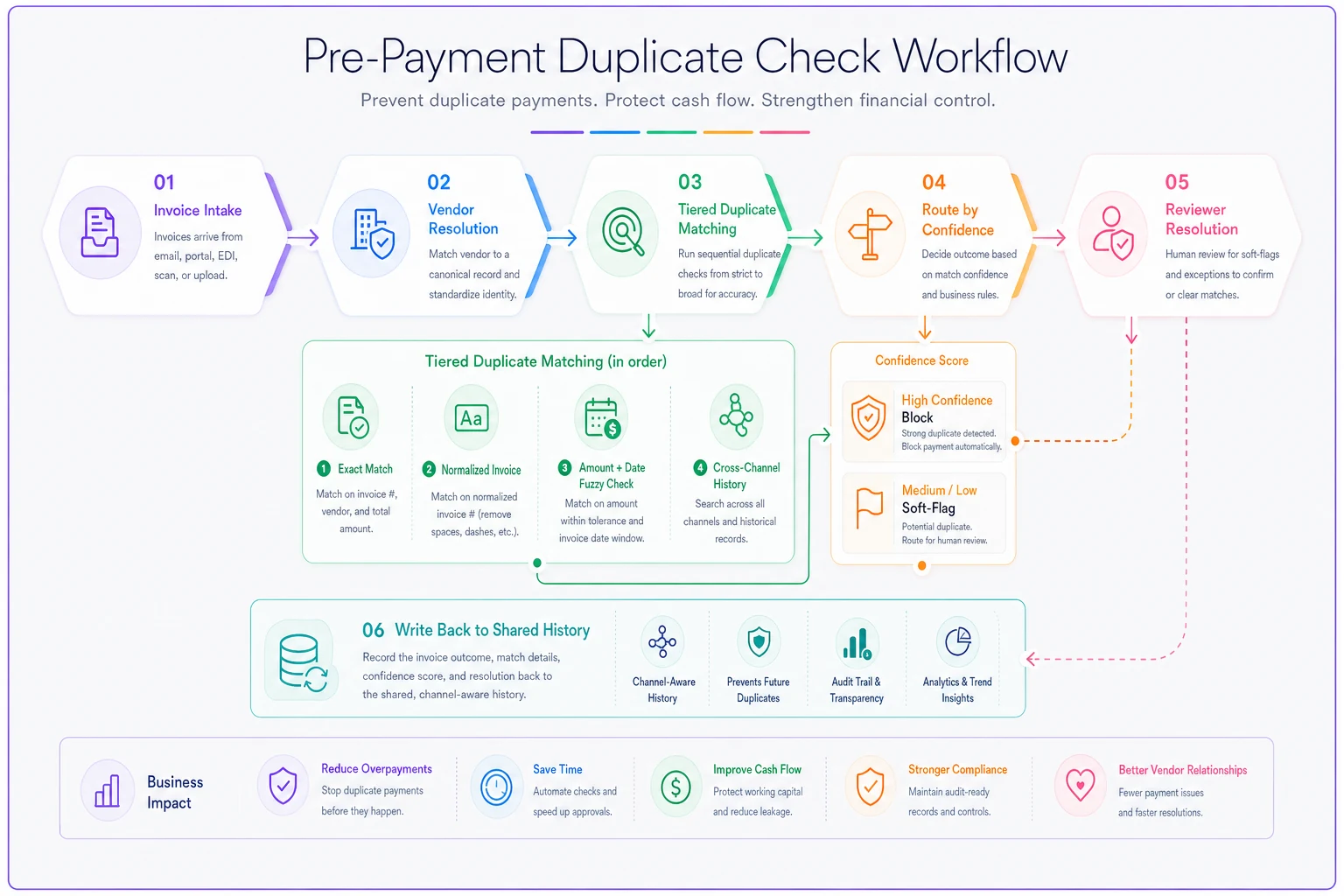
The part teams get wrong is that last step. They run a check, pay the invoice, and never record how it was paid in a place the next check can see. So the same invoice can still come through a second channel and clear, because the history only knows "paid," not "paid by card on the 14th." Channel-aware history is what closes the cross-channel gap.
Tying this into a tighter intake process — something like the one-page request flow in Procure-to-pay lite for small teams: one-page purchase requests, PO-lite and vendor onboarding — means fewer invoices sneak in through side doors in the first place. Every invoice that bypasses intake is a blind spot in the check.
A real scenario
A regional HVAC installer with roughly $3M in annual vendor spend ran AP through their accounting system while three field managers each had company cards for parts and emergency supplies. The cards existed for good reasons — nobody wants a job stalled because a $400 compressor needs manager sign-off. But the two worlds never talked.
Over about a year, the bookkeeper started noticing supplier statements that didn't square with what the accounting system showed they'd paid. A parts distributor had several invoices marked paid on the statement that also appeared as open in AP — because a field manager had already charged them, and then AP paid them again off the emailed invoice. When they finally reconciled the full year, they found somewhere in the range of $11k–$14k in true duplicates, most of it in the $200–$900 band that's small enough to never get a second look individually.
The fix wasn't complicated. They funneled card receipts and AP invoices into a single intake, resolved every vendor to one canonical name, and ran a pre-payment check that compared against both channels. In the first quarter after the change, the check caught and blocked around a dozen would-be duplicates. Just as useful — the field managers stopped feeling like the problem, because it became obvious the leak was structural, not a person being careless.
When money already went out: the recovery runbook
Detection isn't perfect, and some duplicates will clear. Recovery is a separate muscle, and most teams don't have a repeatable one — they improvise every time, which means the small ones never get chased because the effort isn't worth it.
-
Confirm it's actually a duplicate. Pull both payment records, confirm same invoice, same goods, no partial credit already applied. Rule out that one is a deposit and one is the balance.
-
Quantify and prioritize. Anything over a threshold — say $500 — gets chased immediately. Below that, batch them into one monthly vendor conversation instead of sending one-off emails.
-
Contact the vendor with the specifics. Invoice number, both payment dates, both amounts, both methods. Vendors resolve these far faster when you hand them the exact records instead of a vague "I think we overpaid."
-
Choose credit or refund deliberately. A credit against future purchases is faster and vendors prefer it. A refund is cleaner for your books and better if the relationship is winding down.
-
Log the root cause. Which channel, which vendor, which gap let it through. This is the step everyone skips and the one that actually reduces next quarter's count.
That last step is the most overlooked. If you recover the money but never note why it happened, you'll recover the same duplicate from the same vendor through the same gap next quarter. Recovery without root-cause logging is just treading water.
When heavy duplicate controls are overkill
Not every business needs the full apparatus, and building it too early is just wasted effort.
If you're running a single payment channel, under a couple hundred invoices a month, and one person owns AP end to end — a weekly scan of the payment register and a clean vendor list will catch nearly everything. Adding tiered fuzzy matching and a review queue on top of that is friction with no payoff. You'll spend more time tuning the check than you'd ever lose to duplicates.
The controls start earning their keep the moment you add a second payment channel, a second person with pay authority, cross-currency vendors, or you push past the volume where a human can still scan the register. Any one of those is the signal to build the real system. Two or more, and you're already leaking whether you've noticed or not.
Who should not pour energy into this: a solo operator with a handful of monthly bills and one card. The failure mode there is usually subscription creep or misclassification, not duplicates. Match the control to where the actual leak is.
Low-effort governance that keeps it working
The last piece is what decides whether any of this survives past the first enthusiastic month. Controls decay. Someone opens a new payment channel and forgets to route it through intake. A new vendor gets entered three ways. The whitelist of recurring charges goes stale.
-
One monthly duplicate report — how many flagged, how many were real, how much recovered. Fifteen minutes, one owner.
-
A quarterly vendor-master tidy so canonical records don't drift back into aliases.
-
A single rule
every payment channel routes through intake.
No exceptions, no side doors. This one rule prevents more duplicates than any matching algorithm. -
A short review of false positives so the matching stays tuned and people don't start clicking through flags out of habit.
The whole point of duplicate payment detection for SMB teams isn't to build a fortress — it's to close the specific gaps between the systems you already run. Get the intake unified, the vendors canonical, and the check running before the payment instead of after, and most of the leaks stop on their own. Everything else is just keeping the plumbing clean.
The whole point of duplicate payment detection for SMB teams isn't to build a fortress — it's to close the specific gaps between the systems you already run. Get the intake unified, the vendors canonical, and the check running before the payment instead of after, and most of the leaks stop on their own. Everything else is just keeping the plumbing clean.
Ready to master your business expenses?
Join 5,000+ businesses using Costyly to save time, reduce overspending, and improve financial visibility.