


Most small businesses treat vendor payments as a binary: pay the bill when it shows up, or pay it when the money's there. Net 30 means "pay around day 30," and early-pay discounts get ignored because nobody has time to do the math on whether a 2% discount beats keeping cash in the bank for three extra weeks.
The thing is, payment timing is one of the few operational levers where the math is genuinely favorable and mostly ignored. A 2/10 net 30 discount works out to an effective annualized return of around 36%. You won't find a better guaranteed return anywhere else in the business. And yet most finance teams under 20 people leave this on the table because the decision isn't systematized — it's handled reactively, invoice by invoice, by whoever happens to be in the AP inbox that week.
This article is about building the system that decides, consistently, which vendors get paid early and which don't. Not a list of tips. A repeatable way to segment vendors, set decision criteria, schedule payments around your actual cash position, and track whether any of it is working.
Why payment timing quietly breaks down as you grow
When you have 8 vendors, you know all of them. You know the landlord doesn't care if you pay on day 3 or day 28. You know your main supplier offers 2% off if you pay in ten days, and you pay it because you remember. The whole thing runs on memory.
At 40, 60, 100 vendors, memory stops working. Now you've got a mix of recurring SaaS charges, raw-material suppliers, contractors, utilities, and one-off purchases. Some offer discounts, some charge late fees, some will quietly deprioritize your orders if you drift past terms. Nobody holds the full picture, so the default becomes "pay everything roughly on time" — which sounds responsible but actually destroys value in two directions at once.
-
Discounts expire silently. The 2/10 window closes on day 11 and nobody notices. Over a year, a business spending $400k through discount-eligible vendors can leave somewhere around $6k–$8k on the table just by missing windows.
-
Cash gets paid out too early where it doesn't matter. You wire a vendor on day 5 who'd happily wait until day 45, tightening your cash position for no benefit.
-
Late fees and strained relationships appear randomly. A supplier you actually depend on slips to day 50 because their invoice got buried, and now your next order is slow.
The common thread: payment decisions are being made without a framework. Every invoice gets the same treatment regardless of whether paying it early earns you 36% annualized or costs you nothing to delay.
Segment vendors before you optimize anything
You can't optimize 80 vendors one at a time. You segment them into a handful of buckets, set a default behavior per bucket, and only handle exceptions manually. This is the single highest-leverage move in the whole process.
Stop losing track of your business spending.
Costyly helps you record, monitor & control expenses—accurately and efficiently.
- Automated expense categorization
- Real-time budget tracking
- Detailed financial reports
No credit card required
The segmentation that actually holds up in practice is based on two things: whether early payment earns you something, and how strategically important the vendor is to your operations.
| Segment | Early-pay value | Strategic weight | Default behavior |
|---|---|---|---|
| Discount suppliers | High (real discount) | Medium–high | Pay early if cash allows, always capture discount |
| Critical no-discount | None | High | Pay exactly on terms, never late |
| Commodity no-discount | None | Low | Pay on terms, stretch to the back of the window |
| Flexible / informal | None | Low | Pay at the latest reasonable date |
| High-risk / new | Varies | Unknown | Pay on terms, watch closely |
Segment first, then automate the schedule for each bucket — that's where you get lasting value without individual invoice triage.
The insight most people miss here: strategic weight matters as much as the discount. A vendor offering no discount but who controls a scarce input deserves on-time payment every single time, because the cost of them deprioritizing you dwarfs any cash-timing benefit. Meanwhile a commodity vendor with generic terms should be paid at the absolute back edge of the window — stretching that cash costs you nothing and them almost nothing.
A mistake I see constantly: businesses chase a 1% discount from a minor vendor while paying a critical supplier late because the invoice wasn't prioritized. They optimized the wrong relationship. Segment first, and the priorities become obvious.
The decision: early-pay vs standard terms
Once a vendor is in the "discount supplier" bucket, you still need a rule for when taking the discount makes sense, because it's not automatic. It depends on your cost of cash.
The real comparison is: the effective annualized return of the discount vs. what that cash is worth to you right now.
The standard formula: Effective annual rate = (discount % ÷ (100 − discount %)) × (365 ÷ (full term − discount period))
For 2/10 net 30: (2 ÷ 98) × (365 ÷ 20) ≈ 37.2%. For 1/10 net 30: about 18.4%. For 1/15 net 45: about 12.4%.
-
The effective annual rate comfortably beats your cost of capital
-
You have cash buffer above your minimum operating threshold
-
The vendor relationship is one you want to strengthen anyway
-
Taking it pushes you below your cash floor in a tight week
-
The effective rate is marginal (under ~15%) and cash is doing useful work elsewhere
-
The "discount" is really a penalty-avoidance disguised as a discount (read the terms — some vendors inflate the base price and call the normal price a discount)
Who should NOT chase discounts aggressively: businesses with seasonal or lumpy cash flow and thin buffers. If your cash swings hard month to month, protecting your floor matters more than squeezing 2% here and there. Capture discounts only in the weeks you're clearly above threshold. This ties directly into understanding when your expenses hit versus when cash arrives — something worth mapping carefully if timing regularly catches you off guard, which we covered in depth in building a cashflow-aware expense system with 30/60/90-day action maps.
A simple payment-scheduling template
The scheduling layer is where segmentation turns into action. You don't need software to start — a weekly payment run with a structured schedule works fine until volume forces an upgrade.
Here's the process that works for teams running a weekly AP cycle:
-
Pull all open invoices every Monday. Sort by segment, not by date received.
-
Flag discount-window invoices expiring before the next run. These are decision items — check cash position, then approve or skip.
-
Assign a scheduled pay date to every invoice based on its segment default: - Discount suppliers → day 10 (if approved) - Critical no-discount → exactly on terms - Commodity → terms minus 1–2 days (so it clears on time, not early) - Flexible → latest reasonable date
-
Check the cash calendar for the scheduled dates. If a pay date lands on a tight week, move low-priority (flexible/commodity) payments — never critical or discount ones.
-
Batch and release the approved run.
-
Log any skipped discounts with the reason, so you can review patterns later.
A lightweight scheduling table for one week might look like this:
-
- Invoice 4471 — raw materials supplier (discount) 2/10 net 30, due date tracked, scheduled day 10, discount captured, ~$180 saved
-
- Invoice 4472 — packaging (commodity) net 30, scheduled day 29
-
- Invoice 4473 — specialty contractor (critical) net 15, scheduled day 15 exactly
-
- Invoice 4474 — software annual net 30, flexible, scheduled day 30
The point of writing it down: the schedule holds the memory now, not a person. New hires can run it. Nobody has to remember which vendor offers what.
Here's a simple visual of the weekly AP workflow to keep everyone aligned.
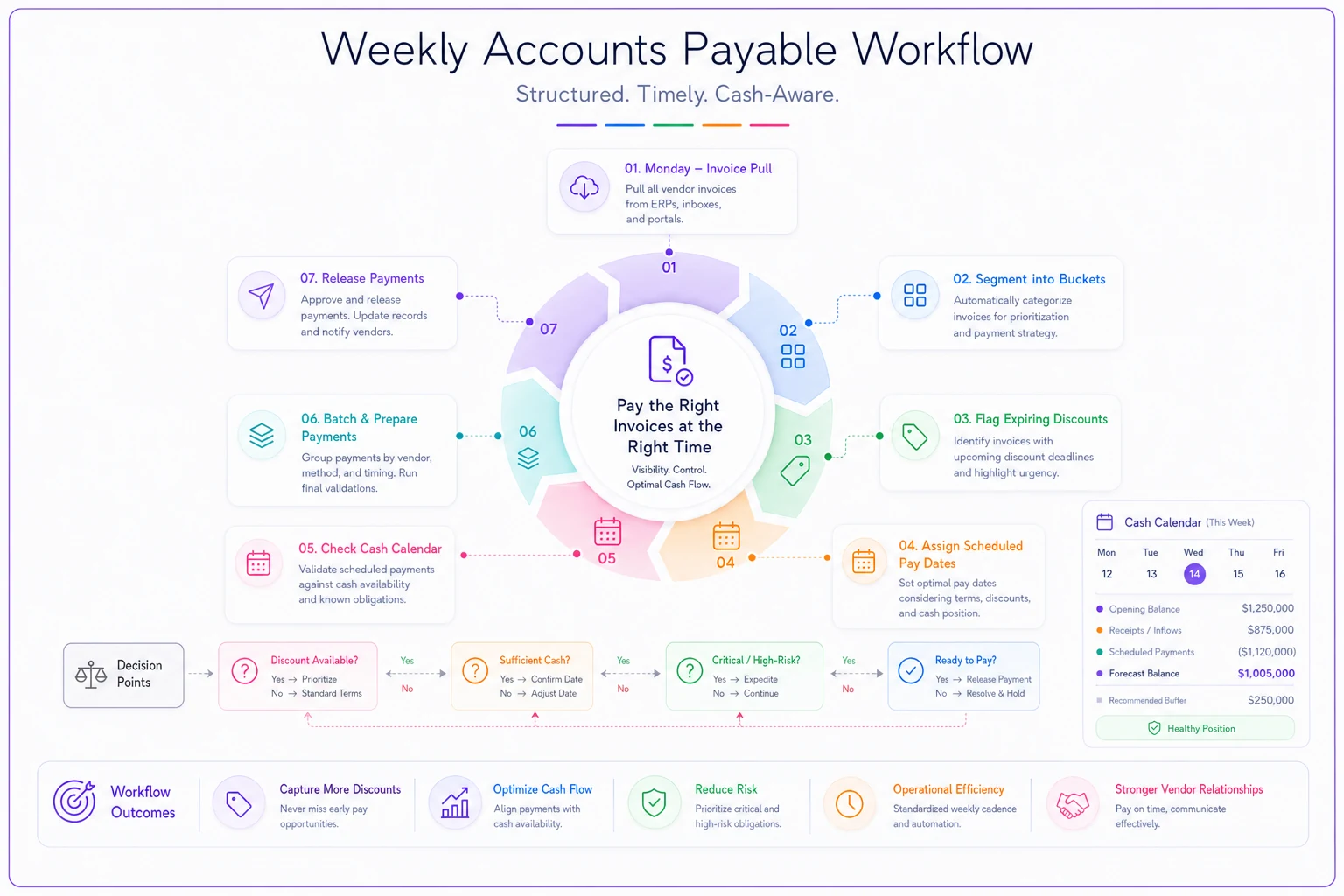
The visual maps to the numbered process above and makes the decision points easy to spot during a quick Monday review.
Running small experiments to actually capture discounts
Most teams never find out whether their discount strategy works because they don't measure it. Treat discount capture as something you test and improve, not something you assume is happening.
-
Baseline month Just record. How many discount-eligible invoices came in? How many did you actually capture? What was the total available vs. captured? Most teams are shocked to find they're capturing only 40–60% of what's available.
-
Change one thing Move your payment run earlier in the week, or add the "expiring discount" flag to the top of the Monday pull.
-
Measure again next month Did capture rate move?
A realistic example of what this surfaces: a business finds it's missing discounts not because of cash, but because invoices from one supplier arrive by email to a sales rep who forwards them late. The fix isn't financial at all — it's rerouting that vendor's invoices straight to AP. Capture rate jumps from around 55% to above 90% with zero change to cash strategy.
This kind of thing only shows up when you measure capture as a rate, not as individual wins. The gap between "available discounts" and "captured discounts" is usually a workflow leak, not a money problem. Getting vendor intake clean in the first place — consistent terms, a single inbound channel — is part of why a disciplined onboarding process pays off, something worth setting up early as described in procure-to-pay lite for small teams.
Journal examples: seeing the cashflow impact
It helps to see how discount capture actually lands in the books, because the way you record it affects how visible the savings are.
Scenario: $9,000 invoice, 2/10 net 30, discount taken.
At invoice booking: Dr Inventory / Expense 9,000 Cr Accounts Payable 9,000 At payment (day 10, discount taken): Dr Accounts Payable 9,000 Cr Cash 8,820 Cr Purchase Discounts 180
The important part: that "Purchase Discounts" line is your scoreboard. Roll it up across the year and you see the real impact of the whole system. A business capturing an extra $500–$700 a month that it used to miss sees $6k–$8k land in that account annually — money that was previously invisible because it never got tracked separately.
The cash-timing side is less about journals and more about the calendar. Paying on day 10 instead of day 30 means $8,820 leaves 20 days earlier. If you did that across, say, $120k of monthly discount-eligible spend, you're consistently holding roughly $80k–$100k less in the bank at any given moment than if you waited. That's the trade-off the system is managing: real discount income vs. tighter working capital. Which is exactly why the decision rule ties back to your cost of capital and cash floor.
A real scenario
A regional specialty-foods distributor, around 14 people, was running roughly $380k/month through its vendors. AP was handled by one person who paid invoices as they cleared approval — no segmentation, no schedule. Discounts got captured maybe half the time, and two key ingredient suppliers had occasionally slipped past terms, which slowed reorders during busy weeks.
They did three things. First, they segmented vendors into the five buckets — took about an afternoon. Second, they moved to a Monday payment run with discount-window invoices flagged at the top. Third, they started recording captured discounts in a separate account to actually see the number.
Over the next couple of quarters: discount capture went from around 50% to the low 90s, adding roughly $700–$900 a month in recovered discounts. The two critical suppliers stopped slipping past terms entirely, and reorder speed during peak weeks improved noticeably. The cash floor held because they only took discounts in weeks they were clearly above their minimum — in two tight weeks they deliberately skipped a discount and documented why.
Nothing dramatic happened. No new hire, no big software overhaul at first. The change was purely that payment decisions moved from memory and reaction to a repeatable system with clear buckets and a schedule.
When this system is worth building — and when it isn't
Fewer than 15 vendors and cash is never tight? Honestly, don't over-engineer this. Pay on time, grab the obvious discounts, move on. The overhead of segmenting isn't worth it yet.
The system starts paying off when:
-
You have enough vendors that no one person holds the full picture
-
A meaningful share of spend runs through discount-eligible terms
-
Cash position varies enough that when you pay actually matters
-
Payment decisions are currently inconsistent depending on who's handling AP
At that stage, the manual Monday-run version works well, but it eventually hits a ceiling. Tracking discount windows across dozens of vendors, checking each payment against the cash calendar, and catching invoices that got routed to the wrong inbox becomes its own part-time job. This is where operational software with AI-assisted scheduling genuinely earns its place — not by replacing the decisions, but by surfacing expiring discount windows automatically, flagging when a scheduled payment would push you below your cash floor, and routing vendor invoices to the right place so nothing gets captured late. The judgment stays with your team; the remembering and the watching get handled for you.
For businesses dealing with vendors across currencies, the timing decision gets another layer, since exchange-rate movement interacts with when you pay — worth reading alongside the rules for recording and budgeting cross-border expenses before you lock in an early-pay policy on foreign-currency invoices.
Vendor payment optimization isn't about paying everyone faster or everyone slower. It's about matching payment timing to what each vendor relationship is actually worth, and doing it the same way every week so the value doesn't depend on who's at the keyboard. Segment first, apply a clear early-pay rule tied to your real cost of cash, schedule around your cash position, and measure capture as a rate so you can see the leaks. Do that and the discounts you've been quietly leaving behind start showing up where they belong — in your account, and in a cash position you actually control.
Ready to master your business expenses?
Join 5,000+ businesses using Costyly to save time, reduce overspending, and improve financial visibility.